
Human Resource Management: The Complete Guide
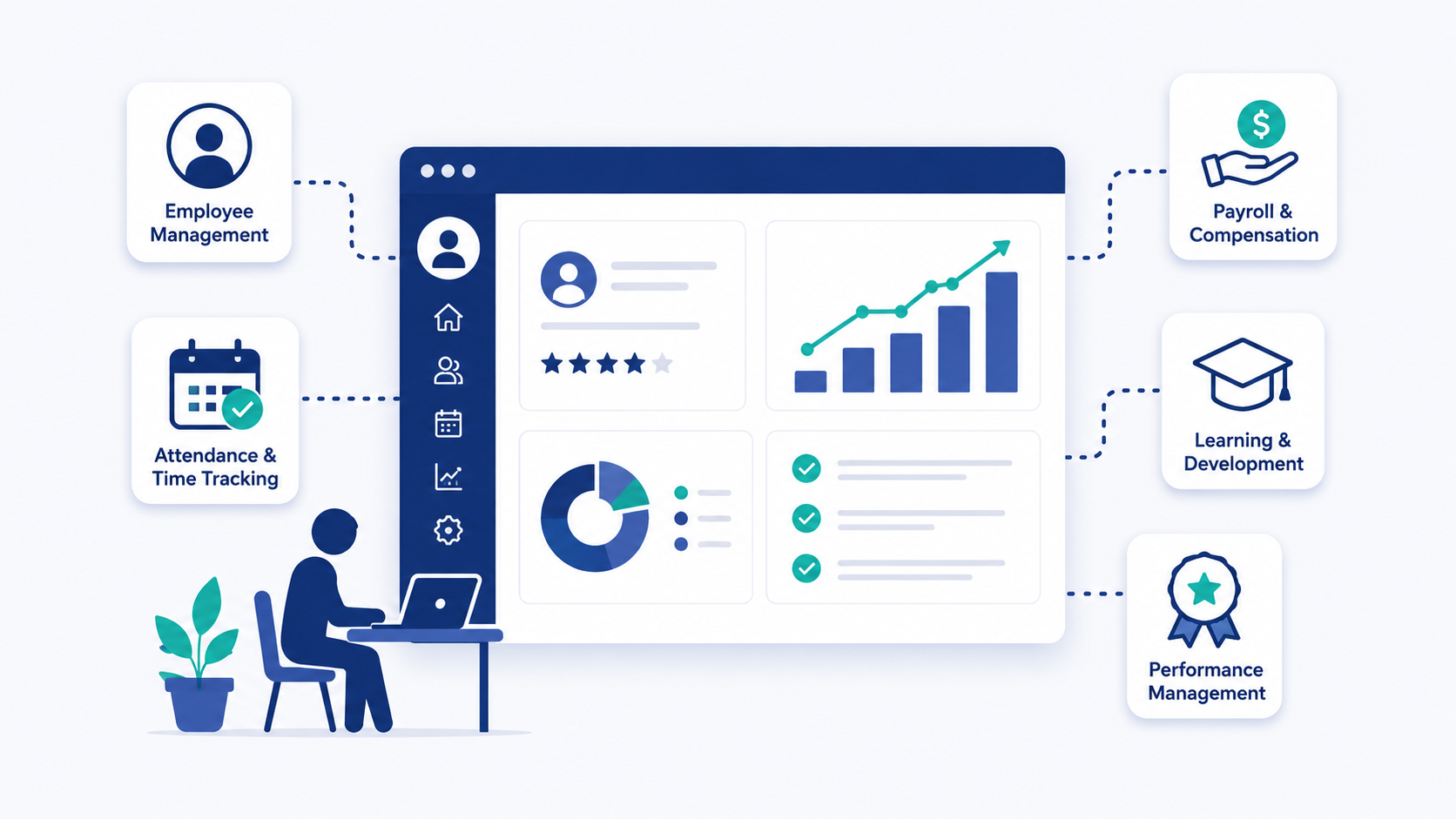
Human resource management gives a business a clear way to manage people, work, and the employment relationship. For growing companies, it connects workforce decisions with operations, risk, and long-term plans.
This practical HR management guide explains the discipline, its objectives, functions, process, and place in business strategy.
What is human resource management?
Human resource management is the discipline of planning, organizing, supporting, and managing people throughout their employment. It aligns workforce needs with business goals while supporting fair, consistent, and lawful employment practices.
Human resources management is a common variant of the same term. Its scope includes headcount planning, talent acquisition, onboarding, performance management, compensation, employee relations, development, and separation.
The discipline works at three levels. Administration keeps records and employment transactions accurate.
Operations gives managers repeatable ways to hire, schedule, support, and address issues. Strategy connects the workforce with future capability and capacity.
Human Resource Management, shortened to HRM, is not HRMS software. An HRMS is technology that can support the work.
Here, HRM also does not mean the Hierarchical Reasoning Model used in artificial intelligence.
Ownership depends on company size and structure. A dedicated HR department may own policy, records, and specialist work.
Line managers still shape hiring, feedback, attendance, performance, and employee experience. In smaller businesses, an owner or operations manager may coordinate much of this work.
Use this basic ownership check:
- HR or business owner: policies, records, workforce planning, and compliance coordination.
- Line manager: daily direction, feedback, attendance follow-up, and performance conversations.
- Leadership: priorities, resources, accountability, and final business decisions.
Clear ownership follows a simple rule. HR designs the framework, managers use it, and leaders fund and review it.
Employees also keep information current, follow policies, and raise concerns through defined channels.
Human resource management is therefore wider than administration. It creates a structure for workforce decisions and assigns responsibility for carrying them out.
Why human resource management matters
Human resource management turns separate tasks into one operating discipline. Without that structure, hiring, pay, attendance, performance, and employee relations can pull in different directions.
Workforce decisions affect output, service, cost, and continuity. A staffing gap can slow production.
Weak onboarding can delay useful work. Unclear expectations can create uneven performance.
Its organizational value appears in four connected outcomes:
- Productivity: capable people work in clear roles with suitable support.
- Retention: employees receive a fair and understandable employment experience.
- Risk control: defined policies, reliable records, and review points reduce avoidable gaps.
- Culture: daily management decisions reinforce expected workplace behavior.
Good practice connects five elements: a clear role, a capable manager, a usable process, reliable records, and scheduled reviews. A broken link often shows up as delays, inconsistency, rework, or conflict.
These outcomes depend on execution, not policy documents alone. The importance of HRM examines the business rationale and value in greater depth.
Core objectives of human resource management
Objectives explain what the discipline is trying to achieve. They help leaders judge whether people’s activity supports the business and its workforce.
Four objective groups offer a useful planning lens:
- Organizational objectives support business priorities through suitable people, skills, and structures.
- Functional objectives keep HR work useful, proportionate, and connected with operations.
- Personal objectives support employee goals when they fit the role and organization.
- Social objectives address fairness, employment responsibilities, and wider expectations.
These objectives can be completed. A manufacturer may need tighter labor planning while employees need more predictable schedules.
Managers must balance capacity, employee needs, and employment responsibilities. The objective of HRM explains each objective without confusing goals with daily functions.
The core functions of human resource management
Functions are the recurring areas of work used to meet these objectives. They form a responsibility map, not a fixed department chart.
A practical functional map includes:
- Acquisition: workforce planning, role definition, talent acquisition, selection, and hiring.
- Administration: employee records, attendance, leave, policies, and routine employment changes.
- Performance: expectations, feedback, reviews, development, and performance support.
- Rewards: compensation, benefits, recognition, and related administration.
- Relations: communication, concerns, conduct, conflict, and the wider employment relationship.
- Compliance: documentation, controls, required processes, and coordination with current primary guidance.
These functions often overlap. Onboarding connects administration, manager support, role clarity, and employee experience.
HR may design the process, while managers apply it through daily decisions. Functions of Human Resource Management provides the detailed responsibility and duties map.
The human resource management process: how it runs day to day
The human resource management process turns objectives into repeatable work. It connects planning, action, review, and improvement across the workforce.
At a high level, the cycle follows six moves:
- Assess business demand, current headcount, skills, workload, and workforce gaps.
- Plan roles, capacity, hiring, development, and other people actions.
- Acquire and place people through recruitment, selection, and onboarding.
- Support work through policies, manager practices, compensation, and employee relations.
- Review performance, workforce data, employee needs, and process results.
- Adjust plans, roles, support, or controls as business conditions change.
This cycle is not limited to an annual review. A production schedule may expose a skills gap.
Growth may change headcount needs. The cycle also responds to events, such as hiring, promotion, absence, policy changes, and separation.
Each step needs an owner, a decision point, and a reliable record. Human Resource Management Process explains the full operating cycle and its implementation steps.
The employee lifecycle versus the human resource management process
The employee lifecycle describes an employee’s journey through the organization. The management process describes how the business supports that journey.
The lifecycle follows the employee. The process follows the organization’s management activity.
| View | Main question | Typical scope |
| Employee lifecycle | Where is the employee in the relationship? | Attraction, hiring, onboarding, development, retention, and separation |
| Management process | What must the organization do now? | Plan, act, administer, review, and improve |
The views overlap but serve different uses. A lifecycle view helps teams examine employee experience at each stage.
A process view helps teams assign work, controls, decisions, and records. Employee Lifecycle covers the full hire-to-retire journey and its stages.
Strategic human resource management and workforce planning
Stable daily processes create the base for longer-term workforce decisions. Strategic human resource management connects people strategy with business strategy.
It asks which roles, capabilities, behaviors, and leadership capacity the organization will need. Strategic Human Resource Management examines that connection in depth.
Workforce planning turns strategic direction into staffing decisions. It compares current capacity with future demand across headcount, skills, workload, and expected change.
Leaders can then choose whether to recruit, develop people, redesign roles, or adjust schedules. Human Resource Planning covers the full forecasting and planning method.
The strategy-to-execution chain is simple:
- Business strategy defines where the organization is going.
- People strategy identifies the workforce capabilities needed.
- Workforce planning finds gaps between current and required capacity.
- HR and line managers carry out the agreed people actions.
- Leaders review workforce results and adjust the plan.
This chain prevents a common error. Filling today’s vacancy may solve an immediate need while creating a future skill or cost gap.
Measuring human resource management: people analytics and metrics
Measurement shows whether workforce activity supports the intended result. More data does not always create better insight.
HR metrics are defined measures, such as headcount, turnover, absence, time to fill, labor cost, and retention. People analytics examines patterns within those measures to support a decision.
For example, turnover shows what happened. Analysis may compare that measure by role, location, tenure, manager, shift, or hiring source.
The goal is a better decision, not another dashboard. Useful measurement starts with consistent definitions, reliable data, and a clear business question.
Choose the question before choosing the measure. A manager may ask whether enough trained employees are available for planned production.
The right measures then describe capacity, skills, absence, and scheduling. Another question may require a different set.
People Analytics covers HR analytics, workforce analytics, metrics, and responsible interpretation. Access controls, privacy, data quality, and human review remain part of the work.
Where technology fits: automation, artificial intelligence, and HR software
Technology enables human resource management, but it is not the discipline itself. Management defines policies, responsibilities, decisions, and employment practices.
Software records information and supports approved workflows. Good HR management best practices therefore start with process design, ownership, and data rules.
Rules-based HR Automation follows predefined instructions. It may route an approval, issue a reminder, update a status, or transfer authorized data.
This approach fits predictable tasks with known outcomes. Exception routes remain necessary when information is missing or a decision changes.
AI in HR uses models to classify, predict, generate, recommend, or find patterns. Its outputs need human review because they may be incomplete, inaccurate, or hard to explain.
Unlike fixed rules, model outputs are probabilistic. The dedicated page examines suitable uses, risks, oversight, and responsible adoption.
HR Management Software is the wider technology category for employee records and HR workflows. It can provide HR management tools, but it cannot supply management judgment.
A platform may combine records with several workforce processes. The category page explains its scope without treating software as the management discipline.
The terms HRIS, HRMS, and HCM often overlap. Organizations and vendors may use the labels differently.
Define the required capability before comparing names. HRIS vs HRMS vs HCM provides the focused category comparison.
A capability map gives a clearer comparison than category labels alone. It also keeps the evaluation tied to the organization’s actual process needs.
The three technology layers serve different jobs:
| Layer | Main job | Required control |
| Rules-based automation | Complete approved, repeatable steps | Defined rules, access, and exception handling |
| Artificial intelligence | Classify, generate, predict, or recommend | Human review, data checks, and clear accountability |
| HR software platform | Store records and coordinate workflows | Permissions, reliable data, and process ownership |
Features describe what a system can do, not whether the workflow is needed. HR Software Features provides the dedicated capability map.
Benefits depend on process fit, data quality, adoption, and governance. Benefits of HR Software examines those outcomes separately from this informational guide.
An HR management system can also mean an organizational framework. ISO 30201:2026 uses this management-systems sense, not the HRMS software category.
Verify the standard’s current title, edition, status, and scope directly with ISO before publication. Do not describe it as certification for an HR software product.
Compliance foundations every US employer should know
Compliance touches recruitment, timekeeping, leave, safety, records, and separation. Duties may vary by location, employer size, worker status, and industry.
This overview is general information, not legal advice. Verify current federal, state, and local requirements before acting.
- Fair Labor Standards Act. The U.S. Department of Labor’s Wage and Hour Division publishes current wage, overtime, coverage, and recordkeeping guidance. Verify the latest FLSA guidance directly with the Division.
- Family and Medical Leave Act. The same Division publishes current FMLA guidance about coverage, eligibility, notices, and leave administration. Verify the latest requirements directly with the Division.
- Equal employment. The U.S. Equal Employment Opportunity Commission enforces federal employment discrimination laws and publishes employer guidance. Verify current coverage and procedures directly with the EEOC.
- Workplace safety. The Occupational Safety and Health Administration publishes federal safety and health requirements. Verify current OSHA and applicable state-plan requirements with the relevant authority.
- Employment eligibility. U.S. Citizenship and Immigration Services publishes Form I-9 and its instructions. Use the current form and verify completion and retention guidance directly with USCIS.
A structured HR Compliance Checklist can help assign ownership and review recurring obligations. It cannot replace current agency guidance or qualified legal advice.
Apparel employers using piece-rate compensation need added care. Federal and state wage rules may apply differently based on the facts.
Verify current federal guidance with the US Department of Labor’s Wage and Hour Division. Verify state requirements with the relevant state labor agency.
Apparel Piece-Rate Overtime (US Compliance) examines piece-rate pay, overtime, hours worked, and recordkeeping in greater depth.
Human resource management for small and growing businesses
A small company still needs sound human resource management without a full-time specialist. An owner, operations lead, or office manager may share the work with line managers.
Clear ownership keeps hiring, records, payroll inputs, leave, performance, and employee relations from becoming improvised tasks. HR Management for Small Business explains how lean teams can build repeatable processes.
The goal is not to copy a large HR department. It is to create a workable structure for the employment relationship.
Owners also need basic HR management skills. These include defining roles, documenting decisions, leading fair conversations, and escalating complex issues.
HR management courses can support that foundation. Qualified legal, payroll, or benefits advice may still be necessary when risk is high.
Software can support the structure, but it cannot define good management practice. Best HR Software for Small Business covers system selection for smaller employers.
Define each process and its owner before comparing tools. That sequence keeps the software decision tied to an actual operating need.
A lean HR operating base can stay simple. It needs one accountable owner, standard records, a policy review calendar, and clear manager handoffs.
The structure can grow with headcount. Complexity should be added when the work requires it, not copied from a larger company.
Human resource management by industry
Human resource management uses common principles across industries. Each operating model changes where managers need to focus.
The practical question stays the same: which workforce conditions can interrupt the business? Industry context determines whether the answer centers on shifts, scarce skills, distributed work, or production demand.
Manufacturing
Manufacturers connect workforce decisions with production plans, shift coverage, skills, attendance, and frontline supervision. HR in Manufacturing examines that management setting in depth.
The central challenge is coordination across people, shifts, skills, and production demand. The dedicated page owns the related operating practices and workforce risks.
Technology must also fit factory workflows and workforce structures. HR Software for Manufacturing covers the related system requirements without confusing software with the discipline.
That page can examine factory-specific system needs and access patterns. This hub keeps its focus on the wider management framework.
Packaging
Packaging businesses may face staffing gaps alongside changing production and scheduling needs. Packaging Workforce Shortage examines the labor challenge and its operational effects.
The issue can affect recruitment, training, retention, and available capacity. Its dedicated page can examine causes and possible workforce responses.
Scheduling and workforce records may require industry-specific support. Packaging Workforce Management Software covers that narrower technology decision.
It considers the system context for packaging plants without replacing process design. Managers must still define schedules, responsibilities, approvals, and exceptions.
Technology and SaaS
Technology companies may have fast-changing roles, distributed teams, and specialized skill needs. HR for Tech Companies explains how these conditions shape people’s operations.
Their people strategy may focus on scarce skills, rapid role changes, and remote collaboration. The dedicated page examines those management choices.
HR Software for Tech Companies covers systems used by software and SaaS employers. Managers still own policy, judgment, communication, and accountability.
System needs may reflect distributed records, changing teams, and specialist workflows. The separate technology page handles that narrower evaluation.
Key questions about human resource management
What is the difference between human resource management and HRMS?
Human resource management is the discipline of managing people and workforce practices. An HRMS is software that supports those practices.
The software can manage records and workflows. It cannot replace people strategy, management judgment, or accountability.
What are the main objectives of human resource management?
The four broad groups are organizational, functional, personal, and social objectives. Together, they connect business needs, useful HR work, employee goals, and employment responsibilities.
What are the main functions of human resource management?
The main functions are workforce acquisition, administration, performance, rewards, employee relations, and compliance. They cover the employment relationship from planning through separation.
How does the management process differ from the employee lifecycle?
The management process covers the organization’s recurring workforce work. The employee lifecycle follows one person’s journey through the organization.
HR processes support each lifecycle stage. The two views describe the same relationship from different positions.
Who owns human resource management?
Human resource management is a shared responsibility. Leaders set priorities, HR specialists design practices, and line managers apply them.
In smaller companies, an owner or operations manager may coordinate the same responsibilities.
What is the difference between HRIS, HRMS, and HCM?
An HRIS usually centers on employee records and administration. An HRMS often includes broader operational workflows.
HCM usually describes a wider people-strategy view, including talent, planning, development, and analytics. These labels overlap, so compare capabilities rather than names.
Does a small business need a dedicated HR department?
Not always. It does need clear ownership of hiring, records, policies, employee issues, and compliance checks.
A small company can start with simple processes. It can add specialists or technology as headcount and complexity grow.
Which skills support effective human resource management?
Useful skills include communication, judgment, documentation, data interpretation, planning, and fair problem-solving. Managers also need role-specific knowledge and clear escalation paths for legal or specialist questions.
Where to go next
Business owners can start with the small-business section. HR managers may move to the functions, process, strategy, or measurement pages.
Operations managers can follow the manufacturing, packaging, or technology path. Keep the management question separate from the software decision, then choose the page matching your immediate task.