
Employee Lifecycle: Stages from Hiring to Departure
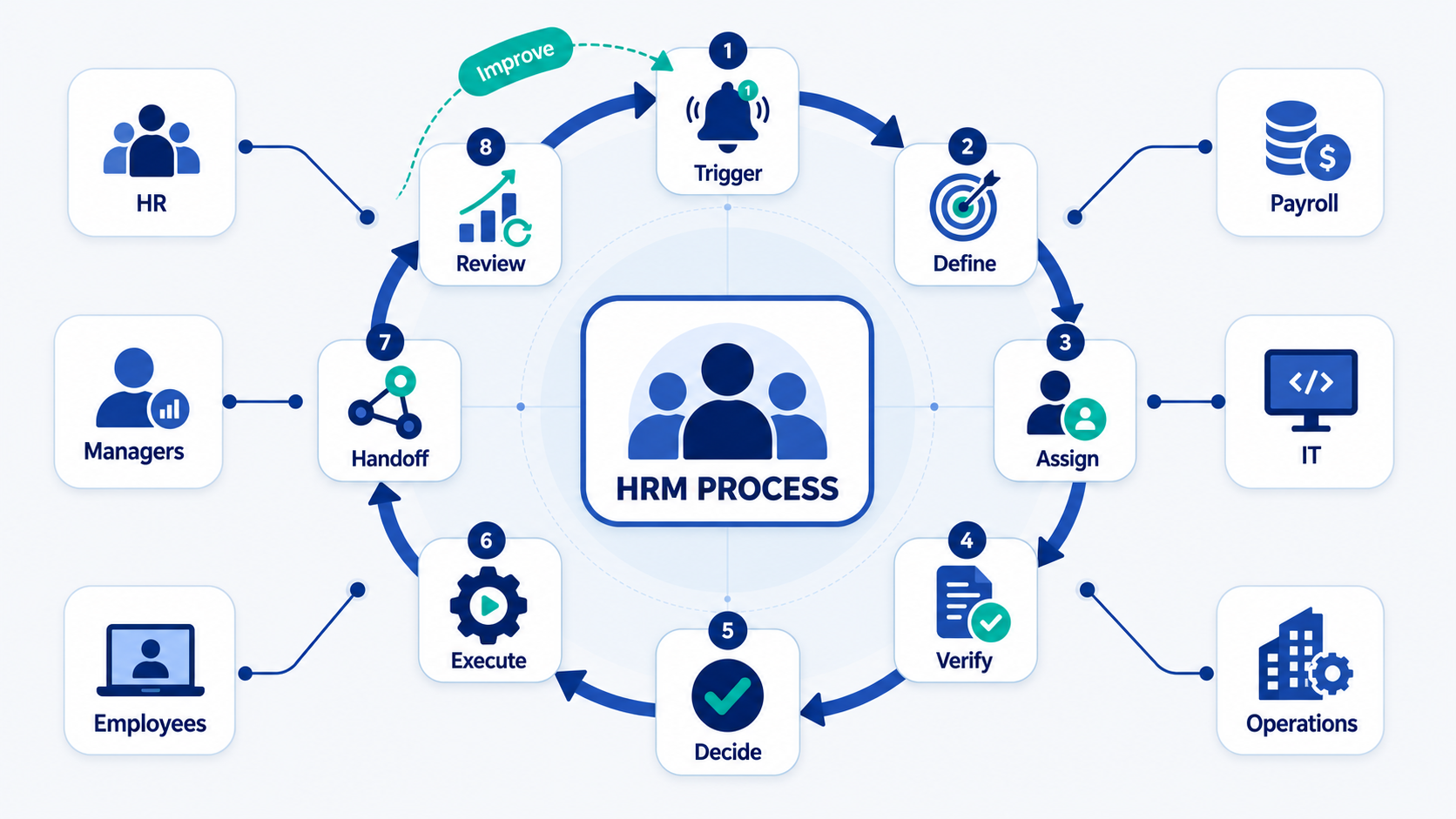
The employee lifecycle is the sequence of stages a person experiences during a relationship with an organization. It starts with attraction and continues through recruitment, onboarding, active work, development, transition, and departure.
Each stage has different questions, owners, records, and completion points. A clear lifecycle map prevents employees from becoming lost between teams or systems.
What is the employee lifecycle?
The employee lifecycle organizes the full employment journey into connected stages. It helps leaders, HR, and managers see what each person needs next.
Employee life cycle is an alternative spelling for the same concept. The HR lifecycle often describes the policies, services, and records supporting that journey.
The employee lifecycle may begin before hiring. A hire-to-retire lifecycle usually begins with hiring and ends with departure.
Some organizations also include post-employment contact, references, alumni relationships, or possible rehiring.
The wider Human Resource Management discipline manages people, work, policies, and workforce information. The lifecycle provides a person-centered view across those responsibilities.
Related HR concepts answer different questions:
| Concept | Main question | Primary focus |
| Employee lifecycle | Where is the person in the employment journey? | Stages, experiences, transitions, and stage outcomes |
| Human Resource Management Process | How does a specific request reach completion? | Triggers, actions, approvals, handoffs, records, and review |
| Functions of Human Resource Management | Which recurring responsibility area owns the work? | Recruitment, records, performance, learning, rewards, and employee relations |
| Objectives of HRM | What workforce result should the organization pursue? | Capability, consistency, employee needs, and responsible management |
| Importance of HRM | Why does organized people management matter? | Workforce readiness, employee experience, consistency, and continuity |
One lifecycle stage can contain several HR processes. Objectives set the intended result, while functions organize the recurring work.
Eight employee lifecycle stages
A practical employee journey contains eight connected stages. Organizations may combine or rename them, but each transition still needs an owner.
Stage 1: Workforce need and attraction
Attraction starts when the organization identifies a workforce need. Approved role information then shapes how potential candidates understand the opportunity.
Job messages should reflect the real work, schedule, location, team, and expectations. A promise gap begins when recruitment language differs from daily conditions.
Human Resource Planning covers forecasting, role demand, skills, and workforce capacity in greater detail.
Stage 2: Recruitment and selection
Recruitment moves a potential candidate from application to a recorded hiring decision. It may include screening, interviews, assessments, selection, and offer handling.
Candidates need clear status updates and realistic next steps. Managers need agreed criteria before they compare applicants.
This stage closes with an accepted candidate, a declined offer, or a closed vacancy. The outcome must reach the next owner.
Stage 3: Preboarding and onboarding
Preboarding begins after offer acceptance and before the starting date. Onboarding helps the new employee enter the workplace and role.
HR coordinates records and standard tasks. The manager owns role clarity, team integration, priorities, feedback, and available support.
Access, equipment, schedules, reporting lines, and initial work should be ready when needed. Paperwork alone does not create role readiness.
Stage 4: Role integration and performance
Role integration connects onboarding with regular contribution. Employees need clear priorities, work standards, feedback, and routes for questions.
Managers should explain what good work looks like. They should record agreed goals, support needs, decisions, and follow-up actions.
Performance discussions should address work evidence and expectations. They should not depend on surprises or incomplete records.
Stage 5: Development and progression
Development helps employees build skills for current or future work. It can include coaching, training, practice, mentoring, or guided assignments.
Start with a defined capability need. Training completion alone does not prove that an employee can apply the learning.
Progression may include broader duties, career planning, promotion readiness, or specialist growth. Available paths should match real business opportunities.
Stage 6: Engagement and retention
Engagement develops through daily work, manager contact, workload, recognition, voice, and fair treatment. It is not one survey or event.
Retention work should respond to identified needs. General activities may miss the issue affecting a role, shift, location, or team.
Managers should record concerns and assigned actions. HR can review patterns while protecting appropriate access to employee information.
Stage 7: Internal transition and mobility
Employees may change roles, managers, departments, shifts, locations, projects, or responsibility levels. Each move creates a smaller lifecycle transition.
The change may affect pay inputs, schedules, reporting lines, access, equipment, goals, and records. Former and new owners need a confirmed handoff.
Strategic Human Resource Management connects workforce choices with wider business direction. This page keeps its focus on the employee’s transition.
Stage 8: Separation and post-employment
Separation starts when employment is expected to end. It may follow resignation, retirement, contract completion, or an employer decision.
Offboarding coordinates communication, work transfer, records, assets, access, and assigned closing tasks. Each action needs an owner and completion evidence.
Departure feedback can reveal issues for review. Treat it as one input rather than a complete account of the workplace.
The lifecycle may continue through references, approved contact, alumni activity, or future rehire consideration. Business rules should define that boundary.
| Lifecycle stage | Main employee question | Manager responsibility | Key HR record | Stage exit criterion |
| Attraction | Is this role and workplace suitable for me? | Explain the actual team need and work context | Approved role and recruitment information | Clear role message is ready for candidates |
| Recruitment | What happens next, and how will I be assessed? | Apply agreed role criteria and provide timely decisions | Candidate status, evidence, and final decision | Accepted candidate or documented vacancy closure |
| Onboarding | What do I need, and who will help me? | Prepare work, clarify expectations, and guide integration | Employee profile and completed onboarding tasks | Employee can enter the role with required support |
| Performance | What does good work look like? | Set priorities, provide feedback, and address support needs | Goals, feedback, attendance, and agreed actions | Expectations and review actions remain current |
| Development | How can I build useful skills and progress? | Coach, assign practice, and review application | Development need, activity, and follow-up | Agreed learning or progression action is reviewed |
| Retention | Is my work experience sustainable and fair? | Listen, respond, recognize work, and manage workload | Concern, response, recognition, and follow-up | Identified issues have owners and review dates |
| Transition | What changes, when, and who supports the move? | Complete the old and new role handoff | Approved change and aligned employee records | Role, pay, schedule, access, and reporting details match |
| Departure | What must happen before and after my last day? | Transfer work and complete manager tasks | Departure details and closure checklist | Records, access, assets, handover, and communication close |
Lifecycle stage gates and moments that matter
A stage gate is a checkpoint between lifecycle stages. It confirms that required decisions, resources, records, and communications are complete.
Gates should protect the employee, business decision, or official record. They should not become extra approvals without a clear purpose.
Moments that matter are interactions carrying unusual uncertainty, change, or personal impact. Preparation matters most when the employee cannot predict what happens next.
| Moment | Common risk | Useful gate question | Completion evidence |
| First candidate response | Silence creates uncertainty | Has the candidate received a clear next step? | Status message and named contact |
| Offer acceptance | Agreed details do not reach supporting teams | Has confirmed information reached each owner? | Accepted terms and assigned setup tasks |
| First working day | Access, equipment, or guidance is missing | Can the employee start the planned work? | Manager confirmation and readiness checklist |
| Early feedback | Expectations remain unclear | Has the manager discussed evidence, priorities, and support? | Recorded conversation and next action |
| Development decision | Learning activity has no business purpose | Is the expected skill change defined? | Development plan and review date |
| Role change | Connected records show different information | Do approved changes match every required record? | Confirmed updates and manager handoff |
| Employee concern | The issue has no owner or response | Is an authorized person responsible for follow-up? | Assigned action and review point |
| Departure | Closing tasks start too late | Are handover, assets, access, and records controlled? | Completed departure checklist |
For each gate, name the sender, receiver, due point, required evidence, and exception route.
Who owns the employee life cycle?
HR usually owns lifecycle design and the central employee record. Managers own much of the daily experience within each stage.
Shared work still needs clear accountability. One named person should confirm each significant stage or transition is complete.
| Role | Lifecycle responsibility | Essential handoff |
| Leadership | Set workforce priorities, decision rights, and management standards | Approved direction and authorized exceptions |
| HR | Design stages, coordinate policies, guide managers, and maintain records | Accurate information and defined next owner |
| Manager | Explain work, support integration, provide feedback, and complete decisions | Accepted responsibility for employee actions |
| Employee | Provide accurate information, ask questions, and complete agreed actions | Timely response and confirmed understanding |
| Payroll or finance | Process approved pay and budget inputs | Verified source data and approval evidence |
| Technology or facilities | Prepare, change, and close access, equipment, and workplace needs | Confirmed timing, ownership, and closure evidence |
| Recruitment support | Coordinate candidate communication and decision records | Complete candidate information for employee setup |
Document overlapping responsibilities before growth makes them harder to see.
Adapting the HR lifecycle to the business
The lifecycle should reflect real operating conditions. It should still preserve consistent decisions, records, communication, and accountability.
| Business context | Practical lifecycle adaptation |
| Small business | Use fewer forms, short stage checklists, named owners, and one trusted employee record |
| Growing business | Add stage gates, standard requests, role permissions, due points, and status visibility |
| Mid-market business | Use shared standards with controlled variations for sites, departments, roles, or employee groups |
| Manufacturing | Connect stages with shifts, site readiness, production skills, equipment, and supervisor handoffs |
| Packaging | Align staffing changes with lines, schedules, seasonal demand, and operator capability |
| Textile and apparel | Link attendance, training, role changes, production records, and pay inputs |
| Software and SaaS | Coordinate remote work, projects, equipment, application access, skills, and distributed managers |
HR Management for Small Business covers lean ownership and basic controls in more detail.
Use the shortest lifecycle model that keeps important work visible. Add a control when repeated gaps show why it is needed.
Employee lifecycle metrics
Lifecycle measures should reveal stage health, employee friction, and handoff quality. They should not become scores for judging individual worth.
| Stage | Useful measure | Decision it can support |
| Attraction | Suitable applicant flow and application completion | Whether role messages and channels reach relevant candidates |
| Recruitment | Time in stage, candidate withdrawals, and offer outcomes | Where decisions, communication, or criteria need review |
| Preboarding | Readiness tasks, unanswered questions, and late handoffs | Which owner or input delays employee setup |
| Onboarding | Required task completion and early support needs | Whether the entry plan prepares employees for work |
| Performance | Current goals, feedback completion, and overdue actions | Where managers need clearer routines or support |
| Development | Learning actions, skill application, and internal movement | Whether development connects with capability needs |
| Retention | Turnover patterns, recorded concerns, and completed follow-ups | Which teams, roles, or experiences require investigation |
| Transition | Processing time, record differences, and late corrections | Which handoff causes change errors or delay |
| Departure | Checklist completion, asset return, and access closure | Whether separation controls work as designed |
Review related measures together. Faster completion may hide poor communication, missing records, or repeated correction work.
People Analytics covers metric design, interpretation, and workforce evidence in greater depth.
How OryxBlue supports the employee lifecycle
Software can organize lifecycle records, tasks, approvals, and visibility. People must still own policies, employment decisions, communication, and judgment.
OryxBlue is presented as an HR and workforce operations platform. Current public materials describe employee records, attendance, payroll visibility, workforce profiles, roles, skills, availability, and scheduling.
They also describe assignments, requests, approvals, asset tracking, access visibility, and reporting. These capabilities can support workforce administration across several lifecycle stages.
| Lifecycle area | OryxBlue support | What the business must define |
| Workforce preparation | Roles, skills, availability, and reporting | Workforce needs, job requirements, and selection criteria |
| Employee setup | Profiles, employee records, assignments, assets, and access visibility | Required records, orientation, responsibilities, timing, and policy communication |
| Active work | Scheduling, assignments, availability, and attendance | Schedule rules, attendance rules, corrections, and manager duties |
| Employee requests | Structured requests, role-based routing, approvals, and status | Request types, evidence, approvers, response rules, and escalation paths |
| Development and movement | Skills, roles, assignments, availability, and reporting | Development plans, promotion criteria, transfers, and career paths |
| Payroll coordination | Payroll visibility and employee records | Pay rules, deadlines, source checks, exceptions, and final approval |
| Departure control | Employee records, asset return tracking, and access visibility | Exit decisions, handover, access removal, asset return, and final records |
| Lifecycle review | Workforce dashboards and reports | Measures, review timing, authorized viewers, and corrective actions |
OryxBlue can show information and route defined work. The business must decide who reviews, changes, approves, and closes each item.
HR Management Software explains the wider software category. HR Automation covers stable, rules-based tasks and routing.
Map the lifecycle before configuring fields or approvals. Verify the current product scope before publication, configuration, or selection.
Common employee lifecycle gaps
Most lifecycle failures begin at a handoff or an unclear ownership point:
- Promise gap. Recruitment messages do not match the role, schedule, manager, or work environment.
- Paperwork onboarding. Forms are complete, but access, work, support, or expectations are missing.
- Ownerless handoff. Information is sent, yet nobody confirms receipt or accepts the next action.
- Feedback gap. Employees receive late, vague, or surprising messages about work expectations.
- Development fog. Learning activity has no defined capability need, application check, or follow-up owner.
- Transition drift. Approved role changes reach payroll, schedules, access, or records at different times.
- Exit lag. Work transfer, asset return, access closure, or final records begin too late.
- Metric misuse. Process measures become judgments about people without enough context.
Use this repair order:
- Name the affected stage and failed handoff.
- Assign one person accountable for correction.
- Define the missing decision, record, or communication.
- Set an exit criterion and review date.
- Check whether the same gap appears elsewhere.
Employee lifecycle audit checklist
Use this checklist with one real employee journey. Written procedures may hide gaps that appear during actual transitions.
- Are all employee lifecycle stages clearly named?
- Does each stage have an accountable owner?
- Does every stage have entry and exit criteria?
- Can employees understand their next action?
- Are manager responsibilities clear at each stage?
- Do recruitment messages match actual working conditions?
- Are new employee records complete before required handoffs?
- Are access, equipment, schedules, and initial work prepared?
- Are expectations, feedback, and support actions recorded?
- Do development actions have a capability goal and review point?
- Are concerns assigned to an authorized owner?
- Do role changes reach payroll, scheduling, access, and records?
- Are handoffs accepted rather than only sent?
- Do connected records show the same approved information?
- Does departure cover work, assets, access, records, and communication?
- Does each lifecycle measure support a defined decision?
Turn each “no” answer into an owner, action, due point, and review date.
Frequently asked questions about the employee lifecycle
What is the employee lifecycle?
The employee lifecycle covers the stages of a person’s relationship with an organization. It starts before hiring and continues through departure.
What are the main employee lifecycle stages?
Common stages include attraction, recruitment, onboarding, performance, development, retention, internal transition, and departure. Organizations may combine or rename them.
Is employee life cycle different from employee lifecycle?
No. Both terms describe the same employment journey, although “employee lifecycle” is the more compact spelling.
What does hire-to-retire lifecycle mean?
It means managing the employment relationship from hiring through active employment, changes, and departure.
How is the HR lifecycle different from an HR process?
The HR lifecycle shows where a person sits in the journey. An HR process explains how one request or decision reaches completion.
Who owns the employee lifecycle?
HR usually owns the overall design. Leaders, managers, employees, payroll, technology, and facilities own decisions or tasks within each stage.
How can a small business improve its employee lifecycle?
Start with simple stages, named owners, short checklists, and one trusted record. Add controls when repeated gaps appear.
Can software manage the complete employee lifecycle?
Software can connect records, tasks, approvals, and reports. People must still own policies, judgment, communication, and employee relationships.
Where to go next
Use workforce planning when the question concerns future roles or skills. Use the HR process when a request needs clearer ownership and closure.
Use analytics when evidence is unclear. Use software and automation when stable work needs better records, routing, or visibility.