
Objectives of Human Resource Management: Purpose and Goals
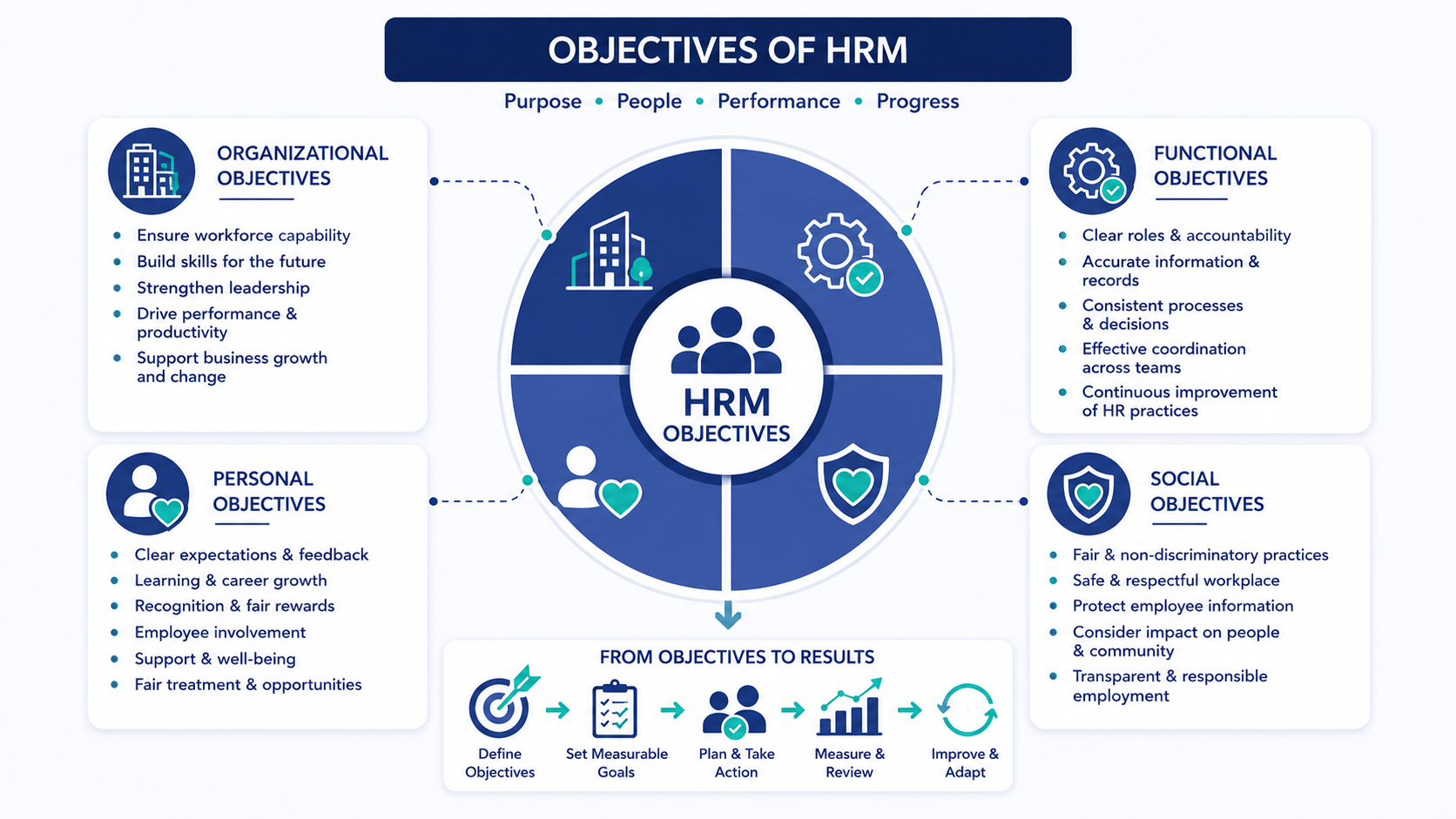
The objectives of human resource management are the results an organization expects from managing its workforce. They usually fall into four groups: organizational, functional, personal, and social.
These objectives give workforce decisions a clear direction. They connect business needs, HR responsibilities, employee needs, and responsible employment practices.
What are the objectives of human resource management?
Human Resource Management (HRM) uses defined objectives to guide workforce choices. HRM objectives describe intended results, not lists of activities.
The purpose of HRM is to connect business needs with workforce and employee needs. Objectives turn that purpose into clear areas of focus.
HRM goals make those objectives specific for a defined period. In daily use, people may treat “goal” and “objective” as the same term.
For planning, each term has a useful role:
| Term | Meaning | Example |
| Purpose | Why the discipline exists | Connect workforce decisions with business and employee needs |
| Objective | The workforce result the organization wants | Build enough supervisory capability for planned growth |
| Goal | A measurable commitment under an objective | Improve a defined capability by a set date |
Objectives form one part of the wider Human Resource Management discipline. Company size, industry, locations, shifts, and workforce needs shape the final priorities.
How objectives differ from related workforce concepts
Several workforce concepts answer different management questions. Keeping those questions separate prevents duplicated plans and unclear ownership.
| Concept | Question it answers | Simple example |
| Objectives | What workforce results do we want? | Suitable capability, consistent decisions, and clear employee expectations |
| Functions of Human Resource Management | What recurring work supports those results? | Recruitment, rewards, development, and employee relations |
| Human Resource Management Process | How does the work move from planning through review? | Set priorities, act, measure, and adjust |
| Employee Lifecycle | Where does an employee experience the work? | Hiring, onboarding, development, retention, and departure |
| Importance of HRM | Why does workforce management deserve attention? | It supports capability, consistency, and organizational readiness |
Objectives set the destination. Functions provide recurring areas of work, while processes organize the actions.
The employee lifecycle shows where people experience those actions. Importance explains the value of managing them well.
Four core objectives of human resource management
The four groups help leaders test whether their priorities are balanced. Each group views workforce results from a different angle.
Organizational objectives
Organizational objectives connect workforce management with required business results. They focus on capacity, skills, performance, continuity, and readiness for change.
Common organizational objectives include:
- Maintain enough qualified people for planned work.
- Build skills needed for current and future roles.
- Improve role clarity and accountability.
- Strengthen leadership capacity at critical levels.
- Protect continuity in roles with concentrated knowledge.
- Prepare teams for operational or technology changes.
- Align workforce costs with realistic business requirements.
The objective must reflect the operating model. A copied objective may solve a problem the organization does not have.
Functional objectives
Functional objectives define how well workforce activities should support the organization. They address quality, timing, coordination, consistency, and practical fit.
Here, “functional” does not mean a list of HR functions. It describes how useful and proportionate those functions should be.
Common functional objectives include:
- Give managers clear responsibilities for people decisions.
- Maintain timely and accurate workforce information.
- Use consistent criteria for recurring decisions.
- Coordinate work across departments, sites, or shifts.
- Provide practical guidance when managers need support.
- Remove steps that add effort without improving decisions.
- Review whether workforce programs still serve their purpose.
A small employer may need simple ownership and reliable records. A larger employer may need common standards across several locations.
Personal objectives
Personal objectives address what employees reasonably seek through work. These needs may include clarity, feedback, growth, recognition, fair rewards, and workable conditions.
The organization does not need to satisfy every individual preference. It should define a fair connection between employee needs and business requirements.
Common personal objectives include:
- Give employees clear role expectations.
- Provide useful and timely performance feedback.
- Create credible ways to build relevant skills.
- Recognize meaningful contributions consistently.
- Explain how pay and advancement decisions are made.
- Support employee input on decisions affecting their work.
- Help employees understand available career paths.
- Provide clear channels for workplace concerns.
Managers should separate an employee’s need from one requested solution. A promotion request may reflect growth, recognition, pay, or responsibility needs.
Social objectives
Social objectives address responsibilities to people and communities affected by employment decisions. They guide how business and workforce goals should be pursued.
Common social objectives include:
- Use consistent, job-related criteria for employment decisions.
- Support safe and respectful working conditions.
- Handle employee information with appropriate care.
- Give qualified people fair access to opportunities.
- Explain major workforce decisions clearly.
- Consider how staffing changes affect employees.
- Provide a defined path for serious concerns.
- Review sensitive decisions before avoidable harm occurs.
Social objectives work best as decision rules. Leaders should name the required evidence and escalation path for sensitive choices.
How the four objective groups work together
The groups should support each other. An objective that helps one group while damaging another may need redesign.
| Objective group | Core question | Sample objective | Possible evidence |
| Organizational | What workforce result supports business priorities? | Ensure critical roles have suitable capability and coverage | Capacity plans and skill records |
| Functional | How well should workforce activities operate? | Give managers consistent support for recurring decisions | Service records and decision reviews |
| Personal | What should employees receive through work? | Provide clear expectations and credible development paths | Goal records and development reviews |
| Social | What responsible standard should guide decisions? | Use consistent, job-related employment criteria | Documented criteria and review notes |
Consider cross-training in a packaging operation. It can improve coverage, create growth options, and widen access to skill development.
Functional routines support scheduling, records, and review. One objective can serve all four groups when leaders define the intended results.
How human resource objectives connect strategy to daily work
A business strategy states where the organization must grow, compete, invest, or protect results. Strategic Human Resource Management translates that direction into workforce priorities.
Human Resource Planning then tests future demand, available capacity, and capability gaps. Objectives sit between that planning work and daily execution.
Use this sequence:
- Confirm the business priority.
- Identify the workforce condition needed for success.
- Define the human resource objective.
- Convert the objective into measurable goals.
- Assign ownership, evidence, and guardrails.
- Review progress and make a decision.
Start with a business priority, not an existing HR activity. Ask which workforce condition must change for that priority to succeed.
Growth may require staffing readiness and stronger managers. Quality may require clearer roles, verified skills, and consistent coaching.
Turn broad objectives into measurable human resource goals
An objective states the desired direction. A goal defines the result, population, owner, evidence, target, and review date.
“Improve workforce capability” is an objective. A related goal should name the roles, required capability, deadline, and proof.
Use this copy-ready goal template:
By [date], [owner] will improve [measure] from [baseline] to [target] for [population], using [evidence source].
The placeholders force important decisions without inventing targets. Choose the baseline from reliable company records.
Set the target using business need, available capacity, and acceptable risk. Record assumptions that could affect the result.
Each goal should answer these questions:
- What result must change?
- Which roles, employees, sites, or shifts are included?
- What is the current baseline?
- What target represents success?
- Who owns the final result?
- What evidence will confirm progress?
- Which guardrail will detect unwanted effects?
- When will leaders review the evidence?
Use progress measures and outcome measures where possible. Progress measures show whether planned work is happening.
Outcome measures show whether the workforce condition changed. Guardrail measures check whether one improvement created another problem.
| Objective | Accountable owner | Possible measures | Guardrail | Evidence source |
| Improve staffing readiness | HR or operations leader | Vacancy coverage and time to readiness | Candidate or skill fit | Approved roles and staffing records |
| Build critical skills | Functional leader | Capability coverage and demonstrated skill | Work quality or safety | Skill records and manager validation |
| Strengthen manager practice | Department leader | Completed feedback and issue follow-up | Employee concern patterns | Review records and case notes |
| Improve workforce stability | Site or business leader | Defined retention and absence measures | Workload or coverage | Workforce and scheduling records |
People Analytics supports deeper metric design and interpretation. A metric becomes useful only when it informs a defined decision.
How objectives change with company stage
Company stage changes the priority and level of structure. It does not remove the need for clear workforce objectives.
| Company stage | Common objective focus | Main control need |
| Small business | Clear roles, reliable hiring, accurate records, and basic manager duties | One owner and a workable routine |
| Growing business | Repeatable onboarding, workforce forecasting, manager development, and consistent expectations | Common practices across teams |
| Mid-market business | Internal mobility, succession coverage, specialist skills, and reliable workforce data | Clear decisions across functions and sites |
Small organizations should keep the list focused. Too many goals can overwhelm limited HR and management capacity.
Growing organizations need practices that scale across more managers. Mid-market employers need stronger coordination and clearer decision rights.
How objectives change by industry
Industry context changes the emphasis, not the basic method. Every objective still needs a business reason, owner, target, evidence, and review point.
| Industry | Typical objective emphasis | Useful evidence |
| Manufacturing | Shift coverage, skill readiness, frontline leadership, and stable production teams | Staffing plans, skill records, and supervisor reviews |
| Packaging | Seasonal capacity, cross-training, maintenance skills, and consistent shift leadership | Schedules, capability records, and coverage plans |
| Textile and apparel | Labor planning, production skills, quality roles, attendance, and seasonal capacity | Line plans, skill records, and attendance data |
| Software and SaaS | Technical hiring, career growth, knowledge retention, mobility, and manager capability | Hiring records, career plans, and capability reviews |
Objectives may also differ within one company. Production, warehousing, design, sales, and technical teams often need different evidence.
Who owns human resource objectives?
Human resource objectives need shared support but one accountable owner. Shared accountability often becomes unclear accountability.
| Role | Main responsibility |
| Senior leaders | Approve priorities, resources, risk limits, and major trade-offs |
| HR | Translate workforce needs, coordinate work, maintain evidence, and report risks |
| Department leaders | Own workforce results within their functions |
| Frontline managers | Set expectations, coach employees, and provide reliable information |
| Employees | Participate, give feedback, build skills, and maintain accurate information |
| Finance or operations | Validate cost, capacity, timing, and operating assumptions |
Every objective should name one final owner and its supporting roles. Participation does not transfer accountability from that owner.
Common trade-offs when setting human resource objectives
Human resource objectives often compete for the same money, time, and manager attention. A sound objective states what takes priority and what cannot suffer.
| Trade-off | What to balance | Practical decision |
| Speed versus hiring quality | An urgent vacancy needs coverage, but a weak fit creates more manager work | Set a deadline and minimum selection standards |
| Standardization versus flexibility | Shared rules support consistency, while local teams may need different schedules or skills | Define which rules are fixed and which can vary |
| Cost control versus capability | Lower spending protects budgets, but may delay training or specialist hiring | Protect skills tied to near-term operating needs |
| Employee choice versus consistency | More choice supports individual needs, but adds administration | Offer choices that teams can explain and manage |
| Data access versus privacy | Managers need useful workforce data, while access should match each role | Define the business reason and access level for each measure |
| Current delivery versus future needs | Today’s output matters, while future roles may need different skills | Reserve capacity for immediate work and skill readiness |
Record the decision beside the objective. This prevents a later metric from quietly replacing the agreed priority.
Common mistakes that weaken human resource objectives
Most weak objectives fail before measurement begins. Their wording hides the result, owner, evidence, or trade-off.
- Vague wording. “Improve retention” gives no finish line. Name the workforce group, owner, evidence, and review date.
- Too many priorities. A long list makes every issue urgent. Rank goals and pause lower-value work.
- Activity treated as a result. A workshop count tracks effort. Add evidence of skill use or manager follow-through.
- No baseline. A target means little when the current position is unknown. Check available records first.
- An owner without support. HR cannot control manager behavior alone. Give managers clear duties beside HR’s duties.
- One measure for every team. Production and office teams face different constraints. Keep the objective, then adjust suitable measures.
- No guardrail. Faster hiring can weaken role fit or onboarding quality. State what the team must protect.
- No decision after review. A report without action becomes routine administration. Record the decision, owner, and next review.
Human resource objective audit checklist
Use this checklist before leaders approve an objective. Repeat it when business needs or workforce conditions change.
- Does the objective name a clear workforce result?
- Does the result support a stated business priority?
- Is the affected workforce group clear?
- Does one person own the final result?
- Do supporting teams understand their duties?
- Is the current baseline known?
- Can the team verify the target?
- Is the evidence available and suitable?
- Does the objective have a review date?
- Are major dependencies recorded?
- Are competing goals and guardrails clear?
- Can managers explain the objective in plain language?
- Does data access match each person’s role?
- Will leaders change or stop work when evidence changes?
An objective is not ready when several answers remain unclear. Fix those parts before assigning targets or deadlines.
Frequently asked questions about human resource objectives
What are the four main objectives of human resource management?
The four groups are organizational, functional, personal, and social objectives. Together, they balance business results, HR effectiveness, employee needs, and responsible employment practices.
What is the main purpose of human resource objectives?
Human resource objectives turn workforce needs into results that leaders and managers can own. They guide choices about capacity, skills, people, and working conditions.
Are human resource objectives and goals the same?
People often use both terms for the same idea. An objective states the intended result, while a goal adds a target and date.
How are objectives different from human resource functions?
Objectives describe the results the organization wants. Functions describe the recurring work used to support those results.
How many human resource objectives should a company set?
Choose only what leaders and managers can support with time, authority, and evidence. A short ranked list creates clearer ownership.
Who should own human resource objectives?
Senior leaders set business priorities. HR designs workforce measures, while line managers own many daily decisions that shape results.
Can a small business measure objectives without special software?
Yes. Start with reliable payroll, scheduling, hiring, training, and employee records already available.
Use fewer measures when data quality remains uneven. Improve the source records before adding complex reporting.
How often should human resource objectives be reviewed?
Match the review timing to the decision and available evidence. Review sooner when demand, staffing needs, structure, or workforce risks change.
Where to go next
Choose the next page by the management question you need to answer. Use functions for ownership, process for workflow, and lifecycle for employee stages.
Use strategy and planning for future workforce needs. Use importance for the business case, and analytics for deeper measurement.