
Functions of Human Resource Management: Roles and Duties
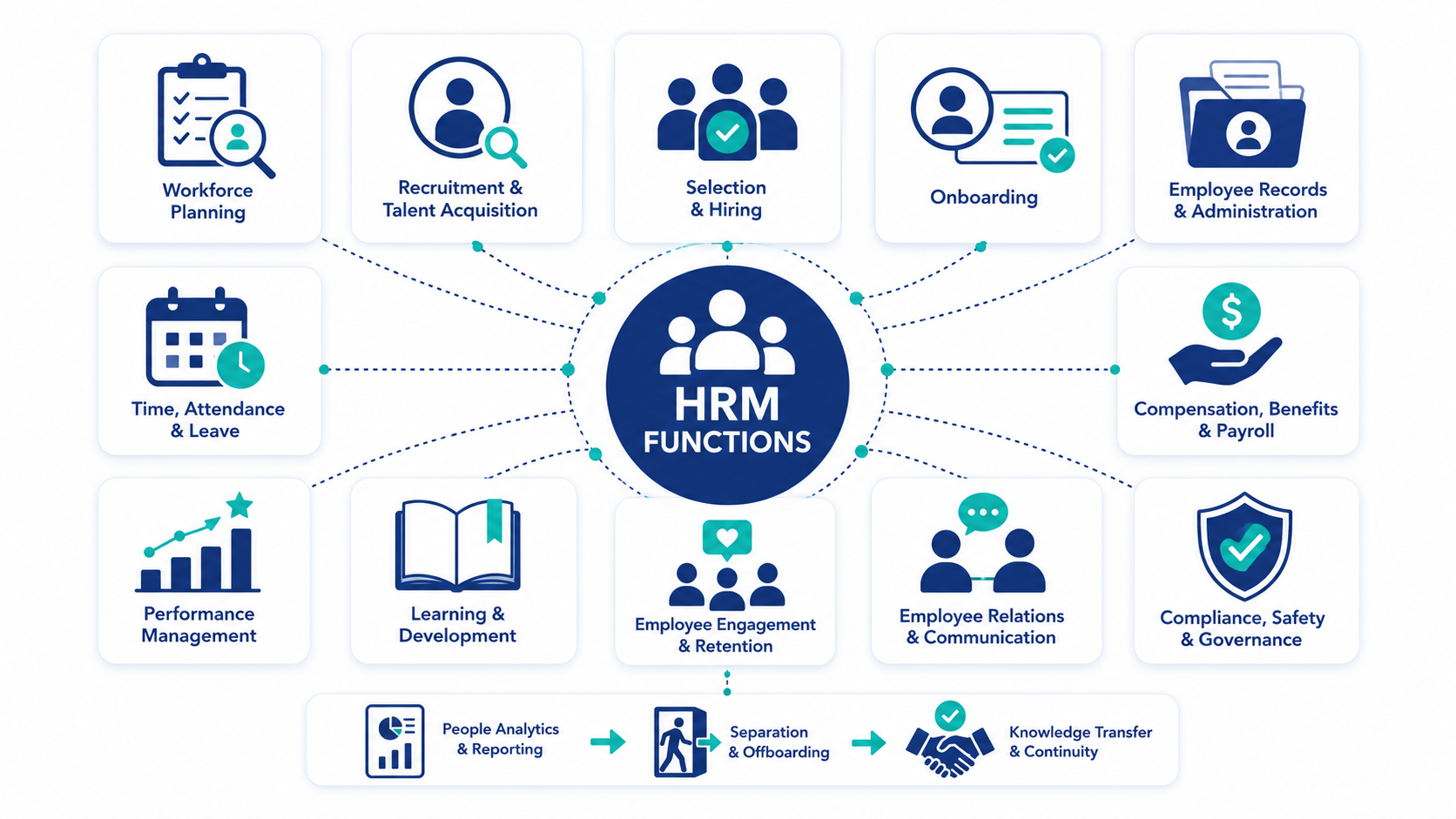
The functions of human resource management are recurring responsibilities for managing people and the employment relationship. They cover how a business plans, hires, supports, rewards, develops, and separates employees.
These responsibilities exist even without a formal HR department. An owner, operations manager, or office lead may handle several functions in a smaller business.
What are the functions of human resource management?
Human resource management functions define the work needed to manage a workforce consistently. They connect business needs with employee needs, manager actions, reliable records, and workplace standards.
HRM functions are one part of the wider Human Resource Management discipline. The exact structure depends on company size, industry, locations, shifts, and workforce complexity.
The terms below are related, but they answer different questions:
| Concept | Question it answers | Simple example |
| Functions | What workforce responsibilities must the organization manage? | Recruitment, compensation, and employee relations |
| Objectives of HRM | What results should those responsibilities support? | Suitable staffing, fair treatment, and business support |
| Human Resource Management Process | How does the work move from one step to another? | Plan, act, review, and improve |
| Employee Lifecycle | Where is an employee in the employment journey? | Hiring, onboarding, development, and separation |
Functions describe areas of ownership. Objectives describe intended results.
Processes provide operating steps, while the lifecycle follows the employee’s journey.
A practical map of core HR functions
No single department structure fits every employer. However, a practical responsibility map for growing businesses includes the following core HR functions.
Workforce planning and role design
Workforce planning identifies the people, skills, roles, and schedules needed for expected work. It compares current capacity with future business demand.
Role design defines duties, reporting lines, decision rights, and required capabilities. Human Resource Planning covers the detailed forecasting and planning method.
Recruitment and talent acquisition
Recruitment creates a suitable candidate pool for an approved position. It covers job descriptions, sourcing, vacancy communication, and candidate coordination.
Talent acquisition also considers recurring demand and future skill needs. The hiring manager should define the role and approved need before sourcing begins.
Candidate selection and hiring
Selection compares candidates with the role’s stated requirements. It may include applications, interviews, assessments, references, and documented approval.
Hiring completes the employment decision and required records. Consistent criteria help managers explain why one candidate met the role’s needs.
Employee onboarding
Onboarding helps new employees understand their role, workplace, team, and early expectations. It starts before the first day and continues through initial adjustment.
HR prepares records and policies. Managers provide work guidance, training, access, introductions, and scheduled check-ins.
Employee records and HR administration
HR administration keeps workforce information accurate, secure, and available to authorized people. Records may include role, pay, leave, training, and employment status.
This function also coordinates transfers, promotions, reporting changes, and updated personal details. Every change needs a clear source and approval trail.
Time, attendance, leave, and scheduling
This function connects working time with operations, payroll inputs, and employee records. It covers shifts, attendance, absences, breaks, leave, and schedule changes.
Clear approval rules prevent conflicting records. Managers verify events, while HR or payroll maintains the approved result.
Compensation, benefits, and payroll coordination
Compensation management defines how roles and employees are paid within the organization. It may include pay structures, adjustments, incentives, and recognition arrangements.
Benefits administration maintains available programs and employee information. Payroll coordination sends approved workforce data to the payroll process accurately.
Performance management
Performance management sets expectations and reviews how employees meet them. It covers goals, feedback, formal reviews, coaching, recognition, and performance support.
Managers own daily performance conversations. HR provides the framework, records, consistency checks, and guidance for sensitive cases.
Learning and employee development
Learning and development build skills needed for current or future work. Activities may include job training, coaching, technical instruction, and manager development.
Training should connect with a defined capability need. Completion records alone do not prove that employees can apply the learning.
Employee engagement and retention
Engagement reflects how employees connect with their work, managers, and workplace. Retention work examines the conditions that influence whether capable employees stay.
HR can organize feedback and identify patterns. Leaders and managers must decide which concerns need changes, resources, or clearer communication.
Employee relations and workplace communication
Employee relations covers concerns, conduct, conflict, complaints, and workplace expectations. It supports a fair and consistent employment relationship.
Managers should address routine issues early. HR guides sensitive cases and maintains defined reporting, review, and escalation routes.
Workplace safety and employee well-being
This function supports working conditions that protect employees and enable reliable work. HR often coordinates with operations, supervisors, and safety specialists.
Responsibilities may include training records, incident procedures, workplace support, and return-to-work coordination. Ownership should remain clear at every site and shift.
Policy, compliance, and governance
Policy governance turns approved workplace rules into clear responsibilities and procedures. Compliance coordination helps the business identify, document, and review employment obligations.
Requirements can change by location, employer size, worker status, and industry. Verify current duties with primary authorities and qualified advisers.
Use the HR Compliance Checklist for a deeper review. A checklist supports control, but it does not replace current guidance or legal advice.
Separation and offboarding
Separation covers resignations, retirements, dismissals, contract endings, and other departures. It coordinates records, access removal, final responsibilities, and operational handovers.
A consistent offboarding process protects continuity and closes the employment relationship clearly. Managers and HR should document decisions and assigned actions.
People analytics and workforce reporting
Workforce reporting organizes approved data into useful measures. People analytics examines patterns that support a defined workforce decision.
The function needs consistent definitions, access controls, and reliable source records. People Analytics covers the deeper measurement and interpretation methods.
How core HR functions connect through handoffs
HR functions do not run independently. Each workforce event moves information, decisions, and records between several owners.
The table shows common functional handoffs without replacing the detailed process page:
| Workforce event | Starting function | Connected functions | Evidence of completion |
| Approved hire | Selection and hiring | Onboarding, records, payroll, IT, and training | Approved offer, start details, and assigned actions |
| Attendance or leave event | Time and attendance | Scheduling, payroll, employee relations, and records | Manager approval and updated time record |
| Performance concern | Performance management | Employee relations, learning, records, and leadership | Feedback record, agreed action, and review date |
| Role or pay change | Role design or compensation | Records, payroll, benefits, access, and reporting | Approved change and effective date |
| Employee departure | Separation | Records, payroll, IT, facilities, and knowledge transfer | Notice, clearance, access closure, and final handoff |
Every handoff needs a trigger, sender, receiver, record, and exception owner. Missing one element creates delay, conflicting data, or unfinished work.
HR roles and responsibilities: who owns each function?
Human resource management is not owned by HR alone. It depends on shared responsibility across leaders, managers, specialists, and employees.
The matrix separates process ownership from final accountability. Titles may change, but every result still needs a named owner.
| HR function | Primary process owner | Supporting roles | Final accountability |
| Workforce planning | HR or assigned business lead | Department managers and finance | Executive leadership |
| Role design | Department manager | HR and team leaders | Department head |
| Recruitment | HR or recruiter | Hiring manager and interview panel | Hiring manager |
| Onboarding | HR or assigned coordinator | Manager, IT, finance, and facilities | Hiring manager |
| Attendance and leave | HR or operations administration | Managers and payroll | Department manager |
| Performance management | Department manager | HR and employees | Department head |
| Learning and development | HR or manager | Subject specialists and employees | Department manager |
| Compensation and benefits | HR | Finance and payroll | Executive leadership |
| Employee relations | HR and manager | Senior leadership or specialist adviser | Designated senior leader |
| Employee records | HR or assigned administrator | Employees, managers, and IT | HR or business leadership |
| Safety | Operations and managers | HR and safety specialists | Site or business leadership |
| Offboarding | HR or assigned coordinator | Manager, IT, finance, and payroll | Department head |
HR normally designs processes, protects records, advises managers, and checks consistent application. Managers make daily people decisions because they observe work directly.
Executives approve priorities, budgets, risk limits, and company-wide policies. Employees provide accurate information and follow established procedures.
Main duties of the HR department
The duties of the HR department extend beyond forms and employee files. HR converts workforce principles into repeatable practices that managers can use.
Its main department duties usually include:
- Designing policies, responsibility maps, workflows, and approval rules.
- Maintaining secure and accurate employee records.
- Coordinating recruitment, onboarding, employment changes, and offboarding.
- Advising managers on performance, conduct, attendance, and employee concerns.
- Coordinating pay, benefits, leave, and payroll inputs with responsible teams.
- Monitoring consistency across departments, sites, shifts, and managers.
- Escalating matters that require senior, legal, payroll, safety, or benefits expertise.
- Preparing approved workforce reports for defined business decisions.
HR should not make every people decision. Its role is to establish fair methods, guide decision-makers, and preserve reliable evidence.
How HR ownership changes with company size
Company size changes how HR work is divided, not whether the work exists. Operational complexity can matter as much as headcount.
| Company stage | Typical HR model | Manager responsibility | Main control need |
| Small business | Owner, administrator, or HR generalist covers several functions | Managers handle daily attendance, training, feedback, and concerns | Written ownership and reliable records |
| Growing business | Generalist team adds recruiting, payroll, or learning support | Managers follow clearer workflows and approval levels | Strong handoffs and consistent documentation |
| Mid-market business | HR uses specialist roles, shared services, or business partners | Managers remain accountable for team decisions | Common standards across sites and departments |
Multiple locations, shift patterns, and workforce types may require structure earlier. A smaller factory can need clearer site ownership than a larger office team.
How core HR functions change by industry
The functions remain similar across industries, but the operating emphasis changes. Managers should adapt ownership and records to the way work is performed.
| Industry | Functions needing added attention | Typical ownership handoff |
| Manufacturing | Staffing, shifts, attendance, skills, safety, and training records | HR sets controls while production managers deploy employees |
| Packaging | Line staffing, schedule changes, onboarding, and role competence | Operations confirms demand while HR records approvals and training |
| Textile and apparel | Skill records, line allocation, attendance, incentives, and performance | Production validates work data while HR checks policy consistency |
| Software and SaaS | Specialist hiring, distributed onboarding, career paths, and access changes | Managers assess capability while HR and IT coordinate lifecycle actions |
Industry context should change the operating detail, not the accountability principle. Each function still needs an owner, record, handoff, and escalation path.
Common gaps across HR functions
Most failures occur between functions, not inside a written policy. Look for these five warning signs.
Unclear ownership
A policy may name HR without defining the manager’s role. Work then stalls between departments or returns to the same person repeatedly.
Strong administration but weak management
Accurate records cannot replace clear feedback, fair decisions, or manager follow-through. HR supports managers, but managers still manage employees.
Missing handoffs
Hiring, onboarding, leave, performance, and separation involve several people. An undefined handoff creates delays, lost information, duplicate work, or missed access changes.
Activity without a defined objective
Teams may continue tasks because they have always done them. Each duty should support a named business, functional, personal, or social objective.
Records without a decision purpose
Completed forms and meetings show activity. They do not prove that the function achieved its purpose or informed a better decision.
Human resource function audit checklist
Use this checklist to compare documented duties with daily work. Apply the same questions to every core function.
- What business or employee need does this function address?
- Who is accountable for its final result?
- Which managers, employees, or specialists support the work?
- What request, event, or decision starts the work?
- Are the required actions clear and repeatable?
- Which decisions need review, and who provides it?
- What record proves the action or decision?
- Where does responsibility move between teams?
- What happens when information is missing or disputed?
- When must each action begin and finish?
- Can employees and managers find the correct policy or process?
- How will the organization identify gaps and improve the function?
The audit is complete only when each answer names a person, record, or decision point. Vague ownership should become an assigned action.
Frequently asked questions about human resource functions
What are the main functions of human resource management?
The main functions cover workforce planning, hiring, administration, performance, rewards, development, employee relations, compliance, reporting, and separation. Together, they support the employment relationship from planning through departure.
What are the duties of the human resources department?
HR usually designs policies, maintains records, coordinates people workflows, advises managers, and monitors consistent application. Exact duties depend on company size, industry, structure, and available specialists.
Are human resource functions owned only by HR?
They are shared. HR often designs the framework and coordinates specialist work.
Managers apply many duties through hiring, scheduling, feedback, attendance follow-up, and performance decisions.
Leaders approve priorities and resources. Employees provide accurate information and follow defined procedures.
How do functions differ from human resource objectives?
Objectives describe the results the organization wants. Functions are the recurring responsibility areas used to pursue those results.
For example, suitable workforce capability is an objective. Recruitment, learning, and performance management are functions that support it.
How is an HR function different from an HR department duty?
A function is a recurring responsibility area, such as recruitment or performance management. A duty is a specific action assigned within that function.
Several people may perform duties inside one function. The responsibility map should still identify one accountable owner.
Which HR function should a growing business establish first?
Start with the area carrying the greatest operational or employment risk. Common early needs include employee records, payroll inputs, hiring ownership, attendance rules, and issue escalation.
The correct order depends on current gaps. Use the audit checklist to set priorities.
How do HR functions support business strategy?
Functions convert workforce priorities into assigned work. Recruitment builds capability, development closes skills gaps, and performance management aligns expectations.
Strategic Human Resource Management explains that connection in depth. This page stays focused on functional ownership and duties.
How often should human resource functions be reviewed?
Review them when roles, headcount, laws, systems, or operating conditions change. Set a regular schedule for checking ownership, records, handoffs, and unresolved exceptions.
Where to go next
Use the objectives page when the intended result is unclear. Choose the process page when the issue involves operating steps or handoffs.
Use the lifecycle page when the question concerns an employee stage. Strategy, planning, analytics, and compliance pages provide their own deeper methods.