
People analytics: definition, benefits, metrics, and examples
People analytics: definition, benefits, metrics, and examples
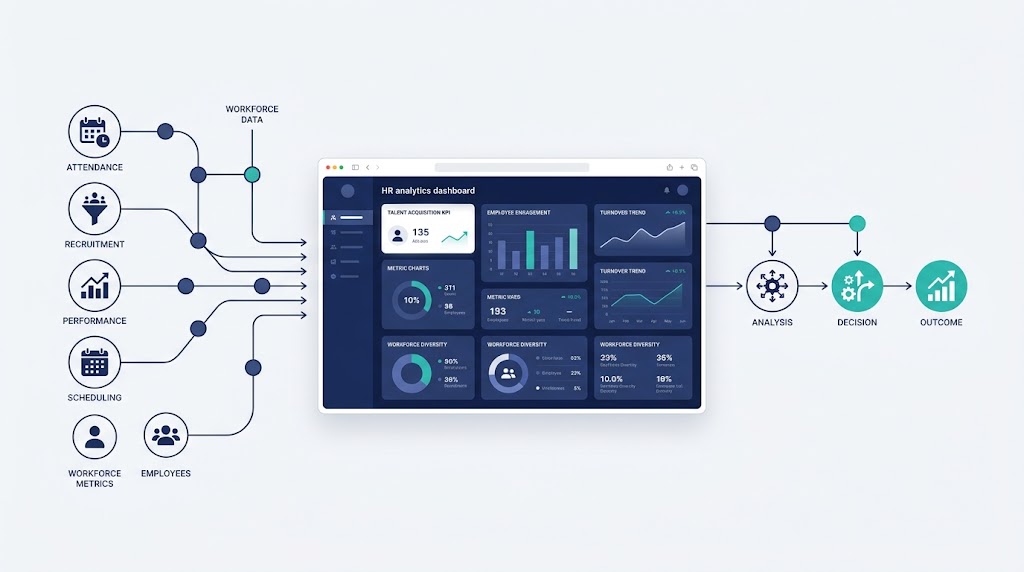
People analytics is the structured use of workforce data to answer business questions about people. It connects measures with decisions, actions, and reviewed outcomes.
The goal is not more dashboards. The goal is better judgment based on defined, checked, and responsibly used evidence.
This discipline supports the wider Human Resource Management system. It does not replace managers, employee context, or accountable decision-making.
What is people analytics in HR?
People analytics in HR turns workforce records into evidence for a defined decision. It combines business questions, HR metrics, data checks, interpretation, and action.
A report becomes analytics only when someone uses it to answer a question. The resulting action should also receive a later review.
| Stage | Main question | Required output |
| Business question | What do we need to understand? | One answerable workforce question |
| Measurement | Which evidence represents the issue? | Defined measure, population, period, and comparison |
| Validation | Can the data support the analysis? | Quality results, gaps, corrections, and limitations |
| Interpretation | What patterns appear, and what remains unknown? | Finding, context, alternatives, and confidence limits |
| Decision | Which action may follow? | Named decision owner and approved boundary |
| Outcome review | Did the action help, harm, or change nothing visible? | Recorded result, next action, and review date |
Skipping one stage weakens the chain. A polished chart cannot repair a vague question or unreliable source record.
People analytics vs HR analytics vs workforce analytics
Companies often use these terms interchangeably. Clear internal definitions still prevent confusion about scope and ownership.
| Term | Common focus | Example question | Main owner may include |
| People analytics | Employee and organizational patterns across the lifecycle | Where do employee events or working conditions need review? | HR, business leaders, managers, and analysts |
| HR analytics | HR process, service, policy, and program performance | Where does the hiring or request process stall? | HR process owners and analysts |
| Workforce analytics | Workforce size, composition, capacity, deployment, and movement | Do current skills and availability match required work? | Operations, HR, finance, and workforce planners |
| HR reporting | Organized facts from approved records | What was recorded during the selected period? | System, data, and report owners |
The labels matter less than the decision chain. Every analysis needs a clear question, metric definition, data owner, reviewer, and action boundary.
Analytics also differs from automation and artificial intelligence. Analytics interprets evidence, while automation routes defined tasks and rules.
HR Automation covers triggers, approvals, exceptions, and repeatable workflows. AI in HR covers models, generative tools, and AI-specific risks.
Benefits of people analytics for workforce decisions
Start with a decision, not an available field. This keeps reports connected with an owner and a possible response.
Defined evidence helps leaders locate process gaps, compare responses, and review whether an approved action helped.
| Business question | Useful evidence | Possible decision | Important limit |
| Where does recruitment slow down? | Stage dates, status changes, withdrawals, ownership, and open actions | Correct a handoff, approval, or sourcing process | Funnel data does not prove candidate quality |
| Are new starters operationally ready? | Required tasks, owners, due dates, access, equipment, schedules, and training | Fix onboarding ownership or task order | Checklist completion does not prove job capability |
| Where is coverage unreliable? | Demand, shifts, availability, skills, leave, attendance, and open assignments | Adjust schedules, cross-training, or staffing actions | A coverage gap does not explain its cause |
| Which employee changes create rework? | Requests, approvals, effective dates, connected updates, and corrections | Redesign the change workflow or control | More corrections may reflect better reporting |
| Where do departures require review? | Status history, departure types, tenure, team, location, and exit evidence | Investigate working conditions or process issues | A rate cannot identify individual intent |
| Are managers completing required people work? | Assigned tasks, completion dates, exceptions, and quality checks | Clarify ownership, training, or escalation | Completion does not prove decision quality |
| Do current capabilities match planned work? | Roles, skills, assignments, capacity, vacancies, and demand assumptions | Develop, recruit, redeploy, or change work | Skill records may be incomplete or outdated |
Use analytics to identify process or workforce needs. Employee-level action needs current evidence, job-related criteria, and meaningful authorized review.
Objectives of Human Resource Management help define intended results. Analytics tests whether the chosen evidence supports those objectives.
Strategic Human Resource Management connects people choices with business direction. Analytics provides evidence for that discussion without setting strategy itself.
Descriptive, diagnostic, predictive, and decision-support analysis
Analytical depth should match the question and data quality. Advanced methods do not fix weak definitions.
| Analysis type | Question answered | Example | Required caution |
| Descriptive | What happened? | Recorded headcount changed by department | Confirm status, date, and department definitions |
| Diagnostic | Where and when did a pattern appear? | Onboarding delays cluster around one handoff | The pattern does not prove the handoff caused delays |
| Predictive | What outcome may be more likely? | A validated model estimates a future operational risk | Test accuracy, group performance, drift, and appropriate use |
| Decision support | Which options deserve review? | Leaders compare staffing, scheduling, and development responses | An authorized person must own the final choice |
Most teams should stabilize descriptive and diagnostic work first. Predictive outputs need documented purpose, validation, monitoring, and human review.
Do not use a prediction as an employee fact. A likelihood score does not establish motivation, loyalty, performance, or future behavior.
HR metrics and KPIs that support people analytics
A metric is a defined measure. A key performance indicator is a selected metric tied to an objective, owner, trigger, and action.
Every KPI is a metric, but not every metric should become a KPI. A useful dashboard displays only measures connected with decisions.
Apply these calculation controls before comparing results:
| Calculation control | Rule |
| Included population | Define worker types, statuses, roles, locations, and effective dates first |
| Zero denominator | If the denominator is zero, show not applicable when the numerator is zero. Otherwise flag a data or definition error |
| Rate display | Show the numerator and denominator beside every percentage |
| Group rollup | For additive rates, divide summed aligned numerators by summed aligned denominators. Do not apply this rule to non-additive measures |
| Cohort outcome | Fix the cohort first and include only cases with a complete observation window |
| Duration measure | Show a median when a few long cases could distort the average |
| Missing data | Separate missing, unknown, and not applicable values |
| Historical context | Use effective dates rather than record-entry dates |
Keep people, positions, assignments, and full-time equivalents separate. They answer different questions and should not share one count.
Workforce composition and capacity measures
| Measure | Working definition | Main use | Interpretation limit |
| Snapshot headcount | Distinct included employees active at a defined date and time | Review workforce size and distribution | Concurrent jobs should not duplicate people |
| Department share | Employees in one time-effective primary department divided by all included employees at the same snapshot | Review workforce distribution | Use allocated full-time equivalents for split assignments |
| Approved vacancies | Open approved roles meeting the chosen status rule | Review unfilled workforce demand | An open role may not equal an immediate hiring need |
| Schedule coverage | Matched covered units divided by required units for the same role, location, skill, and time | Review near-term staffing coverage | Cap each requirement at full coverage |
| Utilization | Unique qualifying assigned hours divided by eligible available hours for the same population and period | Review capacity allocation | Report overlapping assignments and over-allocation separately |
| Required-skill coverage | Requirement units covered by verified skills and available capacity, divided by total requirement units | Review capability gaps | A skill record needs current verification criteria |
Human Resource Planning explains future demand, supply, gaps, scenarios, and workforce actions. Analytics provides current evidence and trend inputs.
Recruitment and onboarding measures
| Measure | Working definition | Main use | Interpretation limit |
| Funnel conversion | Cohort members reaching the next stage divided by members entering the prior stage | Locate recruitment-stage changes | Define the window, skips, re-entry, duplicates, and incomplete cases |
| Time to fill | For filled roles, time from requisition approval to accepted offer | Review hiring process duration | Report open-role age separately and define pause rules |
| Offer acceptance | Accepted offers divided by accepted plus declined offers after included offers reach a decision | Review offer outcomes | Report pending, expired, rescinded, and withdrawn offers separately |
| Onboarding task completion | Required tasks due and completed by cutoff, divided by all required tasks due by cutoff | Review process execution | Completion does not prove operational readiness |
| Onboarding readiness | Starters meeting every readiness check by deadline, divided by eligible starters whose deadline passed | Review company, operational, and role preparation | Readiness criteria must match the role |
Attendance, leave, and scheduling measures
| Measure | Working definition | Main use | Interpretation limit |
| Unplanned absence time rate | Unplanned absence hours divided by eligible scheduled work hours before absence adjustments | Review coverage and absence patterns | Approved exclusions and schedule accuracy matter |
| Attendance exception rate | Qualifying exception events divided by eligible attendance events | Locate repeated time-record issues | Use a separate measure for exception hours |
| Leave decision time | Median time from complete submission to recorded decision for requests decided during the period | Review approval flow | Show complete open requests by age at cutoff |
| Schedule change rate | Unique published shift instances changed after publication, divided by all published shift instances | Review schedule stability | Demand changes may make some updates necessary |
| Open coverage exceptions | Qualifying unresolved gaps at cutoff, with age and affected hours | Direct manager attention | The count depends on timely reporting |
Retention and employee movement measures
| Measure | Working definition | Main use | Interpretation limit |
| Turnover rate | Qualifying departures during the period divided by average eligible headcount across the same period | Review employee movement | State the averaging cadence and any annualization rule |
| Voluntary resignation rate | Qualifying resignations during the period divided by average eligible headcount across the same period | Prioritize structured retention review | A higher rate does not explain individual reasons |
| Internal mobility rate | Unique employees moving during the period, divided by average eligible employees across that period | Review movement and opportunity | Define qualifying moves and report multiple events separately |
| Length-of-service distribution | Employees at the selected snapshot, grouped by bands from the approved service date | Review workforce composition | Bands can hide important differences within groups |
| Departure-process completion | Required departure tasks due and completed by cutoff, divided by all required tasks due by cutoff | Review offboarding control | Show overdue open tasks separately |
Learning, performance, service, and data-quality measures
| Measure | Working definition | Main use | Interpretation limit |
| Required-learning completion | Required items due and completed by cutoff, divided by all valid required items due by cutoff | Review learning administration | Completion does not prove skill application |
| Review completion | Eligible reviews due and completed by cutoff, divided by all eligible reviews due by cutoff | Review manager process execution | Completion does not prove feedback quality |
| Request cycle time | Median time from complete submission to closure for requests closed during the period | Review employee service flow | Define pauses and reopening, then show open-case age separately |
| Record completeness | Eligible records containing every applicable required field, divided by all eligible records | Review source-data readiness | A filled field can still be wrong |
| Record timeliness | Eligible updates completed by deadline, divided by all updates due by cutoff | Review data freshness | Different events may need different deadlines |
| Reconciliation difference | Signed total difference plus absolute unmatched count or value | Locate conflicting totals | Define direction, tolerance, period, and matching key |
Do not copy formulas without deciding their purpose. Record numerator, denominator, exclusions, event dates, averaging method, and update timing.
The people analytics process from question to action
People analytics works as a controlled management process. It should connect directly with wider Human Resource Management Processes.
Use these nine steps:
- Write one business question that supports a named decision.
- Define the included population, events, period, and comparison.
- Select the smallest useful set of measures.
- Document formulas, definitions, exclusions, sources, and owners.
- Test completeness, duplicates, history, dates, and reconciliations.
- Segment only where the comparison supports possible action.
- Record the finding, alternatives, uncertainty, and missing context.
- Assign an authorized action owner and employee safeguard review.
- Review the outcome using the same approved definitions.
The Functions of Human Resource Management help identify process and data owners. Managers and leaders still own operational decisions.
Workflow records can improve analytical inputs. Automation should preserve source, status, timestamps, exceptions, and ownership rather than hiding them.
People analytics examples across the employee lifecycle
The Employee Lifecycle provides a useful event map. Each stage produces questions, records, decisions, and review evidence.
| Lifecycle stage | Analytics question | Useful data | Possible action | Guardrail |
| Planning | Where does demand exceed current capability or capacity? | Work requirements, roles, skills, assignments, availability, and vacancies | Compare development, recruitment, redeployment, or work changes | Keep demand assumptions visible |
| Recruitment | Which stage creates repeated delay or withdrawal? | Approved role, candidate stage, owner, dates, withdrawals, and next actions | Correct sourcing, handoffs, criteria, or approval flow | Do not treat speed as candidate quality |
| Onboarding | Which readiness task remains late or incomplete? | Employee, role, owner, due date, completion, access, equipment, and training | Correct ownership, timing, escalation, or task order | Separate checklist completion from job capability |
| Scheduling | Where do leave, availability, and coverage conflict? | Demand, schedule, leave, availability, attendance, role, and location | Adjust coverage, planning, or manager workflow | Review approved exceptions and context |
| Development | Which roles lack verified required capabilities? | Role requirements, skill evidence, learning, assignments, and review dates | Prioritize development, support, or role-level staffing review | Do not infer skill from course completion alone |
| Employee change | Which connected records remain inconsistent? | Approved change, effective date, manager, role, payroll input, access, and reports | Repair the change workflow and source ownership | Use the approved change as the reference |
| Departure | Which handoffs remain open after the approved event? | Status, final inputs, work transfer, access, assets, records, and owners | Correct offboarding ownership and verification | Limit sensitive departure information |
Each example begins with a process question. It does not begin by scoring an individual employee.
Use this practical people analytics decision contract
A people analytics decision contract is a practical template created for this guide. It links one question with one accountable action.
Complete it before opening a dashboard.
The contract prevents shifting definitions, selective interpretation, and ownerless findings. Use one contract for each material question.
Copy-ready decision contract
| Contract field | What to document |
| Business question | One question that a named leader can answer or act upon |
| Decision boundary | The decision this analysis may support and prohibited uses |
| Population and period | Included workers, locations, arrangements, events, and reporting period |
| Metric definition | Formula, numerator, denominator, exclusions, dates, and update method |
| Data sources | Source, required fields, system owner, extraction date, and join key |
| Quality tests | Completeness, duplicates, valid dates, status sequences, reconciliation, and missingness |
| Permitted segments | Useful breakdowns and why each supports possible action |
| Interpretation limits | Data gaps, delays, small groups, alternatives, and uncertain causes |
| Action rule | Evidence required before action and the approved response boundary |
| Action owners | Data validator, decision owner, operational owner, and safeguard reviewer |
| Safeguards | Access, aggregation, suppression, retention, human review, and prohibited uses |
| Review plan | Review date, success evidence, unintended effects, and retirement condition |
Add question, data, decision, and safeguard owners below the contract. Record approval date, review date, and current contract status.
Worked example: onboarding readiness delays
| Contract field | Example entry |
| Business question | Which onboarding handoffs repeatedly delay defined operational readiness? |
| Decision boundary | The analysis may improve tasks and ownership. It cannot rate a new employee’s potential. |
| Population and period | Include eligible starters, roles, locations, and start events within the approved period. |
| Metric definition | Starters meeting every readiness check by deadline, divided by eligible starters whose deadline has passed. |
| Data sources | Employee record, role, manager, start date, tasks, owners, due dates, access, equipment, schedule, and training. |
| Quality tests | Check unique identifiers, valid dates, complete task ownership, status history, and reconciled starter totals. |
| Permitted segments | Review role, department, location, task type, and process owner where groups protect identities. |
| Interpretation limits | Late tasks show process delay. They do not prove weak employee capability or manager intent. |
| Action rule | Repeated qualifying handoffs receive a process review using task evidence and owner context. |
| Action owners | The analytics owner validates data. The onboarding owner changes the process. A safeguard owner reviews access. |
| Safeguards | Aggregate results, limit access, protect small groups, and prohibit individual potential scoring. |
| Review plan | Repeat the same measure after the change. Record results, unintended effects, and the next decision. |
Do not change the formula after seeing an inconvenient result. Document any revised definition as a new version.
Data quality controls for HR analytics
Workforce records change over time. Analytics needs history, effective dates, and consistent identifiers to reconstruct the correct state.
| Data problem | How it distorts analysis | Control |
| Duplicate employee records | Inflates counts and splits event history | Use one approved identifier and merge rules |
| Missing required fields | Removes people or events from comparisons | Show missingness by field and relevant group |
| Stale employee status | Misstates headcount, turnover, access, or eligibility | Reconcile status and effective dates |
| Overwritten history | Applies current managers or departments to older events | Preserve time-effective assignments and changes |
| Inconsistent department names | Splits or combines the wrong groups | Maintain an approved organization dictionary |
| Mixed event definitions | Counts different events as equivalent | Use a versioned metric dictionary |
| Mismatched reporting periods | Compares totals drawn from different windows | Lock period start, end, snapshot, and timezone |
| Untracked manual corrections | Breaks reconciliation and trust | Record editor, reason, approval, and timestamp |
| Unsafe small groups | Exposes identities or encourages weak conclusions | Suppress, combine, or broaden the view |
| Unclear source ownership | Leaves errors without a correction owner | Assign one source and one owner per field |
Display data freshness and known gaps near each result. Do not hide quality warnings in a separate technical appendix.
HR Management Software explains the wider system category. Analytics needs traceable sources, controlled access, history, exports, and correction workflows.
Build a decision-ready people analytics dashboard
A dashboard should help someone decide, investigate, or act. Every visible measure needs a reason for being there.
| Dashboard element | What it should show |
| Business question | The issue the view is designed to support |
| Measure and definition | Name, formula, population, period, exclusions, and version |
| Current result | The approved value with clear units and date |
| Comparison | Prior period, baseline, plan, capacity, or another relevant reference |
| Data quality | Freshness, missingness, reconciliation, and known limitations |
| Segments | Only breakdowns that support investigation or action |
| Exceptions | Missing, late, conflicting, or unusual records needing review |
| Owner | Person responsible for validation, decision, and follow-up |
| Action status | Open action, due point, result, and next review |
Avoid a single unexplained score. Show the underlying measures, definitions, limits, and responsible owner.
HR Software Features covers broader platform capabilities. This page focuses only on analytics, reporting, access, history, and evidence needs.
Privacy, fairness, and responsible workforce analytics
People data can affect employees. Collection and analysis need a defined purpose, limited access, and accountable human review.
Use these controls:
- Collect only fields needed for the approved question.
- Explain the purpose before expanding collection or use.
- Limit raw records, dashboards, filters, and exports by assigned responsibility.
- Set approved retention and deletion rules that reflect purpose, applicable duties, and active preservation needs.
- Prefer aggregated results. Assess re-identification risks before using de-identified data, linked datasets, filters, or exports.
- Test combined filters that could reveal people in small groups.
- Check missing data and outcomes across relevant employee groups.
- Review fields that may act as proxies for sensitive characteristics.
- Separate an observed association from a proven cause.
- Give employees a route to correct inaccurate source records.
- Require meaningful, documented review before a material employee-impacting action. Reviewers must be able to challenge outputs and correct data.
- Prohibit one score from deciding hiring, pay, promotion, discipline, or departure.
Historical data can reflect earlier decisions and unequal opportunities. More records do not automatically remove those patterns.
Set a suitable minimum reporting group for each use case. There is no universal number that makes every filtered result safe.
A minimum reporting group does not prevent re-identification by itself.
Verify current privacy, employment, recordkeeping, and security requirements for every location and use. Use qualified support for high-risk analysis.
This is operational guidance, not legal advice. Requirements vary by location, worker relationship, data type, and intended use.
How small businesses can start people analytics
A small company does not need a data-science team to begin. It needs one useful question, controlled records, and an owner who can act.
The HR Management for Small Business guide explains the operating foundation. Analytics should follow that ownership and source structure.
Use this starter register:
| Starter field | First version |
| Business question | One recurring workforce problem with an accountable owner |
| Decision | One action the analysis may support |
| Measures | The smallest set needed to answer the question |
| Source | Approved employee, recruitment, time, leave, schedule, or request record |
| Quality check | Completeness, current status, duplicates, dates, and reconciliation |
| Comparison | Previous period, approved plan, required capacity, or relevant group |
| Review | A cadence matched to the decision and data update cycle |
| Action record | Owner, approved response, due point, and result |
| Safeguard | Access, small-group protection, human review, and prohibited uses |
Start with descriptive evidence. Add segments only when each comparison can lead to a responsible action.
How OryxBlue supports people analytics workflows
Editorial note: OryxBlue is the publisher’s product. Evaluate it using the same definitions, quality checks, permissions, and decision controls.
OryxBlue may fit teams needing operational reports from connected workforce records. Its stated scope covers employee, recruitment, attendance, leave, scheduling, requests, approvals, and payroll visibility.
| Reporting area | Stated OryxBlue visibility to verify | Definitions and decisions the business owns |
| Organization overview | Organization-wide KPI dashboard and headcount views by department | Included statuses, effective date, department rules, and role-level staffing review |
| Employee view | Employee-facing personal dashboard and lifecycle status | Displayed fields, employee access, correction route, and status decision |
| Recruitment | Recruitment funnel metrics and progress visibility | Stages, withdrawals, duplicate handling, criteria, and hiring decisions |
| Time and availability | Attendance, leave, schedules, shifts, assignments, and related reports | Schedule rules, exceptions, approvals, coverage, and follow-up |
| Payroll oversight | Payroll-related visibility and reports | Pay periods, approved inputs, corrections, downstream payroll ownership, and final decisions |
| Operations | Utilization, capacity, workload, and delivery-readiness views | Definitions, thresholds, interpretation, assignment, and management action |
| Requests and approvals | Request progress, approvals, roles, and permissions | Policy rules, authority, exceptions, and final approval |
| Reporting use | Dashboards, reports, and exports | Access, retention, definitions, quality, distribution, and resulting action |
Treat these views as decision support. Do not use them as proof of cause or autonomous employment decisions.
Do not assume predictive analytics, automatic compliance, payroll filing, or autonomous workforce planning. Verify any required capability within the proposed scope.
Request a demonstration using approved definitions, sample records, permissions, filters, and corrections. Test whether every result traces to its source.
Best HR Software for Small Business provides a broader selection method. Apply the same evidence standards to OryxBlue and every alternative.
Common people analytics mistakes
These failures turn workforce data into false confidence:
- Metric drift. Teams use the same label with different formulas or populations.
- Vanity reporting. Dashboards show activity without a decision or owner.
- Denominator blindness. A count changes because the eligible population changed.
- Snapshot confusion. Current manager or department fields rewrite older events.
- Average masking. One total hides meaningful differences or data gaps.
- Small-group exposure. Filters reveal people or encourage weak conclusions.
- Correlation overreach. A pattern becomes an unsupported claim about cause.
- Proxy risk. A seemingly neutral field reflects a sensitive characteristic.
- Completion bias. Finished tasks are treated as proof of quality or capability.
- Automation opacity. System rules change records without visible history or ownership.
- Score dependence. One calculated value drives an employment decision.
- Action failure. A finding receives no owner, response, or outcome review.
Turn every failure into a control. Assign its definition, owner, evidence, safeguard, correction route, and review point.
People analytics implementation checklist
Use this checklist before publishing a workforce report or acting on its findings:
- Is the business question clear and connected with a named decision?
- Are prohibited uses, population, period, events, and comparison documented?
- Does each measure have one formula, version, numerator, denominator, and exclusions?
- Does every field have an approved source and correction owner?
- Were missing, duplicate, stale, and conflicting records tested?
- Is historical employee context preserved for past events?
- Do segments support action without exposing a small group?
- Are missing context, alternative explanations, and causal limits visible?
- Were access, retention, fairness, proxy, and re-identification risks reviewed?
- Can employees correct inaccurate source records?
- Can the authorized reviewer challenge outputs and request corrections?
- Does an authorized leader own the final decision?
- Is the action, due point, expected evidence, and outcome review recorded?
Do not publish when a required answer remains unknown. Record the gap, owner, corrective action, and next review.
Frequently asked questions about people analytics
What is people analytics?
People analytics uses defined workforce data to answer business questions and support decisions. It connects measures, context, action, and outcome review.
What is people analytics in HR?
It is the use of employee and HR process data within people management. The analysis supports human judgment rather than replacing it.
What is the difference between people analytics and HR analytics?
People analytics often covers workforce patterns across the employee lifecycle. HR analytics often focuses more closely on HR processes, services, policies, and programs.
Is workforce analytics the same as people analytics?
The terms overlap. Workforce analytics often emphasizes size, skills, capacity, deployment, availability, and workforce movement.
What are common HR metrics and KPIs?
Common measures cover headcount, hiring flow, onboarding, attendance, coverage, turnover, movement, learning, process completion, and data quality. Definitions must match the decision.
Can a small business use people analytics?
Yes. Start with one recurring question, a few defined measures, controlled records, and an owner able to act.
Does people analytics require special software?
No. Reliable definitions and records matter first, while software can support access, history, calculation, dashboards, and recurring reports.
Can people analytics predict employee turnover?
A validated model may estimate likelihood within its tested population. It cannot know intent or decide an employment action.
How should HR protect employee privacy?
Limit collection, access, filters, exports, retention, and use. Protect small groups and verify current requirements for each location.
Can a dashboard make an employment decision?
A dashboard should not make an employment decision autonomously. An authorized reviewer must validate data, criteria, fairness, and applicable requirements.
Where to go next
Choose one recurring workforce decision. Complete the decision contract, verify its source data, and assign the review owner before building a dashboard.
Return to the Human Resource Management hub for the wider management system. Keep every measure tied to a purpose, decision, safeguard, and outcome review.