
Payroll Deductions: Types, How They Work, and How to Calculate Them
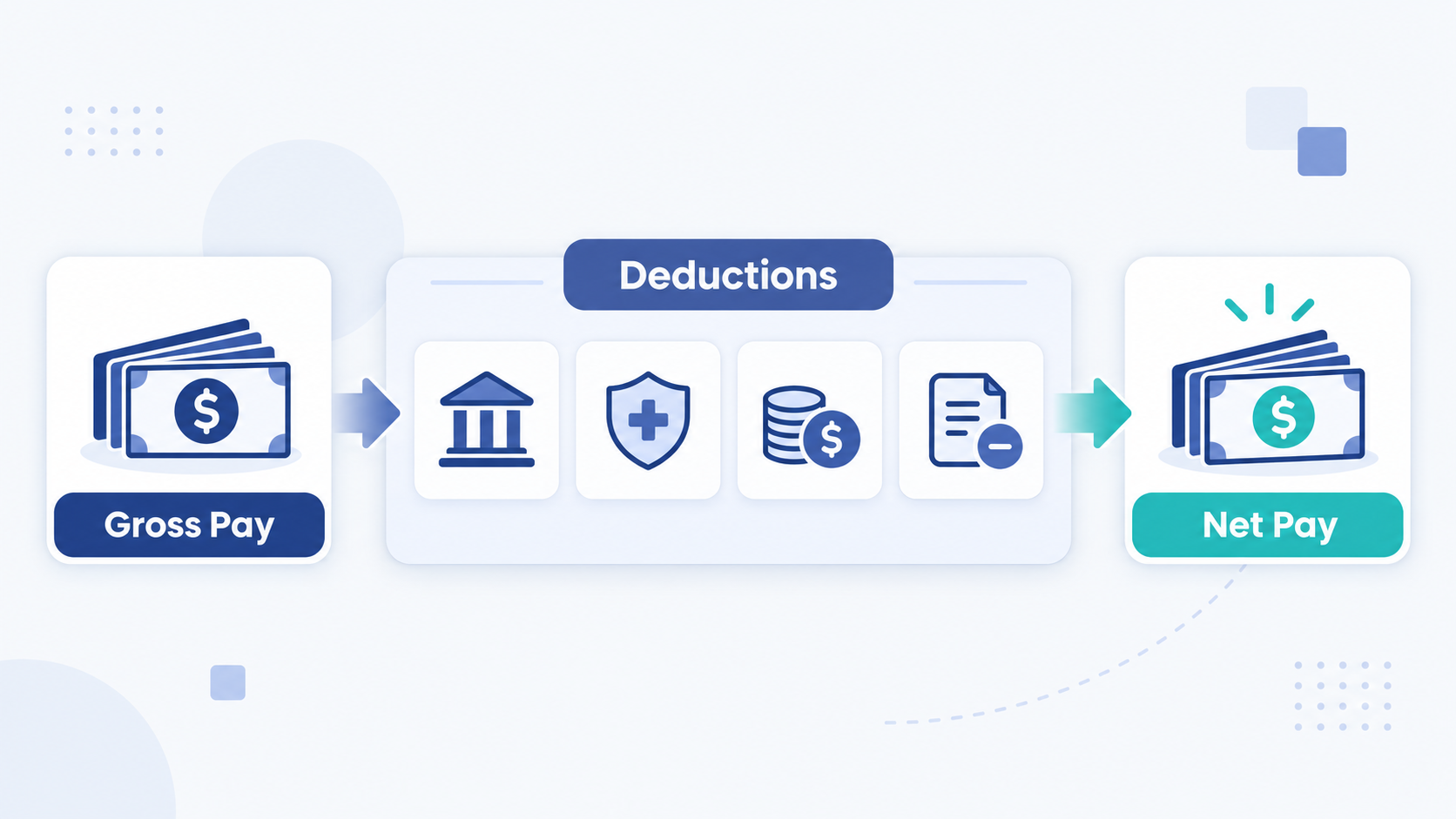
Payroll deductions are amounts taken from an employee’s gross pay before they receive their final net pay. Some deductions are required by law, while others are authorized by the employee for benefits, retirement contributions, or other purposes.
Understanding payroll deductions is important for employees, HR teams, payroll managers, and business owners because incorrect deductions can affect employee pay, payroll records, and compliance.
This guide explains what payroll deductions are, how they work, the different types of deductions, how they differ from withholding, and how businesses can manage them accurately.
What Are Payroll Deductions?
Payroll deductions are amounts subtracted from an employee’s gross wages to determine their net pay.
Gross pay is the total amount an employee earns before deductions. After applicable taxes, contributions, benefits, and other deductions are applied, the remaining amount is the employee’s net pay.
A simplified payroll calculation looks like this:
Gross Pay − Payroll Deductions = Net Pay
Payroll deductions can include mandatory items such as taxes and legally required garnishments, as well as voluntary deductions such as employee benefit contributions.
Payroll deductions are one component of the broader payroll calculation. To understand how earnings, deductions, taxes, reimbursements, employer contributions, and net pay fit together, see our guide to payroll components.
How Do Payroll Deductions Work?
Payroll deductions are generally calculated during each payroll run. The exact process depends on the employee’s compensation, applicable laws, benefits, and the type of deduction.
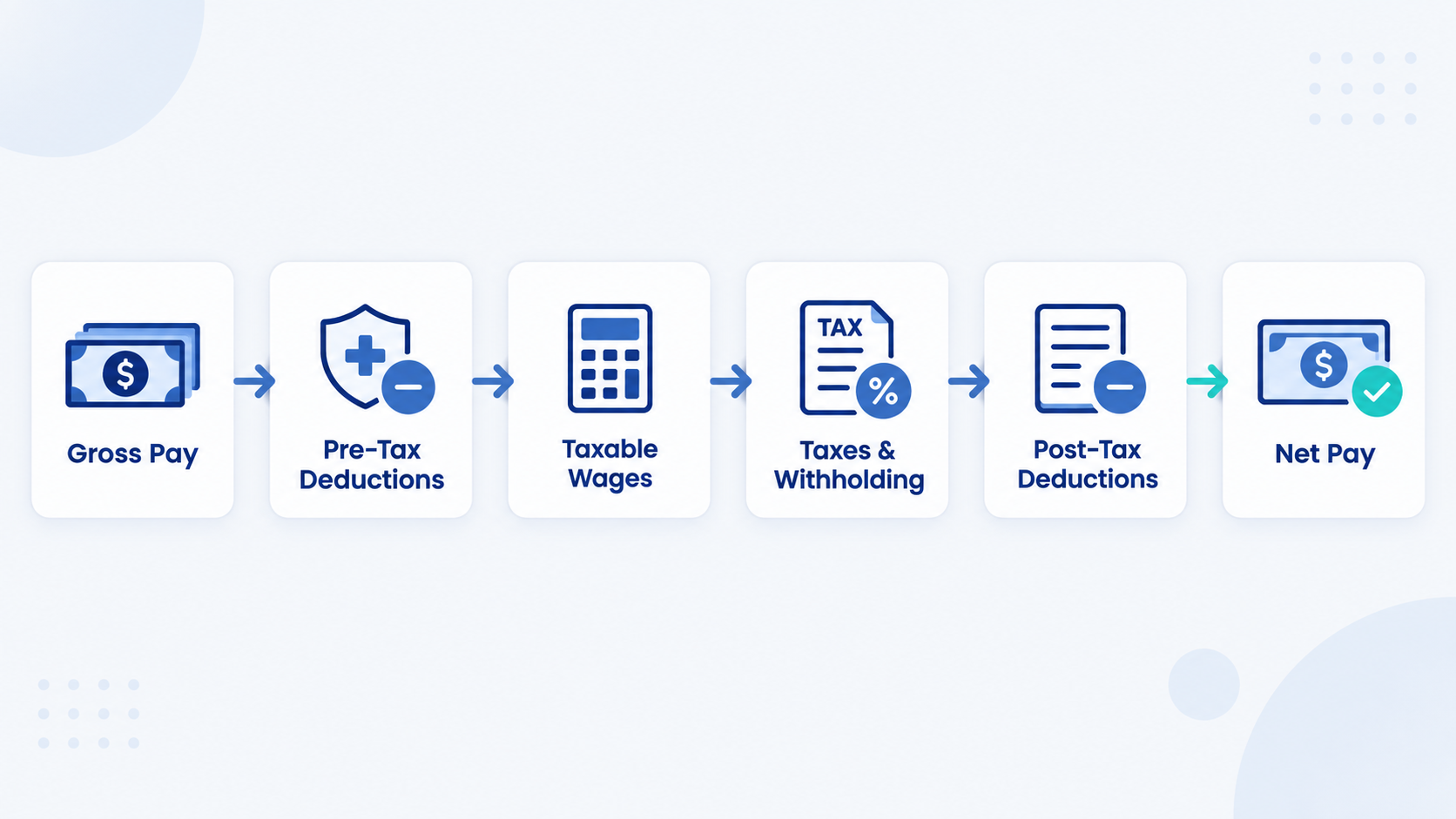
A basic payroll deduction process looks like this:
- Calculate the employee’s gross pay.
- Identify applicable pre-tax deductions.
- Determine taxable wages where applicable.
- Calculate required tax withholdings.
- Apply post-tax deductions.
- Calculate the employee’s final net pay.
- Record the deductions for payroll and reporting purposes.
For example, suppose an employee earns $4,000 in gross wages. If $300 is deducted for an eligible pre-tax benefit, the applicable taxable wages may be reduced to $3,700. Taxes and other deductions are then calculated according to the relevant rules.
The actual calculation depends on the jurisdiction and the specific deduction.
For a broader explanation of the complete payroll workflow, see how to run payroll.
Types of Payroll Deductions
Payroll deductions can be categorized in several ways. The most common classifications are voluntary, mandatory, pre-tax, and post-tax deductions.
Voluntary Deductions
Voluntary deductions are amounts an employee generally chooses or authorizes to have deducted from their wages.
Examples may include:
- Health insurance premiums
- Retirement contributions
- Certain employee benefit contributions
- Charitable contributions
- Other authorized employee programs
The availability and tax treatment of these deductions depend on the employer’s benefits and applicable regulations.
For HR teams, maintaining accurate employee information and records is important because deductions can change when an employee’s benefits or circumstances change.
Mandatory Deductions
Mandatory deductions are deductions that an employer is required to make under applicable laws, regulations, or legal orders.
Depending on the jurisdiction, these may include:
- Income tax withholding
- Social insurance or payroll taxes
- State or local taxes
- Court-ordered wage garnishments
Employers generally need to calculate and remit mandatory deductions according to the requirements that apply to their employees.
Pre-Tax Deductions
A pre-tax deduction is generally taken from an employee’s earnings before certain taxes are calculated.
Depending on the applicable rules, eligible pre-tax deductions can reduce the amount of income subject to particular taxes.
Examples may include certain:
- Retirement contributions
- Health insurance contributions
- Employee benefit plans
Not every deduction qualifies for pre-tax treatment. The tax treatment depends on the type of deduction and the applicable jurisdiction.
Post-Tax Deductions
Post-tax deductions are taken after applicable taxes have been calculated.
Examples can include certain:
- Benefit deductions
- Insurance-related deductions
- Repayments
- Other authorized deductions
The distinction between pre-tax and post-tax deductions matters because it can affect taxable wages and the employee’s final net pay.
What Is the Difference Between Payroll Deductions and Withholding?
Payroll deduction and payroll withholding are related terms, but they are not always interchangeable.
Payroll deductions is a broad term covering amounts subtracted from an employee’s wages.
Payroll withholding commonly refers to amounts withheld from an employee’s pay for taxes or other legally required purposes.
For example, an employee’s paycheck may include:
- Federal income tax withholding
- Social Security and Medicare withholding
- Health insurance deductions
- Retirement contributions
- Wage garnishments
Therefore, withholding can be considered one part of the broader payroll deduction process, depending on how the terms are being used.
Understanding this distinction is especially useful when reviewing payroll components, because deductions, taxes, employer contributions, and net pay are separate parts of the overall payroll calculation.
What Are the 4 Mandatory Payroll Deductions?
There is no universal list of four mandatory payroll deductions that applies to every country. Payroll requirements vary by jurisdiction.
In the United States, common mandatory payroll items include federal income tax withholding, applicable state and local taxes, FICA taxes, and legally required wage garnishments.
1. Federal Income Tax
U.S. employers generally withhold federal income tax from employees’ wages according to applicable federal rules.
The amount withheld can depend on factors such as employee information and the applicable withholding tables and rules.
2. State and Local Taxes
State and local payroll taxes vary considerably depending on where an employee works and the applicable jurisdiction.
Some locations have state income taxes, local income taxes, or other payroll-related requirements, while others may not.
This is why payroll systems need accurate employee and work-location information.
3. FICA Taxes
FICA refers to the Federal Insurance Contributions Act and includes Social Security and Medicare taxes.
These taxes are generally withheld from employee wages, with employers also having applicable employer-side responsibilities.
4. Wage Garnishments
A wage garnishment is a legally required deduction from an employee’s wages based on a court order or other applicable legal process.
Employers receiving a valid garnishment order generally need to follow the requirements specified by the applicable authority.
Because payroll rules differ between countries and jurisdictions, businesses operating internationally should not assume that U.S. payroll deduction categories apply to employees elsewhere.
How to Calculate Payroll Deductions
The exact calculation depends on the type of deduction and the rules that apply to the employee.
A simplified process is:
Gross Pay → Pre-Tax Deductions → Taxable Wages → Taxes/Withholding → Post-Tax Deductions → Net Pay
Consider a simplified example:
An employee has:
- Gross pay: $5,000
- Eligible pre-tax deductions: $400
- Other applicable taxes and withholdings: $1,100
- Post-tax deductions: $200
The calculation would be:
$5,000 − $400 − $1,100 − $200 = $3,300 net pay
This is only an illustrative example. Actual payroll calculations can be significantly more complex because tax rates, deduction rules, employee circumstances, and jurisdictions vary.
Businesses should maintain accurate payroll records and use the applicable tax and deduction rules when processing actual employee payments.
For a broader understanding of the individual elements that make up payroll, refer to payroll components.
Payroll Deductions and the Payroll Cycle
Payroll deductions don’t happen independently of payroll processing. They are calculated and recorded as part of each payroll cycle.
A payroll cycle determines how frequently employees are paid and when payroll activities take place. Depending on the organization, payroll may be processed weekly, biweekly, semimonthly, or monthly.
During a payroll cycle, businesses may need to:
- Collect employee time and attendance information.
- Calculate gross earnings.
- Apply applicable deductions.
- Calculate taxes and withholding.
- Review payroll.
- Approve payroll.
- Process payments.
- Maintain payroll records.
Understanding what a payroll cycle is helps businesses see where payroll deductions fit into the larger payroll process.
Challenges of Managing Payroll Deductions
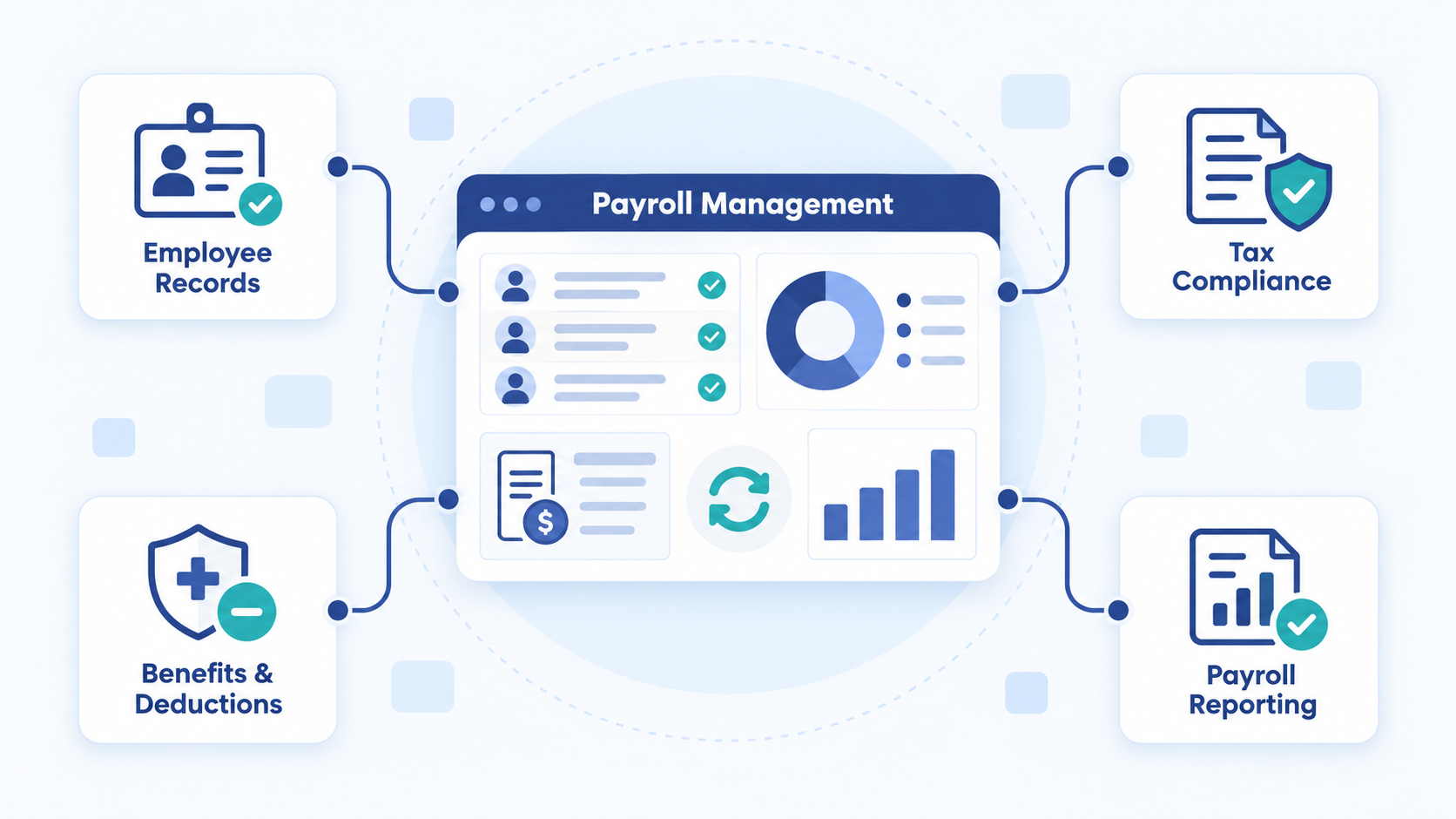
Managing deductions manually can become difficult as an organization grows. Payroll teams may need to deal with changing employee information, different deduction rules, multiple jurisdictions, and frequent regulatory changes.
Geographic Variables
Payroll deductions can vary based on an employee’s country, state, province, city, or other jurisdiction.
For businesses operating across multiple locations, payroll teams may need to account for different:
- Tax rules
- Contribution requirements
- Wage regulations
- Benefit rules
- Reporting requirements
Accurate employee location and payroll information therefore becomes important for correct calculations.
Proper Compliance
Payroll deductions must be handled according to applicable laws and regulations.
Errors can occur when businesses:
- Apply outdated rules
- Use incorrect deduction rates
- Misclassify deductions
- Miss required deductions
- Fail to update employee information
- Process garnishments incorrectly
Payroll compliance therefore requires accurate information, consistent processes, and appropriate recordkeeping.
Tracking Changes
Employee deductions can change over time.
For example, an employee may:
- Change a benefit election
- Start or stop a contribution
- Change compensation
- Move to another jurisdiction
- Receive a new garnishment order
- Become subject to different payroll requirements
Payroll teams need a reliable process for capturing and applying these changes.
Global Considerations in Payroll Deduction Management
Global payroll introduces additional complexity because countries use different tax systems, employment regulations, social contribution structures, currencies, and reporting requirements.
A deduction that is common in one country may not exist in another, while similar deductions may have completely different tax treatment.
For international organizations, payroll processes should therefore be designed around the specific requirements of each jurisdiction rather than applying one universal deduction structure.
Strategic Importance of Payroll Deductions
Payroll deductions may appear to be a technical payroll calculation, but accurate deduction management affects several areas of business operations.
Accurate Employee Pay
Correct deductions help ensure employees receive the appropriate net pay.
Payroll Compliance
Accurate calculations and timely remittance of applicable deductions help organizations meet their payroll obligations.
Better Payroll Records
Maintaining accurate deduction records makes it easier to review payroll calculations and prepare relevant reports.
Greater Transparency
Employees can better understand their pay when deductions are clearly represented in their payroll information.
Reduced Manual Errors
Structured payroll processes can reduce the risk of calculation and data-entry errors associated with manually managing deductions.
How Payroll Software Can Help Manage Deductions
As organizations grow, manually calculating and tracking payroll deductions can become increasingly time-consuming.
Payroll software can help centralize employee payroll information, automate applicable calculations, connect payroll with relevant employee and attendance data, and provide greater visibility into payroll records.
For organizations evaluating HR technology, understanding the benefits of HR software can help explain how centralized HR and payroll processes can reduce administrative work.
Payroll management is also one part of the broader HR technology landscape. Businesses evaluating solutions can explore best HR software options based on their organization size, payroll requirements, employee processes, and other HR needs.
For OryxBlue, payroll works within a broader HRM environment where employee information, attendance, payroll, leave, and other HR processes can be managed through a centralized platform.
Common Payroll Deduction Mistakes
Payroll deduction errors can result from simple data-entry mistakes or more complex compliance issues.
Common problems include:
Using Incorrect Deduction Rules
Applying the wrong tax or deduction treatment can produce inaccurate payroll calculations.
Misclassifying Pre-Tax and Post-Tax Deductions
Incorrect classification can affect taxable wages and the employee’s final pay.
Failing to Track Employee Changes
Changes to benefits, compensation, location, or legal requirements need to be reflected in payroll.
Missing Regulatory Changes
Payroll rules can change over time. Continuing to use outdated information can create compliance problems.
Relying Entirely on Manual Calculations
Manual payroll processing increases the opportunity for calculation and data-entry errors, particularly as employee numbers increase.
Poor Recordkeeping
Payroll teams should maintain appropriate records of deductions, calculations, and changes so payroll can be reviewed when necessary.
Payroll Deductions FAQs
What are payroll deductions?
Payroll deductions are amounts subtracted from an employee’s gross pay to determine their net pay. They can include mandatory taxes, legally required deductions, benefits, retirement contributions, and other authorized deductions.
What are the main types of payroll deductions?
The main categories are voluntary deductions, mandatory deductions, pre-tax deductions, and post-tax deductions.
What is the difference between payroll deductions and withholding?
Payroll deductions is a broad term for amounts taken from employee pay. Withholding commonly refers to amounts withheld for taxes or other required purposes.
What are the four mandatory payroll deductions?
There is no universal set of four mandatory deductions worldwide. In the U.S., common mandatory payroll items include federal income tax withholding, applicable state and local taxes, FICA taxes, and legally required wage garnishments.
How do you calculate payroll deductions?
Payroll deductions are calculated based on the employee’s gross pay, applicable deduction rules, tax treatment, employee information, and jurisdiction. A simplified process is to calculate gross pay, apply applicable pre-tax deductions, calculate taxes, apply post-tax deductions, and determine net pay.
What is a pre-tax payroll deduction?
A pre-tax payroll deduction is an eligible deduction taken before certain taxes are calculated. Its exact tax treatment depends on the deduction and applicable law.
What is a post-tax payroll deduction?
A post-tax deduction is generally taken after applicable taxes have been calculated. Examples can include certain benefits, repayments, or other authorized deductions.
Do payroll deductions vary by country?
Yes. Payroll deduction rules can vary significantly between countries and may also vary between states, provinces, cities, or other jurisdictions.
Conclusion
Payroll deductions are an essential part of payroll processing. They determine how gross wages are adjusted for taxes, benefits, contributions, garnishments, and other applicable amounts before employees receive their net pay.
Understanding the difference between mandatory and voluntary deductions, as well as pre-tax and post-tax deductions, helps businesses build more accurate payroll processes.
As organizations grow, structured payroll systems can make it easier to manage employee information, payroll calculations, deduction records, and reporting while reducing reliance on manual processes.
For businesses looking to bring payroll and other HR processes together, OryxBlue provides an HRM platform designed to help organizations manage core HR and payroll activities from one centralized system.