
Payroll Components: What They Are and How They Work
Payroll has more moving parts than simply paying employees their salaries. From employee information and working hours to earnings, deductions, employer costs, and payroll records, each part needs to connect correctly for payroll to run smoothly.
Understanding the payroll components makes it easier to see how employee pay is calculated, where deductions come from, and what businesses need to track throughout each payroll cycle.
What Are Payroll Components?
Payroll components are the different pieces of information, earnings, deductions, costs, calculations, and records that come together to process employee pay.
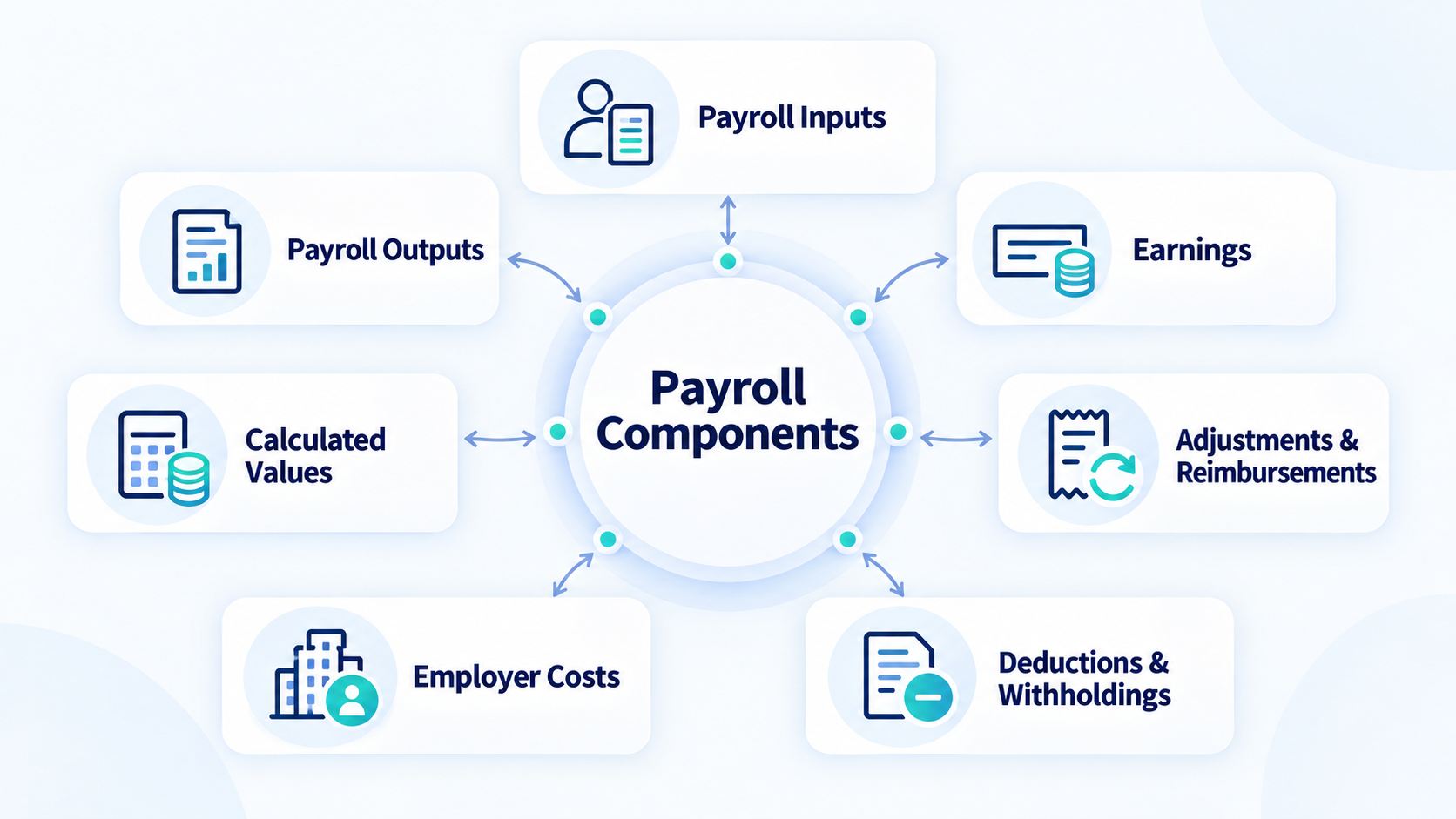
A useful way to understand them is to divide payroll into seven groups:
- Payroll inputs
- Earnings
- Adjustments and reimbursements
- Deductions and withholdings
- Employer costs
- Calculated values
- Payroll outputs
This structure separates what payroll starts with from what it calculates and what it produces.
The 7 Main Payroll Components
1. Payroll Inputs
Payroll begins with accurate employee information. These are the details the business needs before it can calculate pay.
Common inputs include an employee’s employment status, pay rate, tax details, bank details, work location, attendance, working hours, and leave records.
For example, a change in an employee’s salary or work location may affect the information used during payroll processing. Keeping these records current is therefore an important part of payroll preparation.
2. Earnings
Earnings are the amounts an employee receives for their work or under their compensation arrangement.
The most familiar component is basic or base salary. Depending on the employee and organization, earnings can also include regular pay, overtime pay, bonuses, commissions, incentive pay, allowances, shift differentials, paid-leave payouts, leave encashment, retroactive pay, severance pay, and profit-sharing.
Not every employee will have every type of earning. The important point is that payroll needs to identify which earnings apply during a particular pay period.
3. Adjustments and Reimbursements
Payroll may also include adjustments and reimbursements that don’t represent regular salary.
An expense reimbursement, for example, is generally money paid back to an employee for an eligible business expense. An allowance, by contrast, is a payment provided as part of an employee’s compensation arrangement.
These terms shouldn’t automatically be treated as interchangeable. The way an amount is handled can depend on the company’s policies and applicable rules.
Other adjustments can include retroactive pay or shift differentials. These become particularly important when employee circumstances change between payroll periods.
4. Deductions and Withholdings
Deductions and withholdings reduce the amount paid to an employee from their gross earnings.
Some deductions are mandatory. These can include income tax, Social Security and Medicare contributions, and court-ordered deductions such as garnishments.
Others are voluntary, such as health insurance and retirement contributions.
Payroll teams need to apply the deductions relevant to each employee rather than treating every paycheck the same.
5. Employer Costs
Not every payroll-related cost comes out of an employee’s paycheck.
Employer contributions can include the employer’s share of Social Security and Medicare, retirement matching, and workers’ compensation costs.
These amounts are important for understanding the organization’s total employment cost, even though they don’t necessarily reduce the employee’s net pay.
6. Calculated Values
Some payroll elements are results of the payroll calculation rather than inputs or earnings.
Gross pay is the employee’s earnings before applicable deductions and withholdings. Net pay is the amount remaining after those deductions and withholdings.
The basic relationship is:
Net pay = Gross pay − deductions and withholdings
Keeping calculated values separate from actual earnings makes the payroll structure easier to understand.
7. Payroll Outputs
The final group consists of the information and records produced by payroll.
These outputs can include payslips, payroll records, payroll reports, compliance filings, and audit trails.
Payroll therefore doesn’t end when employees receive their money. Businesses also need records that show how payroll was processed and support reporting and review requirements.
How Payroll Components Move Through the Payroll Process
The different payroll components come together through a recurring process.
1. Update employee records
Review employee information and record changes to pay rates, employment status, attendance, leave, or other relevant details.
2. Calculate gross pay
Calculate regular earnings and applicable additions such as overtime, bonuses, commissions, allowances, or other pay elements.
3. Apply deductions
Apply mandatory and voluntary deductions, including applicable taxes, contributions, insurance, retirement deductions, and garnishments.
4. Calculate net pay
Determine what remains after applicable deductions and withholdings.
5. Review and approve
Check payroll for unusual changes, incorrect calculations, missing updates, or other potential errors before approval.
6. Disburse pay
Once approved, employees receive their pay according to the organization’s payroll schedule.
7. Remit taxes and withholdings
Required taxes and withholdings are handled according to the applicable payroll requirements.
8. Complete record-keeping and reporting
Maintain payroll records and complete applicable reporting, such as W-2s, 1099s, and quarterly filings where relevant.
Basic Salary vs. Gross Pay
Basic salary is the regular base amount an employee is paid under their compensation arrangement.
Gross pay is broader. It can include basic salary or regular pay plus applicable overtime, bonuses, allowances, commissions, paid-leave payouts, and other earnings.
So, basic salary can be one component of gross pay, but gross pay can contain several components.
Gross Pay vs. Net Pay
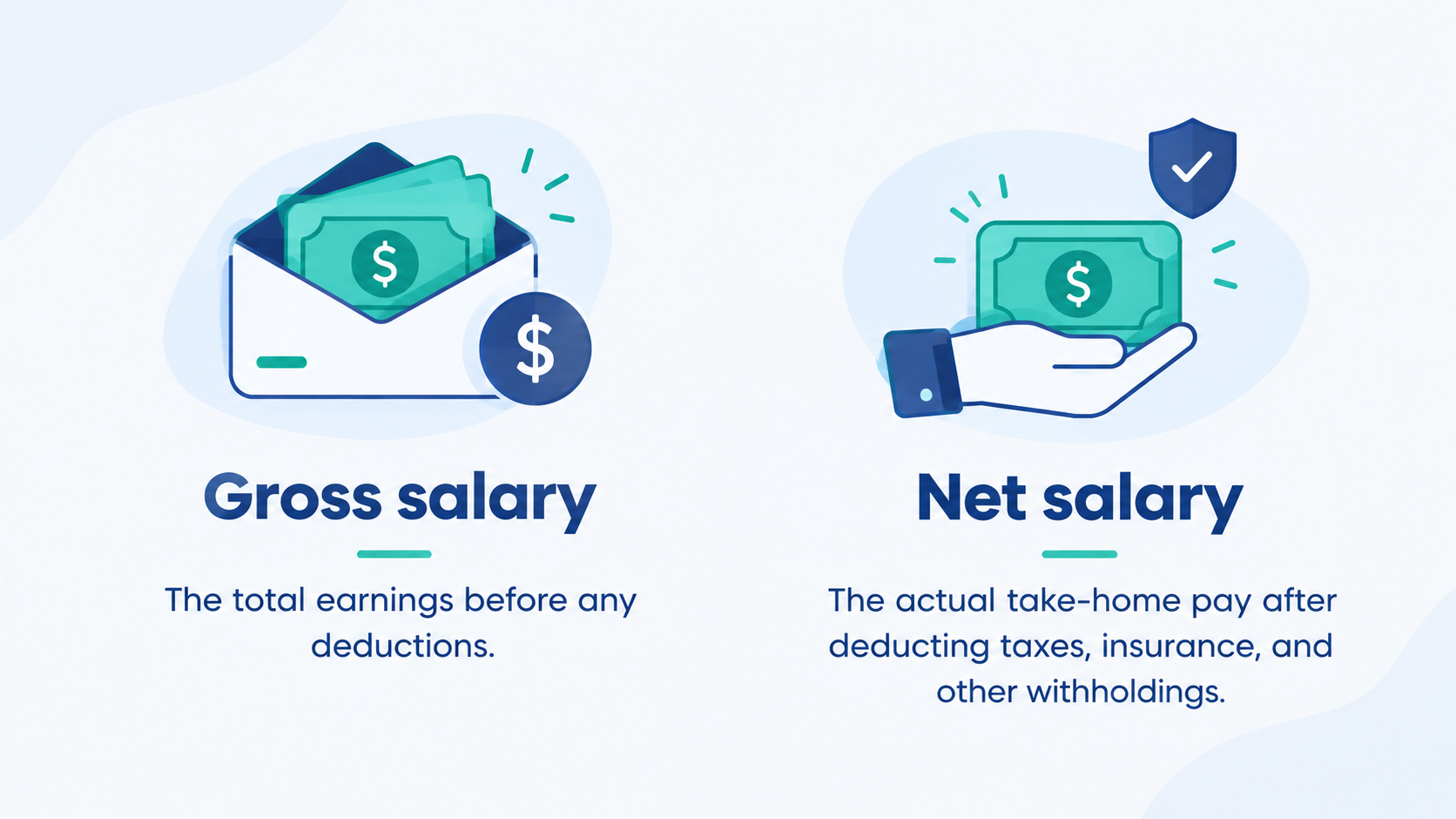
Gross pay is what an employee earns before applicable deductions and withholdings.
Net pay is what the employee actually receives after those amounts have been applied.
For example, if gross pay is $5,000 and applicable deductions and withholdings total $1,000, net pay is $4,000.
The distinction is simple, but it matters when employees compare their compensation with the amount deposited into their bank account.
Allowance vs. Reimbursement
An allowance and a reimbursement can both result in an employee receiving additional money, but they serve different purposes.
An allowance is generally provided as part of an employee’s compensation arrangement. A reimbursement is generally intended to repay an eligible expense incurred by the employee.
Businesses should therefore avoid treating every additional payment as the same payroll component.
Employee Deductions vs. Employer Contributions
Employee deductions are amounts taken from an employee’s earnings. Examples can include taxes, insurance contributions, retirement contributions, and garnishments.
Employer contributions are costs paid by the employer. Examples include employer Social Security and Medicare contributions, retirement matching, and workers’ compensation.
The distinction is important when calculating both employee take-home pay and the company’s overall employment costs.
Payroll Tax vs. Income Tax
Payroll taxes are generally associated with specific programs and can involve both employer and employee contributions.
Income tax is generally an employee tax that the employer withholds from wages and that supports general government funding.
Because the two can appear together during payroll processing, understanding the distinction helps HR and finance teams interpret payroll calculations more accurately.
What Is a Payroll Cycle?
A payroll cycle is the recurring period and process a business uses to collect payroll information, calculate earnings and deductions, approve payroll, pay employees, and complete related reporting.
Common pay period types include:
- Weekly: 52 pay periods per year
- Biweekly: 26 pay periods per year
- Semi-monthly: 24 pay periods per year
- Monthly: 12 pay periods per year
Biweekly payroll is the most common schedule in the U.S.
A payroll schedule should do more than identify payday. It can also establish important cutoffs, approval dates, and payment dates so employees and payroll teams know when information needs to be submitted.
How Payroll Components Change as a Business Grows
Payroll becomes more complicated as businesses add employees, compensation types, locations, and jurisdictions.
A growing company may introduce variable pay, such as commissions, incentives, and profit-sharing. Equity compensation can add stock options, RSUs, or ESPPs to the mix.
Businesses operating across multiple states or countries may also need to account for different tax jurisdictions. Other complexities can include court-ordered deductions, garnishment prioritization, retroactive adjustments, shift differentials, and 13th- or 14th-month pay.
At the end of the year, organizations may also need to handle true-ups, imputed income, and payroll audits.
How HR Software Can Improve Payroll Preparation
HR software can simplify payroll preparation by automating repetitive calculations, connecting time and attendance data, supporting compliance, and giving employees direct access to their payroll information. These capabilities reduce manual data entry and help HR teams prepare payroll more efficiently.
This is where an HR platform such as OryxBlue can support the process.
OryxBlue brings core HR processes into one centralized platform, helping businesses organize employee records, attendance, leave, requests, roles, access, and workforce information. Having these details in a more structured environment can give HR teams a cleaner source of workforce data to work with when preparing for payroll.
The goal isn’t necessarily to replace every payroll function. Instead, better-organized HR data can reduce unnecessary manual work and make it easier for HR teams to identify changes that may need attention before payroll is processed.
For growing businesses, this can mean fewer scattered spreadsheets, fewer manual handoffs, and better visibility into the employee information that supports each payroll cycle.
If payroll preparation is becoming harder to manage as your workforce grows, OryxBlue can help you create a cleaner, more connected HR workflow. Explore OryxBlue to see how centralized HR management can simplify the processes that support your payroll cycle.
Payroll Trends to Watch
Payroll technology is moving toward more connected and automated workflows, but businesses still need appropriate controls and human oversight.
AI and machine learning can be used for anomaly detection and predictive labor-cost forecasting. Continuous payroll is also emerging as an alternative to relying entirely on traditional payroll processing windows.
Other developments include Earned Wage Access (EWA), global payroll services, Employer of Record platforms for international hiring, employee self-service portals, and financial wellness integration.
Pay transparency requirements are also influencing how organizations think about compensation information and payroll-related processes.
The important trend isn’t simply automation. It’s better access to payroll and workforce information, fewer manual handoffs, and stronger visibility into potential issues.
Common Payroll Component Mistakes
Payroll errors often start with information rather than calculations.
Common problems include misclassifying employees and contractors, missing tax filing deadlines, calculating overtime incorrectly, and failing to update employee records after raises or other changes.
Businesses can also run into trouble when documentation is incomplete or state-specific requirements are overlooked.
A well-structured payroll process should therefore make it clear what information is required, which components apply to each employee, who reviews the results, and which records need to be maintained.
Why Payroll Components Matter
Payroll components are easier to manage when businesses understand how the pieces fit together.
Employee information provides the inputs. Earnings determine what employees receive before deductions. Deductions and employer contributions account for different sides of payroll costs. Gross and net pay show the results of the calculation, while payslips, reports, and records provide the documentation that follows.
For growing businesses, having organized HR data can make payroll preparation more manageable. The better those underlying processes are structured, the easier it becomes to keep payroll accurate, reviewable, and consistent from one payroll cycle to the next.
FAQ’s
What Else Do You Need to Run Payroll?
To run payroll, you need employee details, pay rates, hours worked, overtime, PTO, expense reimbursements, tax information, and applicable deductions. You also need accurate payroll records and knowledge of the tax and payment deadlines that apply to your employees.
What Are the Different Payroll Components?
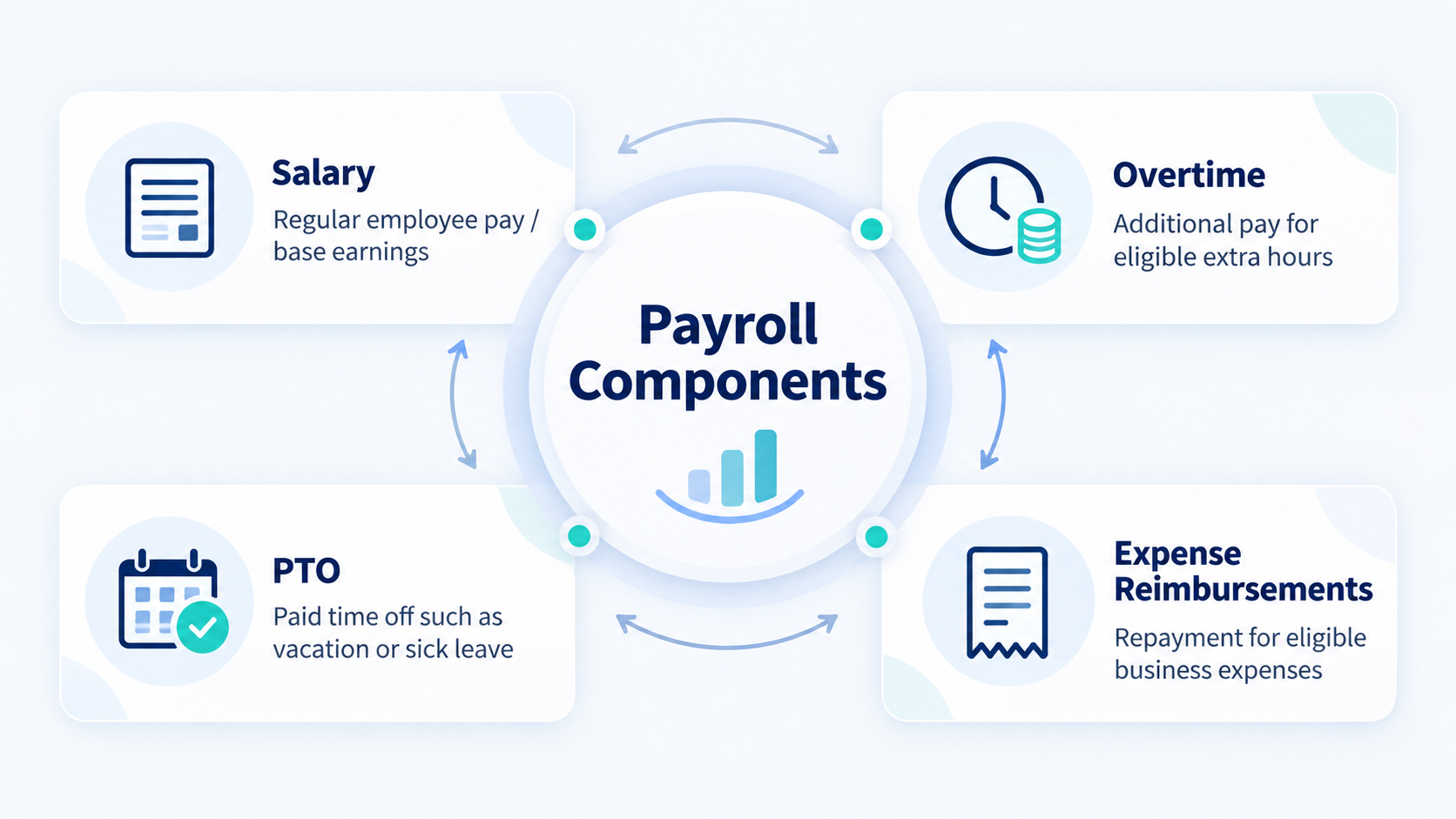
The key payroll components include salary, overtime, PTO, and expense reimbursements. Salary is an employee’s regular pay, overtime covers eligible additional hours worked, PTO covers approved paid time off, and expense reimbursements repay employees for eligible business expenses.
How Do You Calculate Payroll?
Payroll is calculated by determining an employee’s gross pay, including salary, eligible overtime, and other applicable earnings, then accounting for deductions and withholdings to determine net pay. Expense reimbursements may be added separately when employees are repaid for eligible business expenses.
Basic formula: Net Pay = Gross Pay − Taxes − Deductions
How Can OryxBlue Help With Payroll Processing?
OryxBlue helps businesses organize the employee and workforce information that supports payroll processing, including employee records, attendance, leave, and approvals. Keeping this information organized in one system can reduce manual work, improve data accuracy, and give HR and payroll teams better visibility before payroll is processed.
What Are Statutory vs. Voluntary Deductions?
Statutory deductions are required by law, while voluntary deductions are authorized by the employee. Statutory deductions may include applicable income taxes or social contributions, while voluntary deductions can include certain insurance premiums, retirement contributions, or employee-approved benefits.
Do Small Businesses Need Payroll Software?
Small businesses do not necessarily need payroll software, but it can simplify payroll as the business grows. Payroll software can automate calculations, organize employee data, reduce manual errors, and help businesses manage recurring payroll tasks more efficiently.
Final Thoughts
Payroll is more than calculating salaries and sending payments. Payroll components such as employee information, earnings, overtime, PTO, reimbursements, deductions, employer costs, and payroll records all need to work together for an accurate and consistent payroll process.
As a business grows, payroll can become harder to manage because of changing employee records, variable pay, multiple deductions, and additional compliance requirements. Keeping workforce information organized and establishing a clear payroll process can reduce manual work and make each payroll cycle easier to review.
An HR platform like OryxBlue can help businesses centralize the employee information, attendance, leave, requests, and approvals that support payroll preparation. With better-organized HR data and fewer manual handoffs, businesses can create a more reliable workflow around payroll while keeping their HR processes connected.