
Is it cheaper to outsource HR?
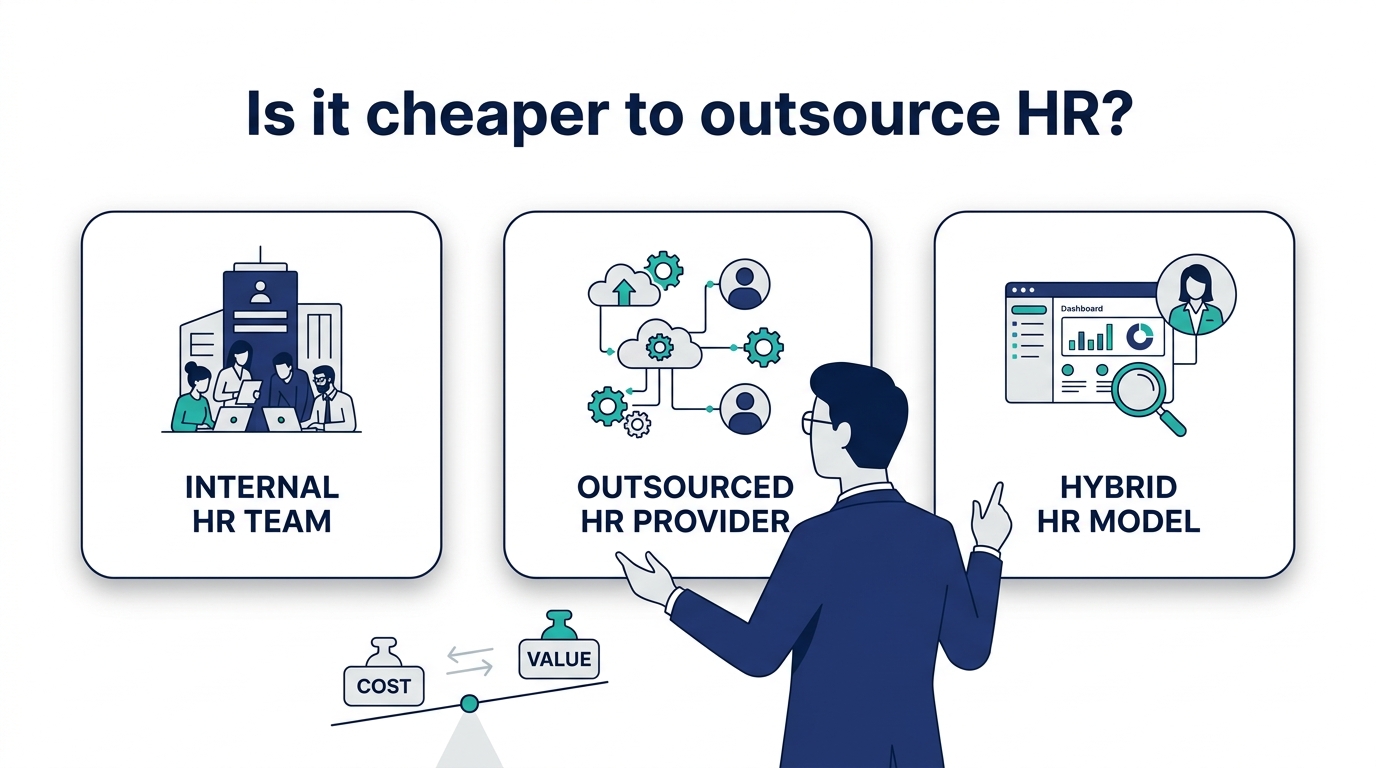
Outsourcing HR can cost less when your business needs limited or specialist support. It may cost more when fees, add-ons, and internal coordination grow.
Compare the same work, risk, and service level before deciding.
There is no useful universal average for every business. Headcount, scope, industry, workforce mix, and jurisdiction all change the answer.
Define the HR outsourcing model first
“HR outsourcing” can describe several different arrangements. A low quote may cover payroll only, while another covers broader HR administration.
Ask every provider to name its model and legal role. Labels also vary between countries, so the contract matters more than the label.
Common options include:
- HR consultant: Advice or project work billed under agreed terms.
- Fractional HR: Part-time HR support without a full internal role.
- Full-service HRO: A provider handles an agreed group of HR functions.
- ASO: A provider arrangement for defined administrative services.
- PEO: A model that commonly uses co-employment where legally available.
- Payroll provider: A service focused on payroll processing and related tasks.
- EOR: A separate model used for employment in supported locations.
- Software-only: Your team runs HR work using an HRIS or HRMS.
- Hybrid HR: Internal owners use software and selected outside specialists.
A Certified Professional Employer Organization, or CPEO, is a US federal designation. The IRS CPEO guidance explains that specific program.
Do not treat PEO, CPEO, HRO, ASO, EOR, and payroll-only services as substitutes. Their responsibilities, prices, and country coverage can differ.
Your first task is simple: write the exact HR work you need. Then ask providers to price that same scope.
Compare total cost, not the advertised fee
The lowest monthly price may exclude setup, software, reports, or corrections. A fair comparison uses total cost of ownership, or TCO.
Use these formulas without adding unsupported assumptions:
Annual in-house TCO = loaded pay + tools + recruitment + training + overhead + outside advisers
Annual outsourced TCO = recurring fees + setup + add-ons + internal coordination + exit costs
Annual hybrid TCO = internal owner cost + software + specialist support + transition costs
Loaded pay includes salary plus employer costs and benefits. Those costs vary by location and should use current official data.
Per employee per month, or PEPM, helps normalize different quotes. Divide annual outsourced cost by average covered employees, then divide by twelve.
Percentage-of-payroll pricing changes when total wages change. Fixed retainers may also carry headcount limits, minimums, or excluded work.
Break-even happens when comparable annual costs become equal. The comparison is useful only when both sides cover the same duties.
Copy this total-cost worksheet
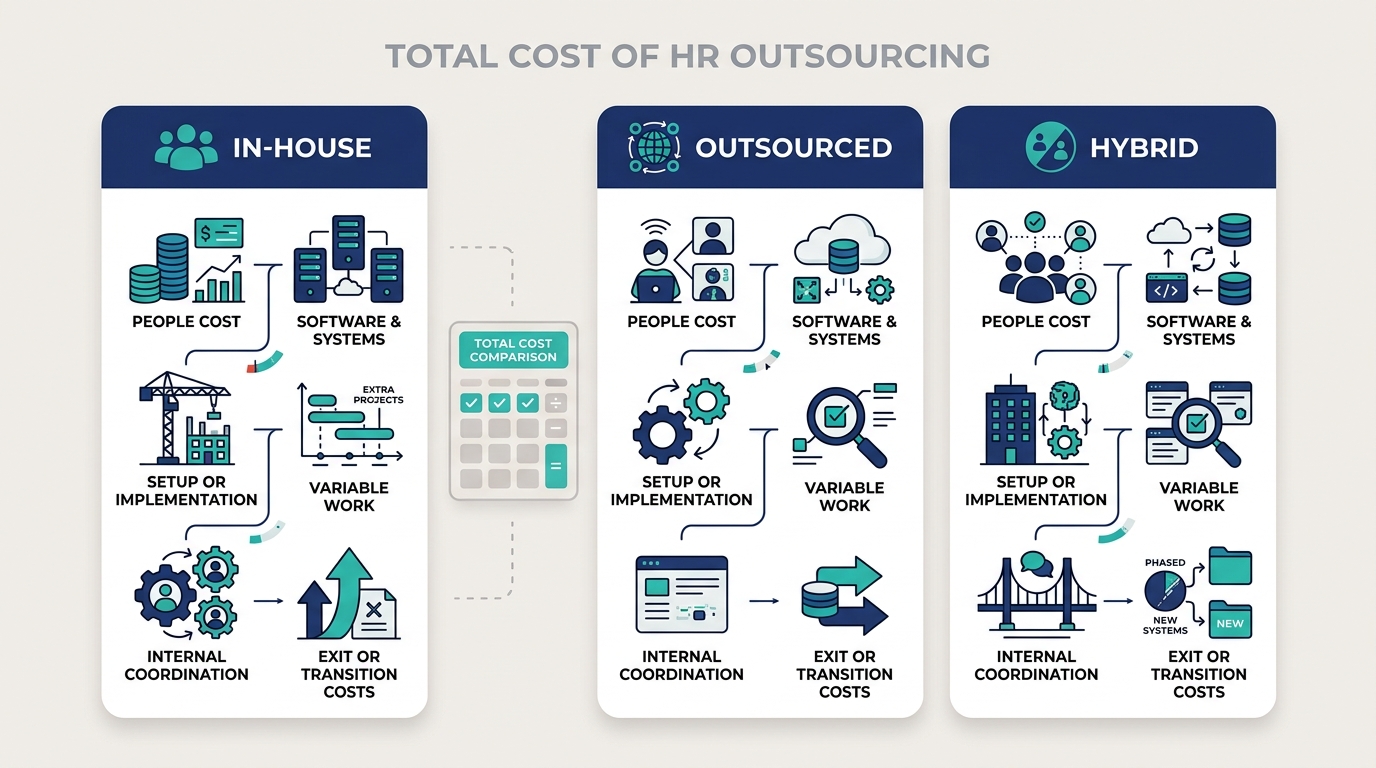
rency, headcount, scope, and quote date first. Then complete every row with sourced or quoted amounts.
| Cost or control item | In-house option | Outsourced or hybrid option |
| Recurring people cost | Salary, employer costs, and benefits | Retainer, PEPM, hourly, or payroll-based fee |
| Systems | HRIS, payroll, recruitment, and reporting tools | Included software plus excluded licenses |
| Start and change costs | Hiring, training, and process setup | Implementation, migration, and configuration |
| Variable work | Adviser fees and temporary support | Add-ons, corrections, reports, and extra locations |
| Internal time | Manager supervision and administration | Provider coordination, approvals, and issue handling |
| Exit cost | Recruitment and knowledge transfer | Termination fees, data export, and transition support |
| Control and risk | Internal expertise and backup gaps | SLA, escalation, dependency, and data access |
Add notes beside every blank or estimate. Never hide unknowns inside a single monthly total.
When outsourcing HR may cost less
Outsourcing often deserves consideration when the workload cannot support a full internal role. It can also provide specialist help for defined, occasional needs.
The comparison may favor outsourcing under these conditions:
- The required scope is narrow and predictable.
- Internal HR work is limited or irregular.
- The provider already supports your locations and worker types.
- Your managers can supply clean inputs and timely approvals.
- The contract includes the reports and support you need.
- Your business lacks specialist knowledge for a defined task.
- You can retain a capable internal provider owner.
These conditions simplify the comparison, but they do not guarantee savings.
Write a one-page scope before requesting quotes. List each task, owner, frequency, location, and required response time.
When outsourcing can become more expensive
Outsourcing can lose its cost advantage when the work changes often. Frequent exceptions can turn a simple fee into many added charges.
Watch for these warning signs:
- Minimum monthly charges exceed your real usage.
- Implementation and migration sit outside the headline price.
- Payroll corrections or custom reports cost extra.
- New locations, worker types, or benefit plans trigger add-ons.
- Managers spend heavy time preparing inputs and chasing answers.
- You keep duplicate software after buying the service.
- Contract changes require long notice periods or added fees.
- Complete data export and exit support are not included.
Outsourcing may also be the wrong fit when HR work shapes daily management. Sensitive employee issues still need informed internal judgment and accountable leadership.
Cost should not hide weak control because a cheaper service may still fail your needs.
Ask for a sample invoice with all likely additions. Also request the termination process before signing.
Keep employer decisions and accountability inside
A provider can perform agreed tasks, but your business retains important responsibilities. Exact legal responsibility depends on the arrangement and jurisdiction.
Keep a named internal owner for these areas:
- Provider instructions and approvals
- Hiring and workforce decisions
- Employee relations and sensitive conversations
- Workplace culture and manager behavior
- Policy choices and fair application
- Final review of payroll or HR records
- Data access, ownership, and portability
- Complaints, escalation, and contract performance
External advice can support those decisions without replacing leadership ownership or local legal review.
Set a service-level agreement, or SLA, for measurable service commitments. Include response times, correction handling, escalation contacts, and reporting expectations.
Review the data-processing agreement for access, storage, subprocessors, retention, return, and deletion duties.
Finish with a map marking each task as internal, provider-owned, shared, or software-supported.
Decide whether partial outsourcing is enough
Full outsourcing is only one option because many small businesses need a hybrid model instead.
Your internal owner might manage employee records, approvals, and manager questions. An external specialist might handle payroll, local filings, or complex employee matters.
Software can support repeatable records, requests, reminders, and approvals. It does not replace professional HR, payroll, tax, or legal advice.
Consider partial outsourcing when:
- Some tasks are steady and easy to document.
- Other tasks require occasional specialist judgment.
- Your team wants direct control over employee experience.
- You need outside coverage during growth or absence.
- A full-service contract includes work you do not need.
The HR management for small business guide can help define internal ownership. Use it before selecting an external provider.
The HR automation guide explains which repeatable workflows may suit rules, while sensitive decisions need human review.
Normalize every HR outsourcing quote
Different pricing models can make two quotes look impossible to compare. Convert each offer into one annual view.
Step 1: Fix the comparison scenario
Use the same headcount, countries, worker types, services, response needs, currency, and quote date.
Step 2: Separate recurring and one-off fees
List retainers, PEPM charges, payroll percentages, hourly work, and software costs. Add setup, migration, training, and implementation separately.
Step 3: Price likely exceptions
Ask whether corrections, custom reports, extra locations, benefits work, and urgent requests are included.
Step 4: Add internal coordination time
Someone must gather inputs, approve decisions, review outputs, and manage escalations. Include that person’s time in every model.
Step 5: Review contract and exit costs
Check minimum terms, renewal, termination fees, and transition support. Confirm the format and timing of complete data exports.
Step 6: Compare control and employee impact
Score response time, knowledge continuity, data access, employee experience, and escalation. Cost alone does not show service fit.
Step 7: Test the break-even point
Change one assumption at a time, such as headcount or service scope. Note when another operating model becomes more economical.
Use current government data for in-house employment costs. For US examples, the research identified BLS HR manager pay and BLS employer compensation.
Those sources describe the United States only. Use equivalent official sources for every other country.
Compare HR software with outsourcing honestly
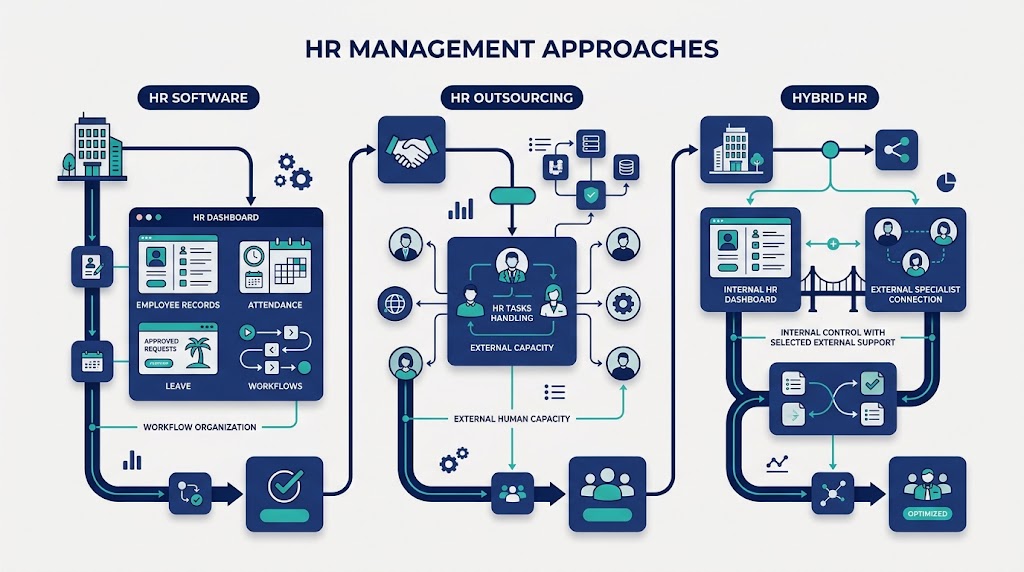
HR software and HR outsourcing solve different problems. Software organizes workflows, while a provider supplies agreed services and human capacity.
OryxBlue is positioned as HR software for startups and small businesses. Its indexed scope includes employee records, attendance, leave, onboarding, recruitment, and payroll-related work.
That positioning does not prove human compliance advice or statutory payroll services. Confirm current capabilities in the product documentation before making a cost comparison.
A software-only model may suit teams with internal knowledge and clear processes. Outsourcing may suit teams needing external capacity or specialist help.
A hybrid may fit between them, so compare all three models with the same total-cost worksheet.
Questions to ask an HR outsourcing provider
Use these questions during each sales call:
- Which exact tasks and countries does this quote cover?
- Which tasks remain the employer’s responsibility?
- What pricing model applies, and what are the minimums?
- Which setup, migration, software, and training fees apply?
- What work creates an extra charge?
- Who handles urgent employee or payroll issues?
- What response and correction times appear in the SLA?
- How can we export our complete data?
- What happens when we end the contract?
- Which qualified professionals review country-specific work?
Ask the provider to answer in writing. Attach those answers to the final comparison.
FAQs
Is outsourcing HR cheaper than hiring an HR manager?
It can be cheaper when your scope is limited or irregular. Compare loaded employment costs with the provider’s complete annual cost.
How much does it cost to outsource HR?
There is no reliable universal price for every business. Cost changes with headcount, scope, model, industry, workforce mix, and jurisdiction.
What are the hidden costs of HR outsourcing?
Hidden costs may include implementation, minimums, corrections, custom reports, software, coordination, migration, termination, and exit support. Request each item in writing.
Should a small business outsource HR entirely?
Not always, since a hybrid keeps decisions inside while external specialists handle defined tasks.
Is HR software a replacement for outsourcing?
Software can manage repeatable records and workflows. It cannot replace every specialist, legal, payroll, or employee-relations need.
Conclusion
HR outsourcing is cheaper only when the comparison uses equal scope and risk. Include internal time, added fees, contract terms, and exit costs.
Complete the worksheet before requesting final quotes. Then compare OryxBlue as one software or hybrid option, not a universal replacement.