
HR in manufacturing: a practical workforce management guide

HR in manufacturing connects people systems with daily plant work. It covers staffing, skills, shifts, time, employee relations, and workforce records.
Effective HR for factories helps leaders place qualified workers where production needs them. It also gives employees clear expectations and reporting routes.
Plant workforce decisions rarely belong to one department. HR, operations, safety, quality, payroll, and supervisors must understand their shared responsibilities.
Use this guide to review those responsibilities and find weak handoffs. It focuses on practical controls for small and mid-sized manufacturers.
Important: This guide provides general US workforce administration information, not legal advice. Federal, state, local, contract, and collective bargaining requirements can differ.
Confirm current obligations with qualified advisers and official agencies. Source review date: September 2, 2026.
What HR in manufacturing means
HR in manufacturing manages people processes within production facilities and related operations. It adapts human resource management principles to plant conditions.
Plant HR connects planned work with people who can perform it. That connection depends on accurate roles, skills, schedules, time, and employment data.
The function usually spans the complete employment journey. Responsibilities begin before hiring and continue through role changes, leave, and separation.
Common responsibilities include:
- Planning workforce needs by site, shift, role, and skill
- Recruiting workers for plant conditions and schedules
- Coordinating onboarding and required records
- Tracking job assignments, training, qualifications, and role changes
- Supporting attendance, leave, timekeeping, and payroll handoffs
- Helping employees and supervisors resolve workplace questions
- Supporting safety communication and worker participation
- Maintaining accurate, controlled workforce records
- Reviewing workforce trends and recurring exceptions
- Coordinating offboarding and final record updates
A simple control loop keeps these activities connected:
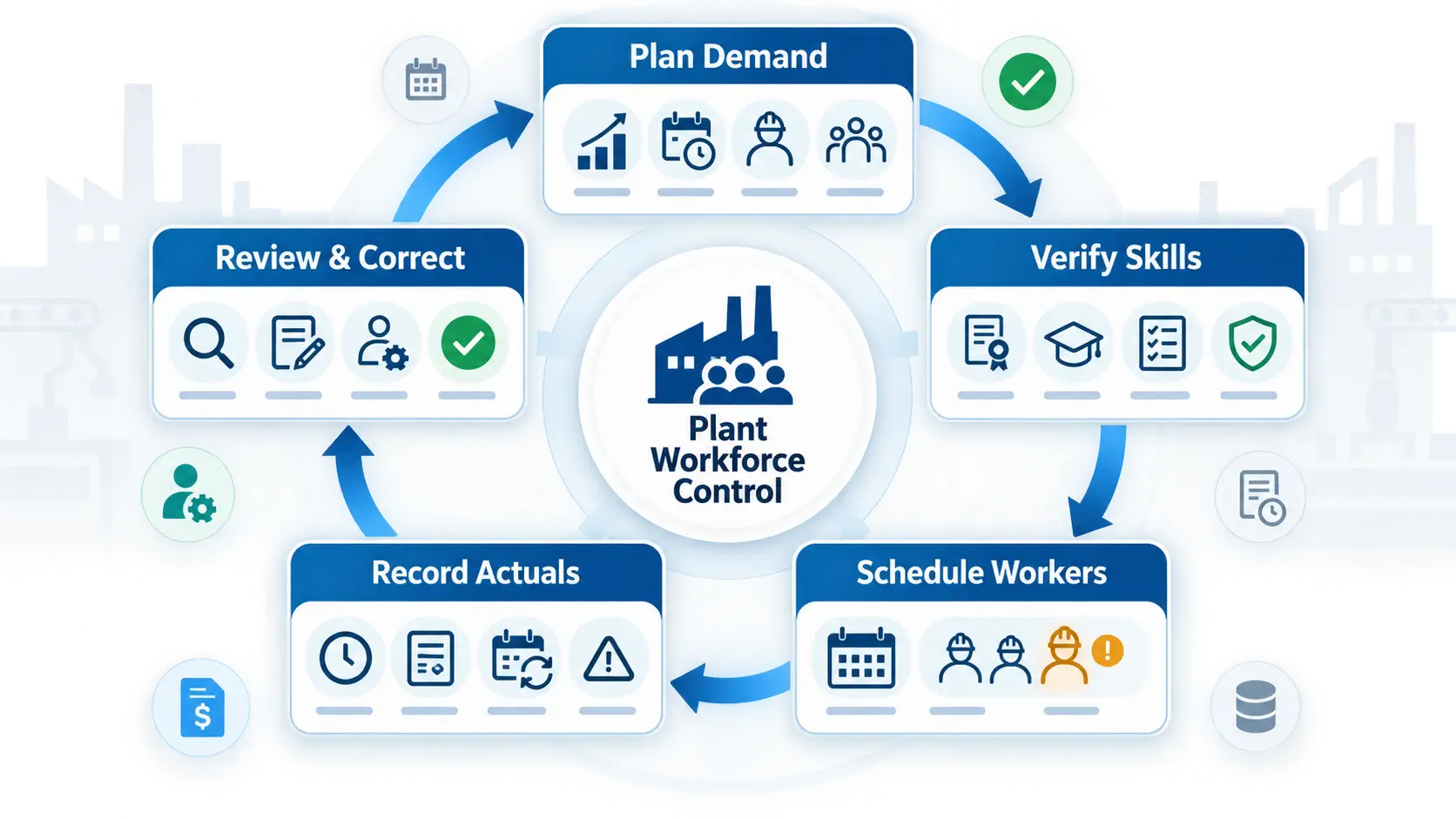
- Plan the workers and skills that production requires.
- Confirm each worker’s qualifications for the assigned job.
- Schedule qualified workers for the required shift.
- Record actual attendance, time, changes, and exceptions.
- Review problems and correct the related process or record.
Each checkpoint needs a named owner, reliable inputs, and a review time. A weak handoff can create coverage, payroll, or training problems.
Good plant HR does not remove every disruption. It gives the plant a consistent way to identify and address disruptions.
Why manufacturing human resources differs from office HR
Manufacturing human resources operates around production schedules, physical work, and job-specific qualifications. Office processes often fail when they ignore plant conditions.
Production schedules shape workforce decisions
Staffing must match required output, shift coverage, maintenance plans, and known absences. A vacancy can affect several connected teams.
Plant HR therefore needs current demand from operations. It also needs enough notice to recruit, train, or move qualified workers.
Skills affect who can cover a job
An available employee may not be ready for every assignment. The worker may need training, assessment, supervision, or formal authorization.
Coverage plans must identify both headcount and qualified headcount. Supervisors should see missing qualifications before making assignments.
Hourly work creates more time-record dependencies
Many plant roles use hourly pay, shift differentials, bonuses, or production-based pay. Small recording gaps can affect several payroll inputs.
Schedules show planned work, while time records show what happened. HR and payroll need a clear correction path.
Safety coordination is part of daily work
Plant work may involve machinery, chemicals, vehicles, heat, noise, or other hazards. HR supports safety work through communication and records.
Operations and EHS teams handle their assigned safety duties. Ownership should match plant structure and current requirements.
Supervisors shape the employee experience
Supervisors explain work, record attendance, observe performance, and answer questions. Inconsistent practices can create uneven treatment and unreliable records.
Manufacturing HR practices should include supervisor training and routine checks. Supervisors also need clear escalation routes for unusual cases.
Communication must work on the plant floor
Employees may have limited computer access during a shift. Some employees may need another language or an accessible format.
A process fails if workers cannot understand or use it. Communication should fit the work area, shift, language, and available device.
How plant teams divide workforce ownership
Shared ownership does not mean unclear ownership. Every recurring task needs one responsible role, required inputs, and an escalation route.
This model supports Strategic Human Resource Management by connecting people decisions with plant goals.
Plant HR
Plant HR usually coordinates employment records, hiring, onboarding, leave, policies, and employee relations. It may also coordinate time or training data.
HR should not assume ownership of every plant decision. It should document where its role begins and ends.
Operations
Operations defines needed output, staffing demand, work priorities, and job requirements. It should share changes that affect workforce needs.
Operations also confirms whether proposed coverage supports the work. It should identify changes that require new skills or training.
Supervisors
Supervisors manage daily assignments and observe actual conditions. They record call-offs, late arrivals, time exceptions, and performance facts.
They should escalate issues through defined routes. They should not improvise policy answers when specialist review is required.
Environment, health, and safety
EHS teams guide assigned safety programs and hazard controls. They may also coordinate incident response, training requirements, and worker participation.
HR supports related records and employee processes. Each plant should document the exact division.
Quality
Quality teams define competence needs for tasks affecting product requirements. They also flag process changes needing new training or verification.
HR can support records, while qualified staff assess task performance. The assigned owner should record each qualification decision.
Payroll
Payroll converts approved workforce inputs into pay under the organization’s process. It needs complete time, pay codes, differentials, bonuses, and leave records.
HR and supervisors should meet each submission deadline. Qualified advisers should review uncertain pay requirements.
Plant leadership
Plant leaders set priorities, assign resources, and resolve ownership conflicts. They should review recurring exceptions instead of accepting them as normal.
Build the ownership map around these questions:
- Who defines the staffing requirement?
- Who approves the job or shift change?
- Who verifies the worker’s qualification?
- Who records actual time and attendance?
- Who reviews a correction?
- Who communicates the decision to the employee?
- Who confirms that the record was updated?
- Who receives an unresolved issue?
Review this map after process, system, policy, or leadership changes. Update it when actual work no longer matches the written process.
Workforce planning for production demand
Start workforce planning with required work, not last month’s headcount. Human Resource Planning turns business demand into workforce requirements.
Manufacturing adds site, line, shift, and qualification needs. Each factor affects whether planned headcount can perform the work.
Plan by role and qualification
List each site, line, shift, role, and required qualification. Then record the qualified workers needed for planned work.
Keep role requirements separate from employee preferences. Both matter, but they answer different questions.
Identify roles that depend on one worker. Also flag positions with long hiring, training, or certification lead times.
Test coverage against real availability
Scheduled headcount can hide unavailable or unqualified coverage. Check leave, restrictions, vacancies, training status, and shift availability.
Identify backup workers for high-dependency roles. Confirm that those workers remain qualified and available.
Review employees scheduled across competing assignments. The same worker cannot cover two jobs during the same period.
Review overtime as a staffing signal
Repeated overtime may signal vacancies, weak cross-training, demand changes, or scheduling problems. It may also reflect a planned short-term need.
Review the cause before choosing a response. Do not treat overtime as a complete workforce strategy.
Include fatigue concerns, employee availability, pay inputs, and training needs. Assign an owner when the same cause keeps returning.
Hold a weekly workforce review
A weekly review should compare demand, skills, absences, vacancies, and planned training. Operations should bring production changes.
HR should bring staffing and absence information. Supervisors should confirm actual coverage and known risks.
Ask these questions:
- Which shifts lack the required headcount?
- Which shifts lack qualified coverage?
- Which roles depend on one employee?
- Which qualifications will expire soon?
- Which absences or vacancies require a coverage plan?
- Where is overtime increasing?
- Which workers await training or assessment?
- Which changes need approval before scheduling?
Record decisions, owners, and due dates. Recheck unresolved items before the next schedule is released.
Job roles, skills, and qualification records
A job title does not prove that an employee can perform every assigned operation. Plant leaders need current, task-level qualification records.
Keep these workforce states separate:
- Training assigned
- Training completed
- Competence assessed
- Qualification approved
- Work authorization granted
- Refresher or reassessment due
Each record should identify the relevant skill, equipment, process, or production area. It should also name the trainer or assessor.
Include the assessment date, result, effective date, and expiration date. Record restrictions when an employee has limited authorization.
An employee may understand a process without authorization to perform it alone. Another worker may need supervised practice before assessment.
Update qualification records after transfers, promotions, equipment changes, or expired credentials. Preserve the earlier record instead of overwriting its history.
Supervisors need a quick way to confirm who can perform each task. They also need visibility into pending and expired qualifications.
The skills matrix should reflect current plant conditions. Review it when roles, machinery, instructions, or production methods change.
Headcount alone cannot confirm workforce readiness. A fully staffed shift may still lack qualified coverage.
Recruiting employees for manufacturing work
Recruiting plant employees starts with a truthful description of the work. Candidates need enough detail to judge the role and shift.
Managers need consistent evidence to judge each candidate. The process should match the job’s actual requirements.
Write job posts that match plant conditions
State the location, shift, schedule, pay basis, reporting line, and main duties. Describe required skills and physical duties accurately.
Separate required qualifications from skills that can be learned after hiring. This widens consideration without lowering job requirements.
Avoid broad phrases that hide the real work. Candidates should understand the role before entering the selection process.
Give candidates a realistic job preview
Show candidates the actual schedule, work area, pace, and attendance expectations. Explain required clothing, protective equipment, and entry procedures.
Do not hide difficult conditions or promise conditions the plant cannot maintain. A realistic preview supports an informed decision.
Use current information from supervisors and operations. Update the preview when equipment, schedules, or duties change.
Use consistent selection criteria
Create the same core criteria for applicants seeking the same role. Ask job-related questions and record evidence against those criteria.
Provide a clear route for accommodation requests. Use qualified guidance when hiring rules are uncertain.
Avoid informal shortcuts during urgent hiring. Fast decisions still need approved criteria and complete records.
Review youth-employment rules before assigning any minor to plant work. Federal law generally restricts manufacturing work and certain hazardous occupations.
The Department of Labor child-labor guide explains the federal baseline. State rules may be stricter.
Before extending an offer or assignment, confirm:
- The job and shift are approved
- The pay basis and approvals are recorded
- Required skills and licenses are defined
- Interview evidence supports the decision
- Any required reviews are complete
- The start date works for plant onboarding
- The supervisor knows the expected arrival
- The candidate received accurate job information
Manufacturing onboarding before independent work begins
Manufacturing onboarding should prepare a new employee for the site, shift, role, and reporting process. It should extend beyond general paperwork.
This stage connects hiring with the wider Employee Lifecycle. It also creates records that later processes will use.
Build day-zero readiness
Confirm the employee record, job, supervisor, site, shift, and start time before arrival. Prepare required access, equipment, and orientation materials.
Tell the supervisor what must happen during the first shift. Give the employee one contact for unanswered questions.
Check that required trainers or reviewers will be available. Reschedule restricted work if the right support is unavailable.
Separate orientation, training, assessment, and authorization
Orientation explains the site and its rules. Training teaches a task.
Assessment checks whether the worker can perform that task. Authorization records approval for independent work when required.
Do not use one completion checkbox for all four steps. Requirements depend on the role, equipment, policy, and current rules.
Record the trainer, assessor, date, result, and next review. Preserve any restrictions or supervision requirements.
Give supervisors an onboarding role
Supervisors turn onboarding instructions into daily work. They should confirm assignments, demonstrate expectations, observe practice, and record questions.
They should know which tasks still require supervision. HR should verify that promised check-ins occurred.
Give supervisors a short checklist for each new starter. Include attendance, timekeeping, work instructions, reporting routes, and open training items.
Check understanding after the first shift
Ask the employee to explain key instructions in their own words. Confirm timekeeping, break, attendance, reporting, and emergency procedures.
Record missing access, equipment, training, or schedule information. Assign each issue to an owner and due date.
A signed form does not prove full understanding. Follow-up questions can reveal unclear instructions or missing support.
Review progress during the first month
Review attendance, task progress, questions, supervisor feedback, and required records. Correct missing handoffs before they affect independent work.
Confirm the current role, shift, qualifications, and support needs. Record any agreed actions and review dates.
Before independent work continues, confirm:
- The employee and job records are accurate
- The assigned supervisor is recorded
- Site and shift information is correct
- Required orientation is complete
- Required task training is complete
- Competence checks are recorded
- Required authorizations are current
- Timekeeping access works
- Reporting routes are understood
- Missing items have owners and due dates
Shift scheduling and attendance
Manufacturing schedules must connect production demand with employee availability and required skills. Every assignment should identify the site, shift, role, and supervisor.
Keep the planned schedule separate from actual time worked. A schedule shows intent, while the time record shows what occurred.
Overtime approval is another separate record. Managers should not change recorded hours because work lacked prior approval.
Track schedule changes, shift swaps, call-offs, late arrivals, and early departures. Record when each change occurred and who approved it.
Clear rules help supervisors handle exceptions consistently. Employees should also know how to report an absence or request a change.
Attendance records should capture facts before assigning a policy category. Supervisors can record the occurrence without making leave determinations.
HR can then review approved leave, accommodations, policy exceptions, or other requirements. Complete this review before disciplinary action.
Night and weekend workers need equal access to attendance procedures. They also need timely help when supervisors cannot resolve an issue.
Communication should match workforce language and accessibility needs. Posting a policy does not confirm that employees understand it.
Timekeeping exceptions need a defined correction process. Common examples include missed punches, duplicate entries, and unrecorded shift changes.
Corrections should preserve the original entry, revised value, reason, date, and approver. This history helps resolve payroll questions.
Consider a simple call-out scenario. A supervisor moves another employee to cover an absent machine operator.
Before reassignment, confirm availability, qualification, authorization, and schedule impact. The final time record must reflect the work performed.
This process supports continuity without treating every available employee as qualified coverage.
Timekeeping, overtime, and payroll inputs
A production schedule shows planned coverage, not the hours employees actually worked. Manufacturers therefore need a reliable path from clock events to payroll.
That path should identify and resolve exceptions before payroll closes.
The Department of Labor manufacturing fact sheet describes broad FLSA coverage within manufacturing. Coverage and exemption decisions still depend on the facts.
Covered nonexempt employees generally earn federal overtime after 40 hours in one workweek. The workweek is a fixed, recurring 168-hour period.
Hours cannot be averaged across workweeks to reduce overtime. Payroll frequency does not change this test, according to federal overtime guidance.
Plant records should capture work performed outside scheduled shift times. Examples include required machine setup, cleaning, tool installation, and shift instructions.
On-duty waiting for repairs may also count when employees cannot use the time freely. Hours-worked guidance explains these fact-specific rules.
Meal periods are generally unpaid only when employees are fully relieved of duties. Supervisors should not interrupt unpaid meals with production requests.
Required or job-related training will often count as working time. Training may be excluded only when all four federal criteria are met.
Those criteria are:
- The training occurs outside normal working hours
- Attendance is truly voluntary
- The training is not directly job-related
- The employee performs no productive work
The Department of Labor Hours Worked Advisor gives further guidance. Review pay treatment before scheduling mandatory training outside a shift.
Payroll teams should review all earnings affecting the regular rate. Production bonuses, attendance bonuses, and shift differentials may change overtime calculations.
Piece-rate or incentive pay does not remove overtime duties. Specific calculations depend on payment terms and applicable exclusions.
The federal regular-rate guidance explains general calculation rules. Complex plans need qualified payroll and legal review.
The Apparel Piece-Rate Overtime guide covers production pay calculations in more detail.
Maintain a clear correction process for missed punches and incorrect job codes. Employees should report errors without losing recorded work time.
Supervisors can review exceptions, but they should not remove actual hours. Payroll should retain the reason, approver, date, and original entry.
Federal records commonly include:
- The employee’s pay basis and applicable rates
- The established workweek start
- Daily and weekly hours worked
- Straight-time and overtime earnings
- Additions and deductions
- Total wages paid each pay period
- Supporting timecards and calculation records
See the federal recordkeeping guide for details. State rules may require more information or longer retention.
Compliance note: Federal rules provide a baseline. State, local, contract, and collective bargaining requirements may provide additional protections.
Safety coordination and worker participation
HR often manages training records, reporting channels, and workforce communications. Operations and safety specialists usually control hazards and work methods.
Ownership should be documented for each site and shift. Employees should know who addresses hazards and approves safe restarts.
OSHA recommends meaningful worker participation throughout a safety program. Participation should include permanent, temporary, contractor, and subcontractor workers.
Invite workers to report hazards, injuries, illnesses, and near misses. Provide routes that work across languages, literacy levels, and shifts.
An anonymous option can reduce fear where practical. Managers should respond promptly and explain what action followed each report.
Workers can also contribute to:
- Job hazard reviews
- Site inspections
- Incident investigations
- Work procedure updates
- Training design
- Program evaluations
- Hazard control discussions
OSHA’s recommended practices are guidance. Separate standards and statutes may create enforceable duties.
Under OSHA’s injury reporting rule, covered procedures must be reasonable. They must not deter accurate injury or illness reporting.
Section 11(c) also prohibits retaliation for exercising protected safety rights. These rights include raising concerns and reporting work-related injuries.
OSHA generally gives workers 30 days to file a Section 11(c) complaint. The agency explains rights on its worker protections page.
Avoid automatic discipline based only on injury reporting. Review attendance points, bonuses, and testing rules for deterrent effects.
A signed training sheet confirms attendance, not competence. Verify understanding through observation, demonstrations, or qualified assessments.
Track training dates, topics, instructors, language, and required renewals. Keep these records connected to the employee’s current assignment.
HR should escalate reported hazards to the responsible safety or operations leader. HR should not independently declare equipment safe.
Safety note: Duties depend on hazards, standards, jurisdiction, and OSHA State Plan rules. Confirm requirements with qualified safety and legal advisers.
Training and cross-training
Manufacturing training should prepare employees for specific tasks and working conditions. Course completion alone does not prove practical competence.
The training record should identify the instruction version used. This matters when work procedures or equipment settings change.
Assessors should use consistent, job-related criteria. Informal approval based only on familiarity can produce uneven results.
Cross-training can improve coverage during absences, demand changes, and transfers. However, assigned cross-training is not completed cross-training.
Managers should review cross-training by shift and production area. Plantwide totals can hide a serious gap on one line.
Refresher training may follow process changes, extended inactivity, incidents, or observed performance concerns. Document the applicable trigger.
Training records need clear ownership. HR may maintain them, while operations, quality, or EHS confirms relevant competence.
Do not reward completion counts without checking learning quality. Rushed sign-offs can make reports appear stronger than actual readiness.
Performance, quality, and corrective action
Manufacturing performance reviews should consider more than completed units. Output alone can hide quality, safety, equipment, or process problems.
Review these dimensions separately:
- Production output
- Work quality
- Standard-work adherence
- Attendance and reliability
- Safety behavior
- Teamwork and communication
- Skill development
Managers should review operating context before evaluating an employee. Relevant factors include downtime, changeovers, material shortages, rework, and quality holds.
Compare employees performing similar work under similar conditions. A plantwide ranking may combine roles with different requirements.
Supervisors should document specific observations near the event. Vague comments are harder to assess and discuss fairly.
Keep production data separate from the final performance judgment. A qualified reviewer should consider context before reaching a decision.
Quality problems may result from training, materials, equipment, instructions, or supervision. They should not automatically become individual performance findings.
Coaching should identify the expected behavior, observed gap, required support, and review date. Employees should understand what improvement looks like.
Supervisors also need calibration. Similar conduct should receive similar review across lines, departments, and shifts.
Automated scores should not make disciplinary or employment decisions. Human review is needed for context, accuracy, and consistency.
Employee relations on the plant floor
Factory employees need practical ways to raise concerns across every shift. A daytime office process may exclude night and weekend workers.
Provide a reporting option outside the direct supervisor. This matters when the concern involves that supervisor or local management.
Reporting channels should reflect language and accessibility needs. Employees also need clear instructions for urgent and nonurgent concerns.
Document the issue, date, people involved, available evidence, and requested response. Separate reported facts from assumptions and conclusions.
Use a consistent review process for similar concerns. Consistency does not require identical outcomes when the facts differ.
Limit case information to people with a valid business need. Workforce records should not expose sensitive details to general supervisors.
Employees should understand that policy prohibits retaliation. They also need a route for reporting suspected retaliation.
Managers need guidance on appropriate conduct during and after a review.
Unionized facilities must also consider applicable collective bargaining terms. Grievance, representation, scheduling, and discipline procedures may affect the process.
Complaint volume needs careful interpretation. More reports may reflect stronger trust or easier access, rather than worsening conditions.
Look for repeated concerns by shift, department, supervisor, or process. Patterns can reveal training, communication, workload, or policy problems.
Close each case with documented findings, actions, ownership, and follow-up dates. Give the employee an appropriate outcome message when possible.
Early, respectful responses can prevent small issues from becoming larger workforce disruptions.
Leave, accommodations, and return-to-work coordination
Leave and accommodation requests can affect schedules, assignments, pay, privacy, and safety. Handle each request through a defined review process.
Supervisors should record the request and send it to the assigned reviewer. They should avoid making an immediate eligibility decision.
The reviewer should confirm applicable federal, state, local, policy, and contract requirements. Coverage and available options depend on the facts.
The EEOC’s small-business guidance explains federal rights involving accommodations, confidentiality, discrimination, and retaliation. State or local protections may be broader.
Keep medical details apart from ordinary supervisor records. Give supervisors only the work information they need to implement approved arrangements.
An approved arrangement may affect duties, equipment, schedules, breaks, leave, or reassignment. The suitable response requires individual review.
Document the request date, reviewer, communications, approved action, effective dates, and follow-up. Record changes when circumstances or duties change.
Return-to-work coordination should confirm current restrictions, approved duties, schedule, manager, and review date. EHS or other specialists may have assigned roles.
Use the HR Compliance Checklist to connect this process with wider employment controls.
Temporary workers, staffing agencies, and contractors
Temporary labor can support changing production needs. It also creates shared responsibilities that require written coordination.
OSHA describes staffing agencies and host employers as joint employers for workplace safety. The extent of each party’s responsibility depends on the facts.
Both parties should coordinate training, hazard communication, equipment, and incident reporting. Review OSHA’s temporary worker guidance before assignments begin.
A contract should identify each party’s tasks. Do not treat it as transferring every legal duty to one party.
Before assignment, document:
- Expected duties and work areas
- Required skills and qualifications
- Known workplace hazards
- General and site-specific training duties
- Required protective equipment
- Emergency procedures
- Injury and concern reporting routes
- Agency and host contacts
On arrival, the host should provide training for actual equipment and hazards. General agency training may not cover plant-specific conditions.
Do not assign a worker before required training and equipment are ready. Production pressure should not override qualification controls.
Use reporting channels that temporary workers can access directly. The worker should know how to contact both employers.
Agency and host contacts should exchange safety reports promptly. They should also coordinate investigations, corrective actions, and worker communications.
OSHA recommends planning these exchanges before work starts. Its communication guidance also addresses contractors and multiemployer worksites.
Decide who reviews attendance, time corrections, absences, and assignment changes. Keep the worker’s employment relationship clear in each record.
Determine injury-recording responsibility using actual supervision and applicable rules. Do not assume the staffing agency records every case.
OSHA’s temporary staffing clarification explains that day-to-day supervision affects recordkeeping. Specific facts control the result.
Temporary workers should receive the same site safety protections as other workers. They also need reporting and anti-retaliation information.
Compliance note: Safety, wage, leave, joint-employment, and recordkeeping duties can follow different tests. Review each relationship under current rules.
Offboarding plant employees
Offboarding should close employment tasks without erasing valid history. It begins when an approved separation or assignment end enters the process.
Confirm the last scheduled shift, final time records, approved leave, expenses, and payroll handoff. Review local final-pay requirements with qualified guidance.
Assign access changes and property recovery to named people. HR can track status, but responsible teams must perform and confirm physical actions.
Remove the employee from future schedules only after the effective date is confirmed. Preserve any record of earlier assignments and changes.
Retain required employment, training, qualification, payroll, safety, and case records. Apply approved access and retention rules.
Reassign open employee relations matters, investigations, or improvement actions. Do not leave unresolved work without an owner.
A final review should confirm:
- The effective separation date is approved
- Final time reached payroll
- Schedule and status changes are recorded
- Access tasks have assigned owners
- Property tasks have assigned owners
- Required notices and records are complete
- Open work has a new owner
- Completion evidence is retained
Keep manufacturing workforce records controlled
Plant HR depends on records from many operational sources. Employee, schedule, time, training, safety, quality, and payroll records may not align.
Name one approved source for each important field. That source also needs an owner, correction route, and retention rule.
For each important field, document:
- Its name and plain-language definition
- Its approved source and responsible owner
- The event that creates or changes it
- Its effective date and required history
- Who may view, enter, approve, or correct it
- Its employee and manager correction route
- The processes or reports using it
- Its approved retention and disposal rule
Keep employees, jobs, positions, and assignments as separate records. One employee may hold different assignments across dates or sites.
A job defines expected work. A position represents approved capacity, while an assignment connects a person with that position.
This distinction prevents transfers from rewriting earlier records. It also supports more accurate staffing and payroll reviews.
Preserve the prior value, new value, effective date, editor, approval, and reason. Do not hide an original entry when correcting it.
Frontline supervisors rarely need complete personnel files. Give each role only the information needed for assigned work.
A quality lead may need qualification status, but not medical details. Payroll may need approved time without investigation notes.
Review permissions after transfers, role changes, and departures. Give temporary access a purpose, approver, and end date.
Employees also need a correction route that works across every shift. A closed request does not prove every connected record is correct.
Choose manufacturing HR metrics that lead to action
Manufacturing HR metrics should answer defined operating questions. A dashboard without an owner or response rule adds little value.
Start with the decision, then define the measure. State its population, period, formula, exclusions, source, and review cadence.
Useful measures may include:
- Staffing coverage: Compare required and available employees by shift, role, and qualification.
- Vacancy pressure: Track approved openings by shift, skill, location, and time open.
- Absence rate: Define scheduled time, absence categories, and exclusions before calculation.
- Overtime: Review hours and cost by workweek, shift, role, and stated cause.
- Schedule stability: Count approved changes after publication and record their causes.
- Time to readiness: Measure time from starting work to approved independent work.
- Qualified coverage: Count employees currently approved for required operations by line and shift.
- Training currency: Review training that is current, due soon, overdue, or awaiting verification.
- Payroll corrections: Track correction type, cause, affected employees, and resolution time.
- Record quality: Monitor missing, stale, duplicate, conflicting, or unapproved records.
Define when each result needs review and who investigates. Do not treat one number as proof of cause.
Use aggregated views when individual detail is unnecessary. Restrict sensitive filters and protect small groups from easy identification.
The People Analytics guide explains how to connect measures with questions, safeguards, and decisions.
Common manufacturing HR challenges and practical controls
Manufacturing HR challenges usually cross several functions. Name one accountable owner for every control and escalation route.
Urgent coverage without qualified workers. Maintain backups by shift and skill. Confirm current qualifications before changing an assignment.
Stale skills records. Separate training attendance, demonstrated skill, qualification, and authorization. Assign owners for review and renewal.
Inconsistent supervisor practices. Give supervisors short decision guides. Review examples across departments and coach recurring gaps.
Late time records. Run daily exception checks. Require a reason and approval for every material correction.
Frequent schedule changes. Define who can change schedules and how employees receive notice. Preserve the original plan and approved change.
Language and access barriers. Provide appropriate formats and languages. Confirm understanding through questions, demonstrations, or supervised practice.
Temporary worker gaps. Reconcile plant and agency rosters. Confirm assignment, training, timekeeping, contact, and reporting details.
Fragmented systems. Find why supervisors keep shadow files. Improve the approved process before retiring duplicate records safely.
Low reporting trust. Offer several reporting routes. Explain confidentiality limits, prohibit retaliation, and show how concerns receive review.
Different practices across plants. Set company minimums and document permitted local differences. Review exceptions with qualified advisers when needed.
A 90-day plan to improve manufacturing HR practices
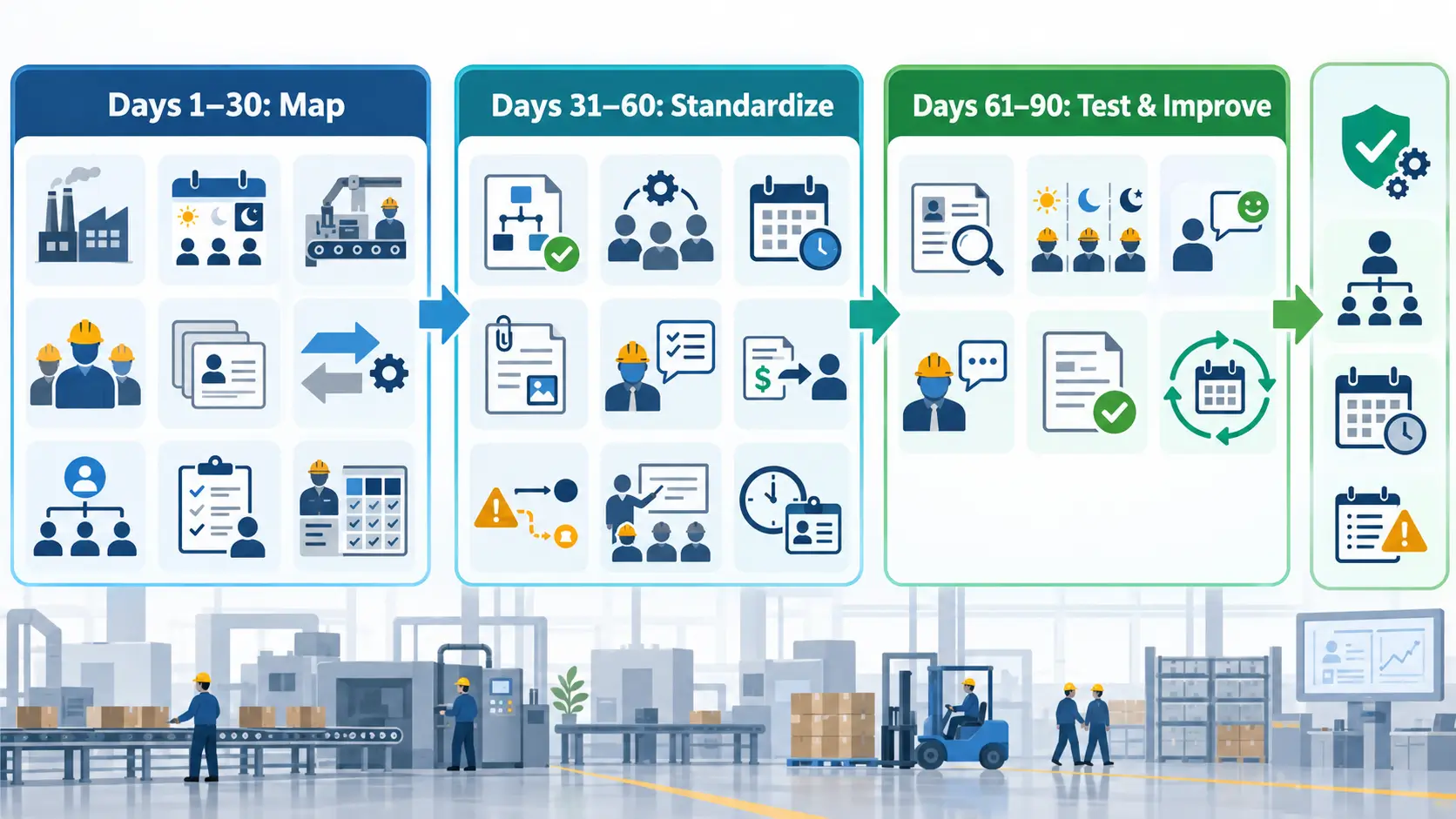
Choose a few recurring problems instead of rewriting everything. Prioritize them by workforce impact, frequency, and current control weakness.
Days 1 to 30: map the operation
- List sites, departments, shifts, worker groups, and staffing arrangements.
- Map roles, critical skills, qualification rules, and backup coverage.
- Identify the approved source for each important workforce field.
- Trace onboarding, call-offs, time corrections, transfers, and departures.
- Record handoffs among HR, supervisors, payroll, EHS, quality, and staffing agencies.
- Create a prioritized issue list with owners and review dates.
Days 31 to 60: standardize priority controls
- Select two or three workflows with recurring errors or meaningful impact.
- Assign a primary owner and backup for each workflow.
- Define approvals, deadlines, evidence, corrections, and escalation points.
- Align schedule, attendance, leave, and payroll handoffs.
- Give supervisors short instructions and realistic practice scenarios.
- Test the process with sample records before wider use.
Days 61 to 90: test and improve
- Sample records from different shifts, departments, and worker groups.
- Compare schedules, time, leave, qualifications, and payroll inputs.
- Ask employees whether reporting and correction routes are understandable.
- Ask supervisors where the process creates delay or confusion.
- Correct records and instructions when evidence shows a gap.
- Schedule regular reviews and record remaining risks.
By day 90, leaders should have tested controls and a prioritized improvement backlog. Each remaining item needs an owner and due date.
How technology can support manufacturing HR
Technology can organize workforce records and route scheduling, attendance, leave, and approval work. It does not define policy or prove compliance.
It also cannot verify qualifications, make employment decisions, or replace safety ownership. Responsible people must review records, exceptions, and outcomes.
See HR Management Software and HR Automation for system and workflow guidance.
For plant capabilities, integrations, implementation, and selection, see HR Software for Manufacturing.
How OryxBlue may support manufacturing workforce administration
Editorial disclosure: OryxBlue is the publisher’s product. This section reflects supplied information, not independent product testing.
According to that information, OryxBlue may support employee records, organizational structures, schedules, attendance, leave, requests, approvals, reporting, and payroll visibility.
Availability and fit depend on selected modules, configuration, and integrations. Confirm these points through current product information and a plant-specific demonstration.
OryxBlue does not replace production planning, qualification decisions, payroll processing, safety ownership, legal review, or physical offboarding work.
Copy-ready manufacturing HR checklist
Use this checklist during plant reviews. Assign an owner, due date, and evidence source to every open item.
- Sites, departments, lines, jobs, and reporting relationships match current operations.
- Staffing plans show demand by shift, role, and required skill.
- Critical roles have qualified backup coverage.
- Job postings state the site, shift, pay basis, conditions, and duties.
- New hires receive site orientation and required task training.
- Supervisors confirm readiness before independent work begins.
- Schedules show planned work, while time records capture actual work.
- Call-offs, swaps, missed punches, and corrections follow defined routes.
- Approved premiums, bonuses, and differentials reach payroll.
- Training completion and demonstrated competence remain separate records.
- Expiring qualifications have named review owners.
- Workers know how to report hazards, injuries, and concerns.
- Employees have accessible routes for workplace questions.
- Leave and accommodation decisions receive qualified review.
- Temporary worker responsibilities are documented before assignment.
- Offboarding covers final time, payroll, access, property, and records.
- Each important field has one approved source and owner.
- Corrections preserve effective dates, history, reasons, and approvals.
- Permissions match current responsibilities.
- Every workforce metric has an owner and expected response.
Frequently asked questions about HR in manufacturing
What does HR do in a manufacturing company?
HR coordinates hiring, records, shifts, attendance, leave, employee relations, and payroll inputs. It also supports training records and safety communication.
Operations, EHS, quality, payroll, and supervisors retain their assigned responsibilities. The plant should document how these roles work together.
What are the main manufacturing HR challenges?
Common challenges include shift coverage, absenteeism, overtime, skills gaps, supervisor inconsistency, and incomplete records. Temporary labor and production changes add coordination work.
The best first step is to find the failed handoff. Then assign an owner, correction route, evidence, and review date.
How can HR address absenteeism in a factory?
Start with clear attendance rules, call-off routes, and record corrections. Review patterns before deciding what they mean.
Consider schedules, transportation, supervision, workload, leave, accommodations, and employee concerns. Avoid automatic discipline without appropriate review.
What records should plant HR maintain?
Maintain accurate employee, job, assignment, shift, attendance, leave, training, qualification, performance, case, and separation records.
Assign each record an owner, approved source, access rule, correction route, and retention rule.
How should HR and EHS work together?
HR can support onboarding, training records, reporting channels, investigations, and return-to-work coordination. EHS and operations should own their assigned technical controls.
Both teams should agree on handoffs, escalation routes, privacy rules, and worker communication.
How do you build a manufacturing skills matrix?
List each role, required skill, proficiency level, assessor, evidence, and renewal date. Review those requirements by line and shift.
Record training completion, demonstrated competence, qualification, and work authorization separately.
How should factories manage shift scheduling?
Plan coverage by shift, role, and current qualification. Record swaps, call-offs, overtime approvals, changes, and actual time through defined routes.
Make schedule information and correction options available to every shift.
Build HR around the way the plant works
HR in manufacturing works best when workforce controls match real jobs, shifts, hazards, and production dependencies. Office procedures alone cannot address plant conditions.
Start with one recurring failure, such as missing time or outdated qualifications. Map its path, assign owners, and test difficult cases.
Review the evidence with employees and plant leaders. Then apply the same method to the next workforce process.