
HR for tech companies: a practical operating guide

HR for tech companies creates repeatable people decisions while products, teams, roles, and work locations change.
It connects founders, managers, HR, finance, payroll, IT, and security around clear ownership and effective dates.
Weak ownership creates hidden risk. A hire may start without access, while a departing employee keeps an active account.
This guide explains the operating model for software, SaaS, and startup teams. It does not evaluate HR software products.
Important: This article provides general information, not legal, tax, wage, privacy, or security advice.
Requirements vary by worker status, work location, agreement, and current law. Confirm decisions with qualified advisers and relevant authorities.
Source review date: September 2, 2026.
What HR for tech companies should own
Tech-company HR should create consistent processes for workforce decisions. It should also identify who holds final authority for each decision.
Human resources rarely owns every action. Managers, finance, payroll, legal, IT, and security carry important responsibilities.
Define the function’s purpose
The people function should support approved business work through clear roles, hiring, onboarding, management, development, and employee changes.
It should also maintain trusted records and escalation routes. More forms do not improve control when ownership remains unclear.
Strategic Human Resource Management explains how people priorities connect with business direction.
Separate ownership from support
HR may own policy, employee records, case coordination, and process design. Managers usually own daily direction, feedback, and team integration.
Finance may control budgets and compensation approvals. Payroll owns pay processing, while IT and security execute access actions.
Legal or qualified advisers may review high-risk decisions. The business leader still owns the approved organizational outcome.
Use five responsibility labels:
- Requester: Starts the business request.
- Decision owner: Holds authority for the final decision.
- Reviewer: Checks policy, legal, financial, or operational concerns.
- Executor: Completes the approved action.
- Recorder: Maintains the required evidence and status.
One person may hold several labels in a small company. The labels should remain distinct in the record.
Write a People Ops charter
Create a one-page charter with these fields:
- Purpose and supported business outcomes
- Services provided now
- Work intentionally outside scope
- Decision owners by process
- Required reviewers and executors
- Employee and manager contact routes
- Urgent escalation path
- Record owner for each process
- Review date and charter owner
Approve the charter with founders and functional leaders. Revisit it after major growth, funding, location, or leadership changes.
Why HR for software companies works differently
HR for software companies operates around fast role changes, specialist knowledge, distributed work, and sensitive digital access.
A small product change can alter required skills or team ownership. An organizational change can also affect customers, systems, and on-call coverage.
Roles change faster than titles
An engineer may move between products without receiving a new title. A manager may keep technical duties while gaining people responsibilities.
Role records should show current outcomes, decision rights, manager, team, and effective dates. Job titles alone provide weak operating detail.
Specialist knowledge creates concentration risk
One employee may understand a critical service, customer integration, deployment path, or security control.
HR should not assess technical depth alone. It can coordinate ownership records, backup plans, learning actions, and review dates.
Distributed work changes coordination
Remote and hybrid teams work across locations, time zones, schedules, and local requirements.
Location cannot remain an informal profile note. An approved change may require payroll, tax, benefits, legal, and security review.
Digital access follows every people change
A promotion, transfer, leave, contractor conversion, or departure may change system access.
HR can coordinate the request and status. System owners must execute and confirm changes in their own environments.
Map the operating context before changing processes:
- Products, services, and customer commitments
- Teams, functions, managers, and decision rights
- Employee, contractor, and other worker groups
- Approved work locations and time zones
- Critical roles and specialist dependencies
- On-call or support coverage
- Current growth and reorganization plans
- Systems holding employee or access records
- Current people risks and responsible owners
The map passes when each risk has an owner, evidence source, and review date.
Build people ops for startups in the right order
People ops for startups should grow with operating complexity. A rigid employee-count rule can trigger investment too early or too late.
Use the number of decisions, locations, managers, worker types, and unresolved risks. These signals show when structure must change.
HR Management for Small Business covers the wider lean-team operating model.
Founder-led stage
Founders often approve roles, offers, pay changes, and sensitive employee decisions. Informal action may feel faster at this stage.
The risk appears when decisions live in private messages or memory. Create basic records before adding complex programs.
Start with:
- Named owners for hiring, pay, leave, concerns, and exits
- Standard offer and approval routes
- Essential employee and contractor records
- A reliable payroll handoff
- A basic onboarding and offboarding checklist
- Restricted access to sensitive information
- A direct employee contact route
First dedicated people owner
The first people professional needs authority, not an unlimited task list. Founders should state which decisions they retain.
The new owner can standardize recurring work, fix record gaps, support managers, and create review routines.
Prioritize:
- Immediate legal or employee risks
- Ownership gaps across current processes
- Hiring and onboarding consistency
- Manager support and escalation
- Employee records and permissions
- Lifecycle changes and offboarding handoffs
- Measures needed for current decisions
Multi-team growth stage
Complexity rises when teams gain managers, locations, worker types, or business units. The people function needs clearer service ownership.
Define which work stays central and which work sits with managers. Add specialist support only when the operating need is clear.
Review these triggers each quarter:
- Repeated approval delays
- Conflicting manager decisions
- More work locations or worker types
- Frequent role or organization changes
- Sensitive cases without trained owners
- Payroll or access handoff failures
- Unclear compensation or leveling decisions
- Reports that require repeated manual repair
Treat each trigger as a backlog item with an owner. Do not solve every issue by adding another policy.
Turn workforce needs into approved roles
Tech hiring should begin with approved work, not a preferred title. A title can hide unclear scope and duplicate ownership.
Human Resource Planning provides the wider process for demand, supply, gaps, and approved actions.
Start with the business need
Describe the product, customer, operational, or control outcome that needs support. State why current capacity cannot meet it.
Include timing and assumptions. A future growth idea should not become a standing requisition without review.
Compare the available responses
A new employee is one option. The team may also reprioritize work, develop internal capability, redesign responsibilities, or use approved external support.
Contracting is not a shortcut around classification review. A system label does not resolve worker status.
Classification depends on facts and applicable legal tests in each jurisdiction. Recheck it when duties, control, location, or terms change.
Create an outcome-based role charter
Record what the role owns before recruitment starts:
- Business need and expected outcomes
- Product, service, or control supported
- Decision rights
- Functional manager
- Project or product relationships
- Job level and approved worker type
- Approved location and time-zone needs
- Required capabilities
- Security or data responsibilities
- On-call expectations, where applicable
- Budget owner and target start date
- Approver and review date
Review the charter with the hiring manager and one close partner. Both should describe the same role outcome.
Create repeatable hiring and offer decisions
Fast hiring becomes inconsistent when criteria change after candidates enter the process. Define evidence before sourcing begins.
The process should support a fair, job-related decision. It should also preserve the responsible people and approved terms.
Build the hiring evidence pack
Use one controlled pack for each requisition:
- Approved workforce request
- Current role charter
- Job-related selection criteria
- Interviewer assignments
- Structured interview questions
- Evidence-based evaluation record
- Candidate accommodation route
- Conflict disclosure
- Selection reason
- Final human decision
- Offer terms and approval
- Candidate communication owner
Do not use unpaid candidate work as real production. Keep assessments limited to the evidence needed for the role.
Keep AI-assisted hiring under control
AI may support drafting, organization, or analysis. It should not make autonomous hiring or rejection decisions.
The Equal Employment Opportunity Commission explains that federal discrimination laws can apply when employers use AI.
Review each tool for job relevance, accessibility, data use, escalation, and unequal outcomes. Human review does not guarantee a lawful result.
AI in HR provides a wider assessment method for employment-related AI.
Control a changed requisition
Change the role scope after interviews begin. Pause affected decisions before using the old criteria again.
Record the changed requirement, affected candidates, reviewer, communication, and restart decision. Old evidence should remain tied to its original version.
Make onboarding prove role readiness
Onboarding is complete when required records, access, context, support, and role expectations are ready.
A signed document or finished checklist cannot prove readiness alone. Each dependency needs a responsible owner and confirmation.
Employee Lifecycle explains how onboarding connects with later development, changes, and departure.
Prepare before the start date
Confirm these items before arrival:
- Approved employment terms and start date
- Work location and time zone
- Manager and team assignment
- Equipment request and owner
- Access requests by role
- First-week schedule
- Required policies and notices
- Payroll and benefits handoffs
- Candidate-to-employee record status
- Support contact for missing items
HR can track each request. IT, payroll, managers, and other owners must confirm their actions.
Track each dependency as requested, approved, executed, confirmed, failed, or waived. Name one onboarding coordinator to chase overdue work.
The manager confirms role readiness. HR closes onboarding after required owners confirm completion or approved exceptions.
Structure the first working period
The employee needs product, customer, team, and security context. The manager should connect that context with role outcomes.
Use staged checks:
- Confirm basic records, equipment, access, and contacts.
- Explain the product, customers, team, and decision rights.
- Review role outcomes and early work priorities.
- Establish manager check-ins and feedback routes.
- Record missing access, training, or support.
- Review progress against agreed outcomes.
Avoid fixed readiness promises for every role. An engineer, support analyst, salesperson, and people manager need different evidence.
Control a delayed start
Move a sample employee’s start date after tasks are assigned. Each dependent action should update without losing its owner.
Confirm that access does not begin on the old date. Verify payroll, equipment, meetings, and manager tasks use the new date.
Give managers a repeatable people system
New managers often inherit people duties before receiving clear guidance. Personal memory then becomes the operating system.
HR should give managers a short cadence, decision rules, templates, and escalation points. It should not take over daily management.
Set the manager cadence
Define recurring actions that match the team’s needs:
- Regular one-to-one conversations
- Work and priority reviews
- Feedback close to relevant events
- Development discussions
- Leave and coverage planning
- New-starter checks
- Pending approval review
- Team health and workload review
- Required policy refreshers
Avoid creating meetings without a decision purpose. The cadence should produce clear actions, owners, and follow-up dates.
Define escalation points
Managers need to know when HR or another specialist must join. The route should be easy to find and use.
Escalation may be needed for:
- Employee complaints or protected concerns
- Possible discrimination, harassment, or retaliation
- Accommodation or leave questions
- Pay, classification, or working-time concerns
- Performance actions with significant consequences
- Role, manager, or location changes
- Sensitive data or access incidents
- Planned departures or urgent exits
Managers should not investigate every concern alone. The assigned reviewer should control sensitive information and next steps.
Give employees a safe reporting route outside their normal manager line when needed. Assign case ownership and limit access.
Company policy should prohibit retaliation and define urgent escalation. Qualified reviewers should decide next steps under applicable law.
Plan for manager absence
Remove one manager during a pending leave, offer, and performance approval. Each item needs an authorized backup route.
The backup process should move responsibility without granting permanent administrator access. Record the temporary authority and decision.
Connect performance, career growth, and compensation
Tech roles can change before job descriptions catch up. Performance records should follow the approved role and review period.
Separate regular feedback from formal employment decisions. A useful conversation does not require a rating every time.
Define expectations by role and level
Each role needs observable outcomes, decision rights, and expected behavior. Avoid vague labels such as “strong performer” without supporting evidence.
Record expectations for the correct period. A later reorganization should not rewrite the standard used for an earlier review.
Use these fields:
- Role and level
- Review period
- Expected outcomes
- Collaboration and conduct expectations
- Relevant evidence sources
- Employee input
- Manager assessment
- Reviewer or calibration decision
- Development actions
- Final outcome and communication
Keep performance evidence in context
Delivery counts alone can hide complexity, quality, support work, or shared ownership. Message volume and online status provide weaker evidence.
Managers should review relevant work and explain their reasoning. Employees need a route to question errors or missing context.
Do not infer performance from protected leave or accommodation records. Limit access to sensitive information.
Control promotion and pay decisions
Promotions should connect with approved role scope, level, evidence, budget, and effective date.
Compensation reviews need defined decision rights and recorded exceptions. Similar titles may still contain different responsibilities or locations.
An offer or change record may separate:
- Base pay
- Variable pay
- Allowances
- Benefits
- Equity references
- Review conditions
- Approval status
- Effective date
- Employee communication
Equity involves separate legal, tax, governance, and ownership records. HR can coordinate tasks without replacing those processes.
The business decision owner approves compensation within delegated authority. Finance confirms budget, while payroll confirms the effective pay instruction.
An authorized governance body approves equity when required. The cap-table owner records the grant and returns confirmation.
HR should record approved terms, effective dates, and confirmed outcomes. A request or verbal promise should not appear completed.
Connect learning with capability needs
Training should begin with a role requirement or documented capability gap. The manager defines the expected work evidence.
Course completion does not prove proficiency. Use supervised work, peer review, practical demonstration, or another role-appropriate check.
Record the capability, learning action, evidence, reviewer, outcome, and next review date. Use a qualified reviewer for sensitive or privileged work.
Apply SaaS HR practices to distributed teams
Useful SaaS HR practices turn remote-work assumptions into explicit agreements. They define location, hours, handoffs, access, and escalation.
A remote policy alone is not enough. Each team needs a workable operating agreement across its actual time zones.
Record approved and reported work locations
Store approved and reported work locations, effective dates, time zones, and expected work patterns.
Name an HR coordinator and business decision owner for each change request. Route it to relevant payroll, tax, benefits, legal, and security reviewers.
Do not mark the move approved until required reviews are complete. Downstream owners should confirm actions or record exceptions.
If work changes early, use the approved urgent route. HR records the effective date, final status, and unresolved actions.
Define the distributed-work agreement
Each team should document:
- Core overlap periods
- Expected response windows
- Asynchronous handoff rules
- Meeting ownership
- Decision-record locations
- Documentation standards
- On-call coverage
- Local holiday handling
- Manager backup
- Urgent escalation channels
- Equipment and security responsibilities
The agreement should respect local requirements and approved accommodations. Review uncertain cases with qualified advisers.
Rehearse a three-time-zone handoff
Give one team a customer issue that crosses three time zones. The receiving person should find the context, owner, decision, and deadline.
The handoff breaks when progress depends on a private message or an unavailable manager. Record the missing operating rule.
Handle working time carefully
Online status does not provide a complete time record or measure performance. Employees need a clear time-reporting and correction route.
The Department of Labor’s hours worked guidance explains the federal baseline for covered work time.
Review available records that may indicate unreported work, as required under applicable rules.
Technical titles or salary alone should not determine overtime treatment. Review duties and current requirements with qualified advisers.
The Department’s overtime guidance provides current federal information. State or local rules may differ.
Finish with an approved operating agreement, acknowledged responsibilities, a named owner, and the next review date.
Address common HR challenges in tech
Common HR challenges in tech usually involve unclear ownership, inconsistent managers, rapid changes, or weak handoffs.
The issue often appears between teams. HR, finance, managers, payroll, IT, and security may each assume another person owns the action.
Founder exceptions become hidden policy
One exception can be reasonable. Repeated private exceptions create an unwritten rule that employees cannot understand.
Record the reason, approver, affected period, and review date. Check whether similar cases received consistent treatment.
Rapid hiring creates unclear roles
Hiring speed can outpace team design. New employees then discover overlapping ownership or missing authority.
Pause the requisition when the role charter changes materially. Reapprove scope, criteria, budget, and reporting lines.
New managers inherit risk too early
A technical promotion does not prepare someone for every people decision. Managers need guidance before handling sensitive cases.
Give new managers a clear cadence, decision limits, templates, and escalation path. Review their access before assigning approvals.
Titles and compensation drift
Teams may create titles independently during rapid growth. Later, similar titles can represent different scope, level, or pay logic.
Review roles using current responsibilities and evidence. Do not repair every difference by changing titles alone.
Product pressure hides workload problems
Release deadlines can normalize repeated overtime, missed leave, or fragile on-call coverage. Workload needs an operating review.
Look at commitments, capacity, interruptions, dependencies, and recovery time. Do not treat individual endurance as a staffing plan.
Employee feedback protects specialist continuity
Use employee feedback to find avoidable workload, manager, growth, or role problems. Give employees a safe route for raising concerns.
Managers should hold stay conversations without promising a specific outcome. Business and finance owners decide approved staffing, career, or pay responses.
Track critical knowledge by role, not by labeling one employee as a retention risk. Assign backups, documentation, learning, and handoff actions.
Leave needs coverage and privacy
Managers own work coverage without receiving unnecessary medical details. HR or a qualified reviewer coordinates the applicable process.
Payroll confirms pay treatment, while security reviews access only when needed. A return owner confirms status, schedule, access, and support.
Reorganizations break handoffs
A new organization chart does not complete a reorganization. Managers, goals, approvals, access, budgets, and reports may still point backward.
Set one effective date and a named owner for each dependency. Confirm the completed state after release.
Prepare managers before announcing the change. Sequence messages, name question routes, protect confidentiality, and schedule follow-up support.
Run this quarterly tech HR risk scan:
- Which decisions still depend on founder memory?
- Which teams lack a trained manager or backup?
- Which roles have conflicting scope or ownership?
- Which location or worker-type changes lack review?
- Which compensation exceptions remain unexplained?
- Which workloads or on-call duties lack recovery plans?
- Which employee changes have unfinished access tasks?
- Which reports depend on manual repair?
- Which concern lacks a safe escalation route?
Assign every material gap an owner, action, and review date. Do not hide unresolved work inside meeting notes.
Put every people change behind a release gate
Tech teams use release gates to stop incomplete code changes. The same idea can protect employee and contractor changes.
The people-change release gate keeps a change pending until required proofs exist. A named person owns every approval.
The gate supports consistent execution. It does not decide whether an employment action is lawful or fair.
Require six proofs
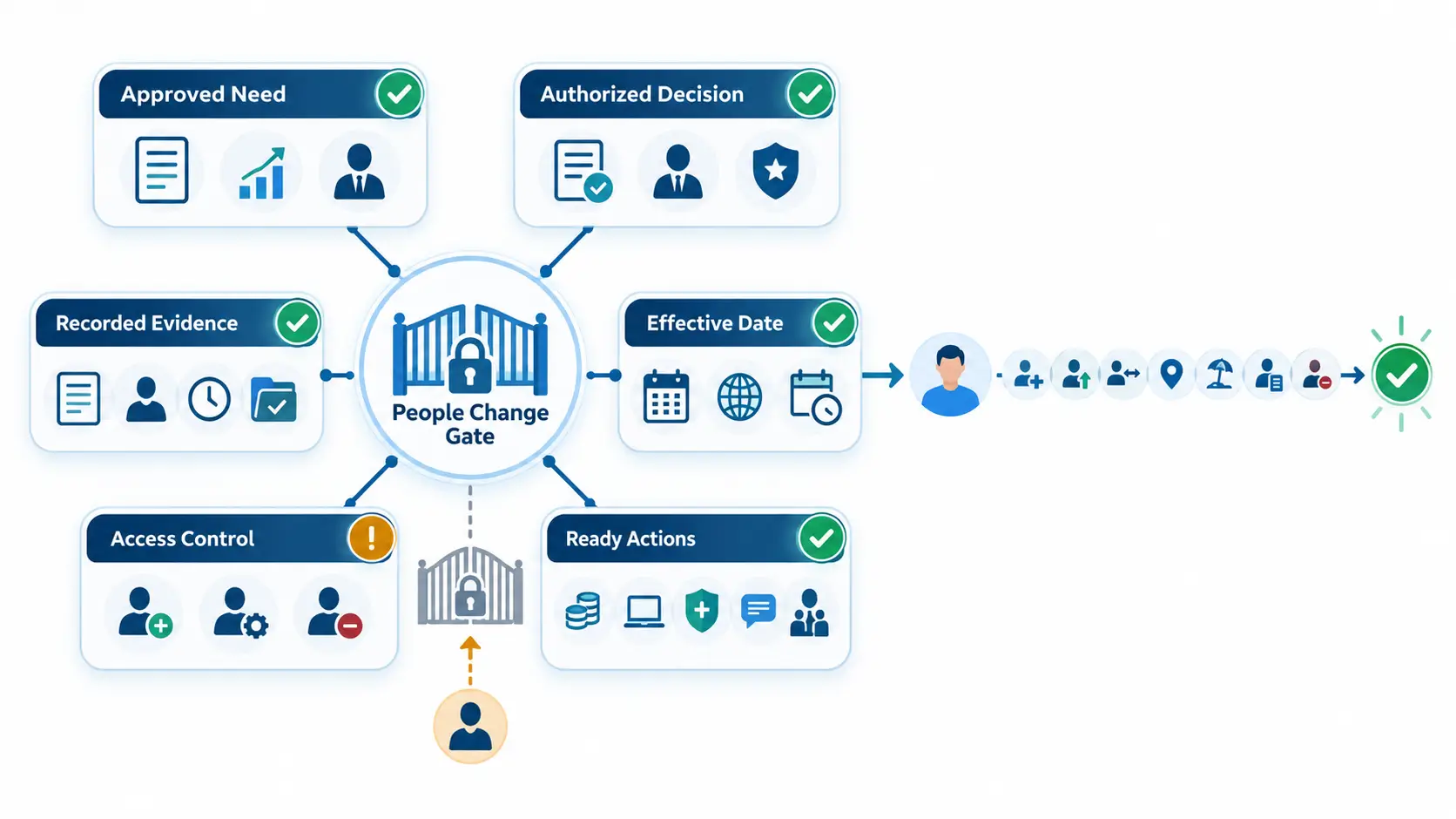
Each change needs these proofs:
- Decision proof: A named decision owner approves the change after required reviews.
- Effective-state proof: The record shows the approved role, manager, location, worker type, effective time, and time zone.
- Pay proof: Relevant finance, payroll, benefits, or contract owners confirm instructions, outcomes, and exceptions.
- Access proof: The system owner approves target access, and the executor confirms the completed change.
- Communication proof: A named sender delivers the approved message at the controlled time and records the outcome.
- Handoff proof: Each receiving owner accepts the duty, record, device, asset, or customer work.
Mark each proof as required, conditional, or not applicable. An authorized reviewer explains every exception.
A missing required proof holds a planned change. Emergency or time-sensitive actions may use an approved exception route.
The record should capture authority, reason, scope, time, and follow-up review. Reopen affected proof domains after a material edit.
Apply the gate to common changes
Use the same gate for:
- A hire or delayed start
- A promotion or compensation change
- A team, manager, or location transfer
- Approved leave and return
- A contractor scope or status change
- A reorganization
- A major people-policy change
- A resignation or other departure
Each event has different reviewers. The six proof types keep the control logic consistent.
Emergency security action may follow an approved emergency process. Record the approver, reason, scope, time, and follow-up review.
Rehearse the release gate
Rehearse a hire, promotion, transfer, leave, contractor change, and exit before changing the live process.
Assign requesters, decision owners, reviewers, executors, recorders, and final reviewers. Give each role an approved backup.
Include these conditions:
- Remove one required proof and identify the hold point.
- Change an effective date and reopen the affected reviews.
- Make one owner unavailable and activate the backup route.
- Reject one handoff and return it to the responsible owner.
- Use one emergency route and record its authority and follow-up.
- Restrict unnecessary details in a sensitive leave case.
- Confirm managers and employees know their question and correction routes.
Record owners, decisions, earlier values, approvals, missing proofs, exceptions, communications, and final outcomes.
The rehearsal fails when a change appears complete without required evidence. Fix each gap before using the process more widely.
Coordinate employee data, access, and departures
Tech companies hold sensitive employee data and valuable system access. A lifecycle change can affect both at the same time.
HR should coordinate the people record. System owners should execute and confirm access changes.
Use a joiner, mover, and leaver handoff
Joiner, mover, and leaver events need connected owners. A status change inside one platform cannot prove every external action occurred.
Create a handoff record with:
- Event type and effective time
- Requester and decision owner
- Employee or contractor target state
- HR record owner
- Manager and work-handoff owner
- Payroll or contract owner
- IT and security executors
- Access requests and confirmations
- Device or physical-asset owner
- Communication owner
- Retention or preservation reviewer
- Final completion reviewer
The process should distinguish a requested action from confirmed completion. This difference matters during urgent departures.
Protect employee information
Limit data access to a defined business purpose. Managers should not see private details that they do not need.
The NIST Privacy Framework can structure privacy-risk discussions. It is not a compliance certificate.
Document collection, correction, access, retention, deletion, and incident responsibilities. Review requests under current policy and applicable law.
Protect accounts and privileged access
NIST’s Cybersecurity Framework 2.0 organizes security outcomes across six functions.
Those functions are Govern, Identify, Protect, Detect, Respond, and Recover. The framework does not certify products or guarantee security.
NIST explains that multifactor authentication uses two or more distinct authentication factors.
Ask system owners to confirm account changes, privileged access, shared credentials, tokens, code repositories, and administrative sessions.
Rehearse an urgent departure
Rehearse a case involving an absent manager and privileged access. Assign every action to an authorized backup.
The process passes when each system owner confirms its own action. Do not infer account removal or asset return from an HR status.
HR Automation explains wider controls for requests, approvals, exceptions, and failed handoffs.
Use people data without creating employee surveillance
People data should answer a defined business question. It should not become a substitute for manager judgment or employee context.
People Analytics explains how to define measures, sources, decisions, and safeguards.
Choose measures tied to action
Useful operating measures may include:
- Approved, open, and filled roles
- Candidate stages and pending decisions
- Onboarding milestones and unresolved access tasks
- Manager coverage and overdue approvals
- Internal moves and development actions
- Leave cases awaiting authorized review
- Contractor and temporary assignment end dates
- Offboarding tasks awaiting confirmation
- Employee requests without an owner
- Reports with data-quality exceptions
These measures describe workflow state. They do not prove employee intent, performance, or future departure.
Define every measure before publishing it
For each measure, record:
- Business question
- Included population
- Source records
- Definition or calculation
- Data cutoff
- Responsible owner
- Allowed viewers
- Decision or response
- Correction route
- Review date
Use stable definitions across periods. Label any changed definition before comparing results.
Protect small groups and sensitive cases
An aggregate can still expose a person when the group is small. Broaden the group or restrict the report when needed.
Do not rank employees using unexplained risk scores.
Use authorized human review and relevant evidence as internal controls for material employment decisions. These controls do not guarantee a lawful result.
End the monthly people review with a decision, owner, and follow-up date. Remove measures that never lead to action.
Maintain governance as the company footprint changes
New work locations, worker types, benefits, and pay practices may create new obligations. The required review depends on current facts.
Do not assume headquarters rules cover every employee. Do not use a home address as the only legal conclusion.
Build a compliance-trigger register
Create a review entry when the company adds or changes:
- A work location or legal entity
- An employee or contractor relationship
- A pay, bonus, equity, or expense practice
- A benefit or leave program
- A working-time or on-call rule
- A monitoring or employee-data practice
- A hiring assessment or AI-assisted process
- A policy with material employee impact
- A merger, acquisition, or reorganization
Each entry needs an effective date, owner, affected group, reviewers, decision, evidence, and next review date.
Preserve required records
Covered employers must maintain specified wage and employment records. Record types and retention periods can differ.
29 CFR Part 516 contains federal Fair Labor Standards Act recordkeeping rules.
Use HR Compliance Checklist to organize a wider review. Confirm current requirements with qualified advisers.
Review policies after operating changes
Review policies when the workforce footprint or operating model changes. A copied policy may not fit the new conditions.
Record the reason, reviewer, approval, effective date, audience, communication, and next review date.
Put the operating model into a 90-day plan
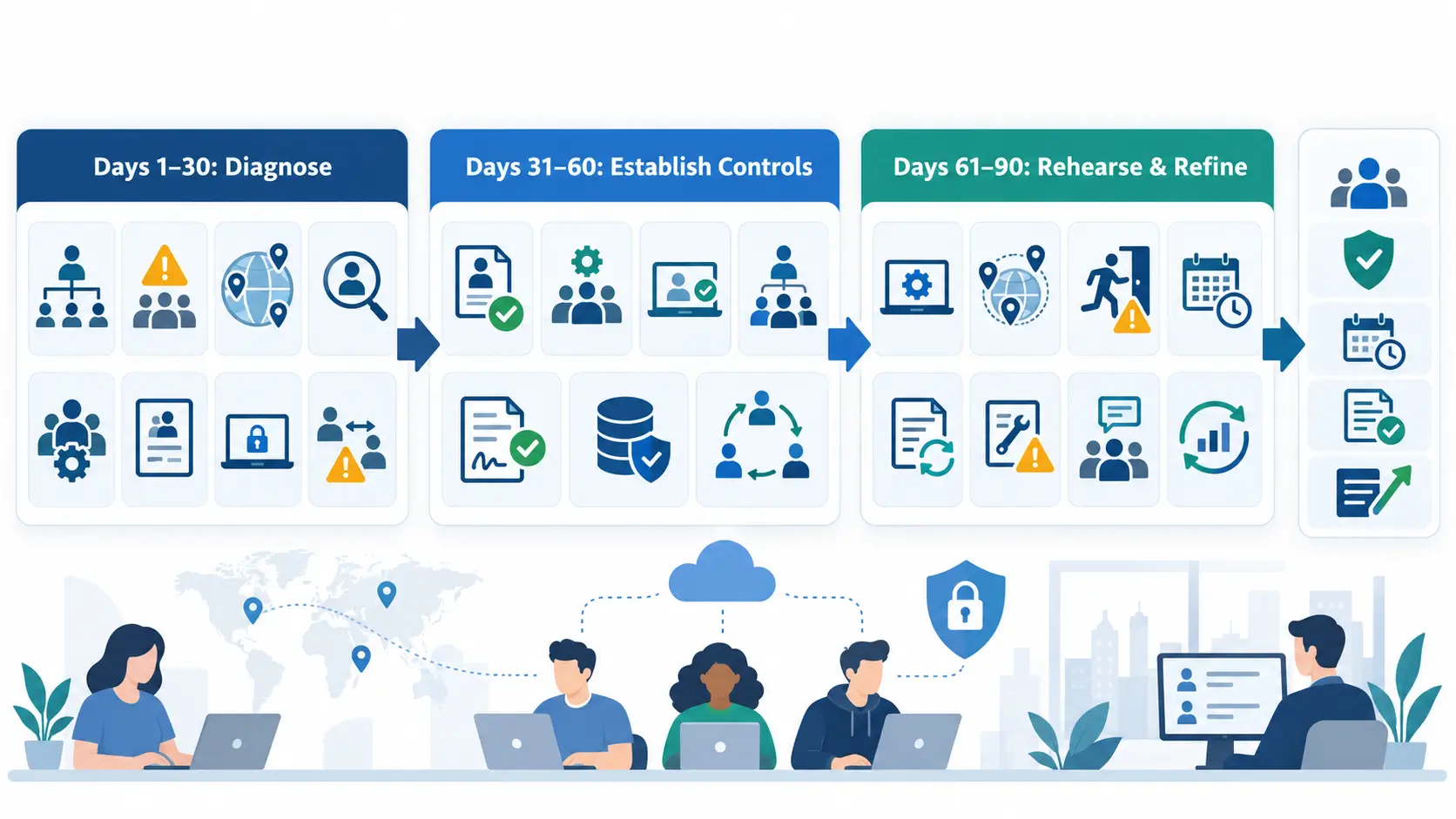
A 90-day plan should repair the highest-risk ownership and handoff gaps first. It should not attempt every possible HR program.
First 30 days: diagnose ownership and risk
- Approve the People Ops charter.
- Map current worker types, locations, managers, and systems.
- Find decisions without named owners or backup paths.
- Review hiring, onboarding, payroll, access, and exit handoffs.
- List urgent employee, legal, privacy, or security concerns.
- Record every issue with an owner and evidence source.
Days 31 to 60: establish core controls
- Standardize role requests and hiring evidence.
- Create role-based onboarding and offboarding records.
- Set the manager cadence and escalation route.
- Define distributed-work agreements.
- Set access and sensitive-data responsibilities.
- Adopt and rehearse the people-change release gate.
Days 61 to 90: rehearse and refine
- Rehearse a delayed hire and changed requisition.
- Rehearse a manager absence and location change.
- Run a transfer, leave, contractor, and urgent-exit scenario.
- Review one complete payroll and access handoff.
- Publish defined people measures with controlled access.
- Assign fixes, retest dates, and later priorities.
Order the backlog by risk, dependency, owner, evidence, and review date. Move lower-value programs behind unresolved control failures.
Where OryxBlue may support tech-company people operations
Editorial disclosure: OryxBlue is the publisher’s product. This section reflects supplied product information, not independent testing.
Supplied materials describe OryxBlue as a multi-tenant platform for common workforce records and routine coordination.
Its supplied scope includes recruitment, onboarding, employee records, locations, departments, roles, permissions, schedules, and rotations.
It also includes attendance, leave, requests, approvals, lifecycle status, dashboards, reports, payroll visibility, and seat tracking.
Map supplied capabilities to operating needs
The supplied scope maps to these operating areas:
- Candidate recruitment records, onboarding steps, and employee records
- Locations, departments, roles, and platform permissions
- Schedules, rotations, attendance, and leave
- Requests, approvals, and lifecycle status
- Dashboards, reports, payroll visibility, and seat tracking
That mapping describes coordination scope. It does not confirm that every company workflow or policy will fit.
Treat platform status as one piece of operating evidence. External payroll, account, and device actions need separate confirmation.
Keep the product boundaries clear
The supplied scope does not establish:
- Payroll calculation, tax filing, statutory submissions, or payments
- Automatic compliance updates or legal conclusions
- Autonomous hiring, promotion, scheduling, discipline, or termination
- Predictive staffing, performance, retention, or employee-risk scores
- Identity provisioning or automatic external-account removal
- Device control or physical-asset recovery
- Project allocation, sprint planning, or engineering-capacity forecasting
- Connections with payroll, identity, code, project, or finance systems
- Specific security certifications, encryption, backups, or recovery controls
This article does not compare or select HR software. The next planned page covers those decisions.
HR Software for Tech Companies will address requirements, selection, validation, and implementation.
Frequently asked questions about HR for tech companies
What does HR for tech companies cover?
It covers workforce planning, hiring, onboarding, managers, performance, distributed work, employee changes, records, access coordination, and governance.
The exact model should match the company’s work, locations, worker types, and decision risks.
How is HR for software companies different?
HR for software companies must handle rapid role changes, specialist knowledge, distributed teams, and sensitive system access.
It also needs strong handoffs between managers, HR, finance, payroll, IT, and security.
Which HR challenges in tech need attention first?
Start with risks affecting employees, pay, access, legal duties, or major decisions. Then address repeated delays and inconsistent management.
Give every issue a named owner, evidence source, action, and review date.
Which SaaS HR practices help distributed teams?
Useful practices include approved location records, time-zone agreements, clear handoffs, manager backups, access ownership, and documented decisions.
Do not treat online status as a complete time record or a performance measure.
When should people ops for startups add more structure?
Add structure when decisions, managers, locations, worker types, or unresolved risks outgrow informal ownership.
Use operating complexity as the trigger. Avoid relying on one employee-count threshold.
What is a people-change release gate?
It holds a workforce change until decision, effective-state, pay, access, communication, and handoff proofs exist.
The gate coordinates work but does not determine whether a decision is lawful or fair.
When should a tech company evaluate dedicated HR software?
Evaluate software when approved processes outgrow current tools or lose reliable ownership, history, permissions, or reporting.
Define the operating model first. Then test software against real employee changes and failed handoffs.
Build the people system before adding more tools
Effective HR for tech companies depends on clear ownership, current records, prepared managers, and controlled